Home
Home
Tanoura is a centuries-old Sufi dance that originated in the 12th century, known for its continuous spinning, spiritual symbolism, and vibrant multi-layered skirts. Rooted in religious ritual, it has evolved into a powerful cultural performance in Egypt, blending poetry, chanting, and hypnotic movement to create a visually stunning and spiritually evocative experience.
The Origins of Tanoura Dance
Roots in Sufi mysticism
The mystical practice of Tanoura traces its spiritual foundations to Sufism, an ancient Islamic mystical tradition. Initially developed in the 13th century by renowned Sufi scholar and poet Jalal al-Din al-Rumi, the dance emerged as a form of physical meditation. Throughout this period, Sufi dervishes employed spinning movements not as entertainment but as a sacred practice to achieve spiritual ecstasy and divine connection.
The spiritual underpinnings of this dance remain profound. Through continuous circular movements, practitioners aimed to reach a trance-like state called "Kemal" (the source of perfection). This meditative spinning represented the endless motion of the universe and symbolized the soul's journey toward peace and unity with something greater.
Arrival and adaptation in Egypt
Various historical accounts exist regarding how this whirling tradition reached Egypt. Many historians note that the dance arrived in Egypt during the 14th century, while other sources suggest it may have been introduced earlier during the Fatimid dynasty's conquest of the region around 970 AD.
Alternatively, some historical records indicate that the roots of Tanoura dance can be traced back to the 12th century in Syria, subsequently spreading to Egypt. Regardless of its exact path, once established in Egypt, the practice evolved substantially. Unlike the Turkish whirling dervishes who performed in groups wearing long white robes, Egyptian Tanoura developed into a more theatrical solo performance characterized by vibrant colors and additional artistic elements.
Meaning of the word 'Tanoura'
The term "Tanoura" derives from Arabic and literally translates to "skirt" in English. This name directly references the distinctive multicolored, layered garments worn by the dancers during performances. These elaborate skirts feature geometric appliqués with colors representing different Sufi orders – green, red, yellow, and blue.
Unlike the simple white attire of traditional Turkish dervishes, these colorful Egyptian skirts became the defining characteristic of the performance, eventually lending their name to the entire dance form. Over time, this terminology expanded beyond merely describing the costume to encompass both the dance itself and sometimes even the performer, who is traditionally a Sufi man.
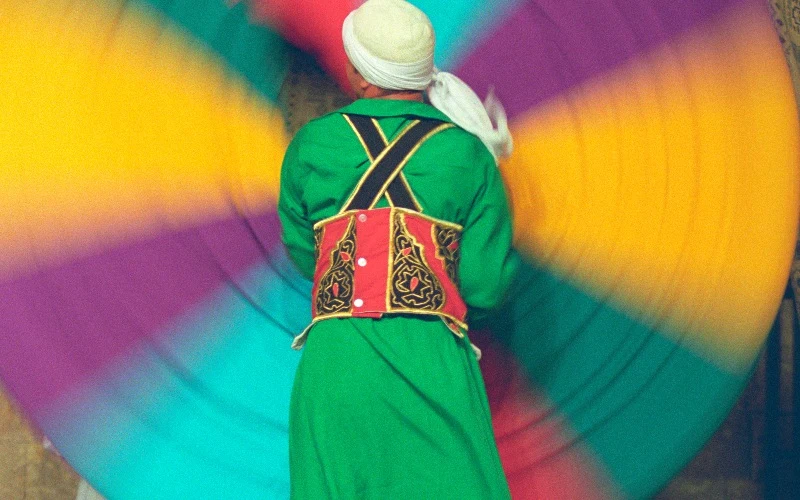
The Tanoura dance originated in the 12th century from Sufi mysticism. It began as a spiritual practice in Turkey and Egypt, with dancers spinning continuously to symbolize the movement of planets around the sun.
Egyptian Tanoura features colorful, multi-layered skirts and is typically performed solo with theatrical elements. In contrast, Turkish whirling involves dancers in plain white robes performing in synchronized groups.
Structure and Elements of the Tanoura Show Egypt
A traditional tanoura show follows a carefully choreographed sequence that has evolved over centuries. From opening rituals to spectacular finales, each element plays a specific role in creating this mesmerizing performance.
Opening with Al Tawasheeh poetry
Every authentic tanoura performance begins with "Al Tawasheeh," an ancient Egyptian art form where a group of singers recite old verses that are partially Koranic and partially ancient poetry. This recitation establishes the spiritual atmosphere necessary for the dance to follow. As the melodious lines approach their conclusion, the singers gradually begin to move in steady, individual circles while maintaining their positions. This subtle transition creates anticipation among the audience as the performance smoothly evolves from poetry to movement.
Role of the lead dancer and supporting performers
Throughout a tanoura performance, the lead dancer typically assumes the symbolic role of the sun while supporting dancers represent planets revolving around this central figure. The performers move in unison, creating visual patterns that reflect cosmic harmony. The group often travels in circular formations with the lead dancer performing in their midst like a nucleus. This arrangement allows energy to flow between performers and audience members, establishing a unique connection during the show.
Use of traditional instruments like Sagat and Tabla
Musicians accompany tanoura dancers with distinctive Egyptian instruments that create the rhythmic foundation for the performance. The primary instrument is the Tabla (Egyptian drum), alongside others including the pharaonic lute, percussion, and Sagat (finger cymbals used by ballet dancers). These instruments produce a hypnotic musical backdrop as performers synchronize their movements with the rhythmic tones, creating the impression they are "riding on waves of music."
Lighting and costume choreography
The visual spectacle of tanoura relies heavily on costume manipulation and lighting effects. Dancers wear multiple colorful skirts that appear as enormous platters when fully extended. Throughout the performance, they spin, lift skirts above their heads, tuck them in, and transform them in various ways - all while maintaining precise rhythmic movements. In contemporary shows, lighting plays a crucial role, particularly during the finale when lights are dimmed to highlight the whirling skirts. Some modern performances even incorporate LED lights into costumes, creating dazzling visual displays that enhance the traditional art form.
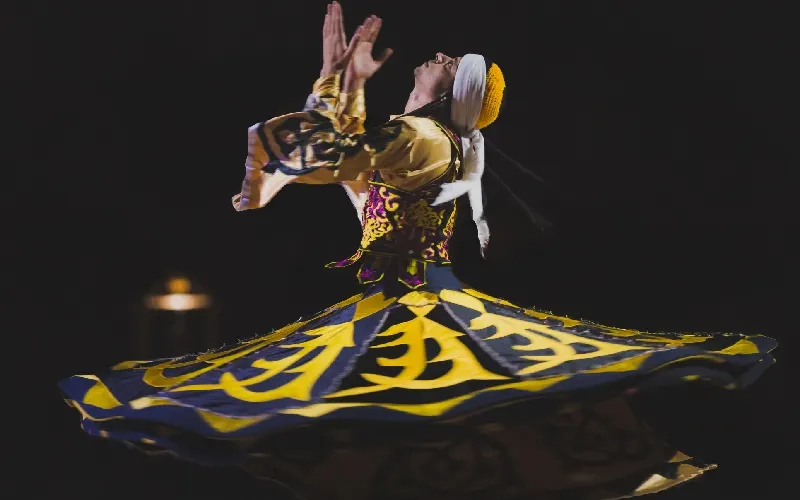
A typical Tanoura show in Egypt begins with Al Tawasheeh poetry recitation, followed by the main dance performance. It features a lead dancer, supporting performers, traditional instruments like the Tabla and Sagat, and often incorporates dramatic lighting effects.
Customize Your Dream Vacation!
Get in touch with our local experts for an unforgettable journey.
Plan Your TripSpiritual and Symbolic Meaning Behind the Dance
Beyond its captivating visual appeal, the tanoura dance embodies profound philosophical concepts that have persisted across centuries of Egyptian cultural expression.
The spinning as a symbol of the universe
The continuous spinning motion at the heart of tanoura represents the celestial movement of planets and stars. According to traditional belief, this circular motion symbolizes the cyclical nature of life and the universe. The philosophical foundation for this spinning stems from the concept that movement begins at a specific point and ultimately returns to that same origin. Throughout performances, the lead dancer portrays the sun while supporting dancers embody planets orbiting around this central figure. This cosmic representation illustrates the eternal motion of the universe that continues without interruption.
Colors and their spiritual meanings
The vibrant multi-layered skirts of tanoura dancers convey rich symbolic meaning through their distinctive colors:
- Green represents peace and spiritual growth
- Red symbolizes love, passion, and energy
- Blue reflects the heavens and truth
- White signifies purity and a clear heart
Together, these colors merge during performances to create a visual representation of how different spiritual elements harmonize into unity.
The dancer as a metaphor for the soul
As performances intensify, tanoura dancers appear to detach completely from earthly concerns, embarking on a spiritual journey. Many practitioners report entering a trance-like state despite spinning continuously for extended periods—sometimes exceeding 30 minutes—without experiencing dizziness or confusion. This extraordinary focus represents the soul's quest for clarity and spiritual balance amid life's chaos.
Connection to divine unity
The dance fundamentally symbolizes the connection between physical existence and divine essence. When performers raise their right arm toward the sky while pointing their left arm downward, they create a visual metaphor unifying heaven and earth. Additionally, dancers typically move counterclockwise, mirroring the Muslim pilgrimage around the Ka'aba. Through these movements, the dancer seeks to transcend ordinary consciousness and achieve spiritual enlightenment through physical expression.
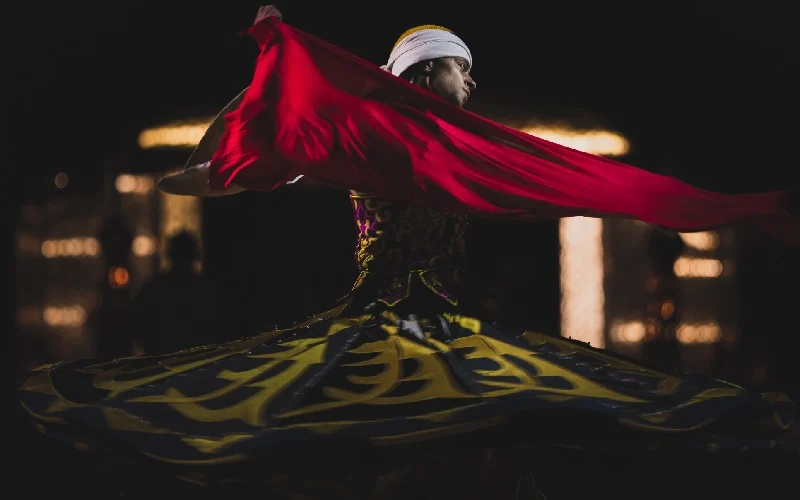
The spinning in Tanoura represents the cyclical nature of the universe and the soul's journey towards divine unity. The colors of the skirts symbolize different spiritual qualities, and the dance itself is a form of moving meditation.
Cultural Significance and Evolution Over Time
Throughout centuries, tanoura has undergone remarkable transformation from its spiritual foundations to become a cultural icon in Egypt.
From religious ritual to cultural performance
The evolution of tanoura illustrates a fascinating journey from sacred ritual to artistic expression. Originally practiced exclusively within Sufi communities as devotional worship, tanoura gradually transitioned into public performances. This evolution made the dance accessible to broader audiences while maintaining elements of its spiritual heritage. Consequently, what was once a private religious experience transformed into a celebrated cultural attraction. Today, tanoura has become a staple of Egyptian tourism, featured in numerous entertainment venues across the country — and visitors can experience it as part of a wider cultural journey through Egypt tours that bring the country's living traditions to life.
Differences between Egyptian and Turkish whirling
Egyptian tanoura differs fundamentally from its Turkish counterpart. First, Turkish dervishes perform in plain white robes and camel-wool hats, whereas Egyptian dancers don colorful, multilayered skirts with geometric patterns. Moreover, Turkish dancers typically perform in groups, creating synchronized formations, whereas tanoura traditionally emphasizes solo performances. Furthermore, the Egyptian version incorporates more theatrical elements, including faster rhythms and elaborate skirt manipulations.
Modern interpretations in Egypt
Contemporary tanoura performances often feature innovative elements aimed at enhancing visual impact. Notably, some performers, especially in tourist venues, incorporate LED lights into their costumes. With more than 15 million Sufis across Egypt representing nearly 80 different orders, the tradition continues to evolve while maintaining its cultural significance.
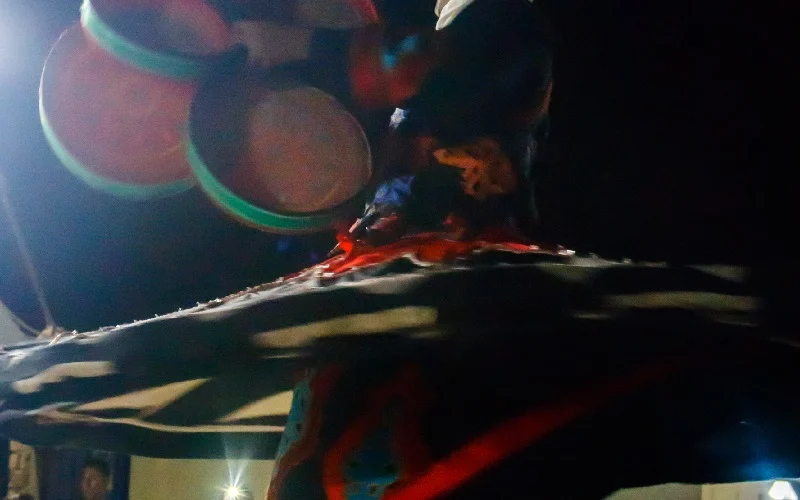
While retaining its spiritual essence, Tanoura has evolved from a purely religious ritual to a cultural performance and tourist attraction. Modern interpretations may include innovative elements like LED lights in costumes, while still maintaining the dance's traditional significance.
Tanoura dance is a living symbol of Egypt’s spiritual and cultural heritage, blending centuries-old Sufi philosophy with captivating artistic expression. While it evolved from a sacred ritual into a public performance, it has preserved its deep symbolism—expressed through circular motion, vibrant costumes, and traditional music. Distinctly Egyptian in style, tanoura reflects how ancient traditions can adapt to modern settings without losing their essence. Its continued practice ensures that this powerful expression of spiritual harmony remains an enduring and dynamic part of Egypt’s cultural identity.
Authentic Tanoura shows can be seen at cultural venues such as Wekalet El Ghoury in Islamic Cairo, Sufi festivals, cultural centers, and during special religious celebrations across Egypt.
A full Tanoura performance can last from 30 minutes to over an hour. In traditional settings, the final spinning segment alone may continue for a long period as the rhythm gradually intensifies.
Dancers spin counterclockwise to mirror cosmic movement, the rotation of celestial bodies, and the direction of Tawaf around the Kaaba, symbolizing spiritual alignment and unity with the divine.
Traditionally, Tanoura is performed by men due to its Sufi roots. However, in modern cultural contexts, some contemporary interpretations may include female performers, especially in theatrical settings.
Experienced Tanoura dancers train extensively to maintain balance and focus. Through breathing techniques, posture control, and visual concentration, they are able to spin for long periods without becoming dizzy.
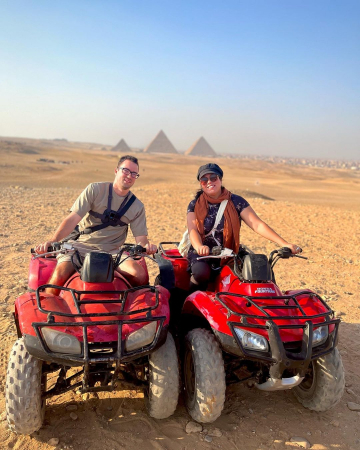

The Great Pyramids of Giza, Egypt’s iconic monuments, showcase ancient engineering brilliance and remain the last wonder of the ancient world, continuing to fascinate visitors and researchers alike.

The Egyptian Museum in Cairo houses over 170,000 ancient artifacts, including Tutankhamun's complete collection and golden death mask. Opened in 1902, it's the world's largest repository of Egyptian antiquities.

Khan el-Khalili is Cairo’s legendary medieval bazaar, where centuries-old Islamic architecture, vibrant trade, and timeless cafés create a living cultural landmark.

The Great Sphinx of Giza, with its lion body and pharaoh head, represents ancient Egyptian artistry, symbolic power, and enduring cultural fascination.

Tanoura is a traditional Egyptian Sufi dance known for its colorful spinning skirts, spiritual rhythm, and deep roots in ancient mystic traditions.

Saqqara, Egypt's ancient necropolis, features Djoser's Step Pyramid—the world's oldest. Spanning 3,000 years, it preserves royal tombs and sacred animal burials.

The Valley Temple at Giza, built 2570 BCE by Khafre, features 16 granite columns and hosted sacred afterlife rituals. Explore Fourth Dynasty architecture.

The Citadel of Cairo is a historic medieval fortress and royal complex, showcasing centuries of Egyptian power, Mamluk architecture, and Islamic heritage, now preserved as a UNESCO World Heritage Site.

Khufu's Solar Boat is a 142-foot cedar vessel discovered 1954 near the Great Pyramid. Built without nails 4,500 years ago, it's now at Grand Egyptian Museum.

St. George Church in Old Cairo, founded 684 AD, features unique circular design, sacred healing relics & underground chapel linked to the Holy Family's refuge.

Pyramids Sound and Light Show transforms Giza into open-air theater with 50 minutes of narration, music & lighting bringing ancient Egyptian history alive.

The Djoser Pyramid at Saqqara is Egypt's first pyramid, built 2600 BCE by architect Imhotep. Standing 62.5m tall, it reopened to visitors in 2020.

The Hanging Church in Old Cairo is a 1,300-year-old Coptic sanctuary built on Babylon Fortress. Free entry, open daily 9 AM-5 PM, dress modestly required.
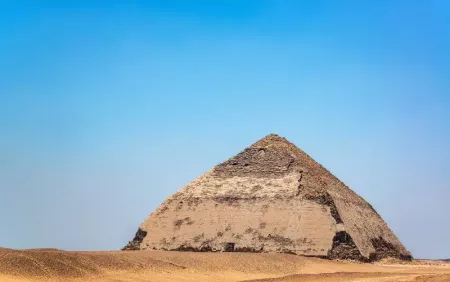
The Bent Pyramid at Dahshur features a rare bent profile created by ancient construction adjustments, offering insight into Egypt’s earliest attempts at smooth-sided pyramids.

Coptic Cairo features 4th-century churches and recent tomb discoveries revealing early Christian heritage. Explore the Hanging Church, Abu Serga & sacred sites.
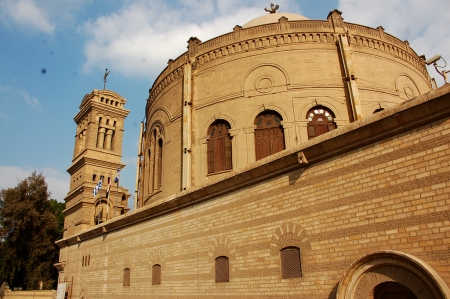
Saint Barbara’s Church in Coptic Cairo is one of Egypt’s oldest Christian monuments, dating back to the 5th–6th century. Known for housing the relics of Saint Barbara, the church reflects centuries of Coptic heritage, architectural evolution, and deep spiritual significance.

Explore the Fortress of Babylon, a major Roman fort in Old Cairo known for its strategic location, massive towers, and enduring historical significance.
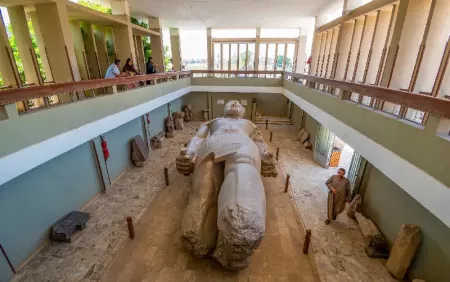
Memphis Necropolis is Egypt’s ancient royal burial site, home to pyramids, tombs, and monuments that reflect the early development of pharaonic civilization.
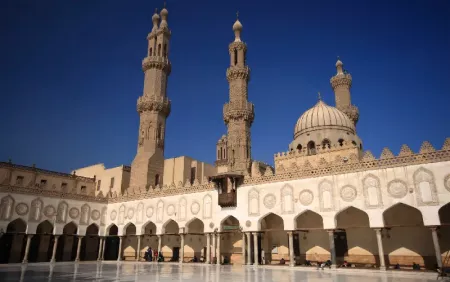
Al-Azhar Mosque is a landmark of Islamic scholarship and Fatimid architecture, home to the world’s second-oldest university and a symbol of Cairo’s spiritual heritage.
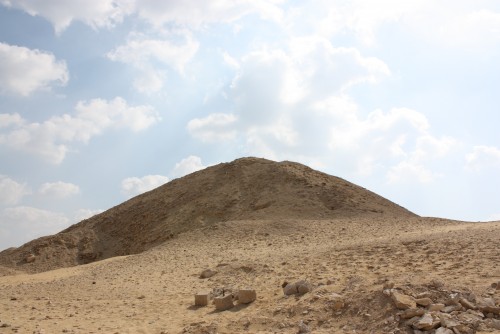
Teti’s Pyramid in Saqqara is an Old Kingdom monument built for the first king of the Sixth Dynasty. Known for its Pyramid Texts and unique mortuary chapel, it remains one of Egypt’s most historically important royal tombs.
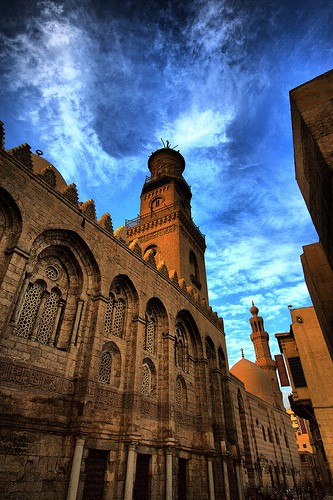
Al Muizz Street is one of Cairo’s oldest and most vibrant historic avenues, showcasing centuries of Islamic architecture. Lined with mosques, palaces, and bustling markets, it offers a captivating walk through Egypt’s medieval past.
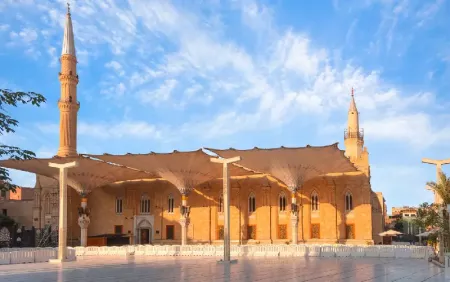
Al-Hussein Mosque is one of Cairo’s most sacred Islamic landmarks, built in 1154 and revered for housing the head of Imam Hussein. Located by Khan El-Khalili, it blends centuries of architectural heritage and remains a major pilgrimage site.
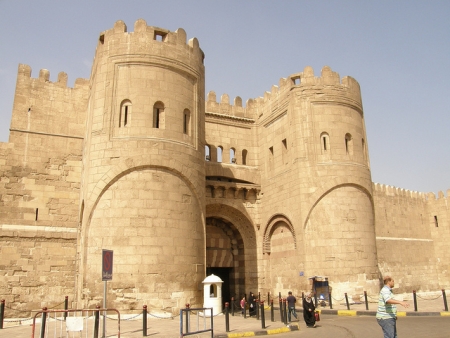
Bab al-Futuh is an 11th-century Fatimid gate in Old Cairo, famous for its massive round towers and strategic role in the city’s medieval fortifications.
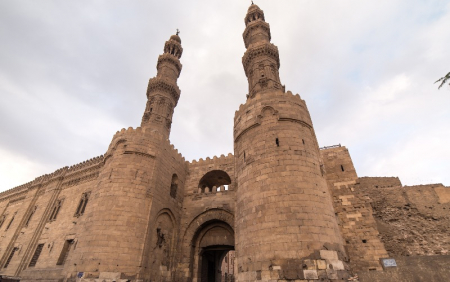
Bab Zuweila is one of Cairo’s last surviving medieval gates, built in 1092 CE by the Fatimid vizier Badr al-Jamali. Famous for its towering twin bastions, massive wooden doors, and later Mamluk minarets, it served as a defensive stronghold, execution site, and ceremonial gateway. Today, it stands as one of Cairo’s most iconic historic monuments.
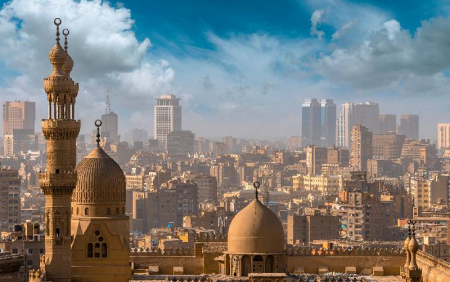
Al Rifai Mosque in Cairo blends Neo-Mamluk architecture with royal history. Completed in 1912, it serves as both a majestic mosque and mausoleum for Muhammad Ali’s family.
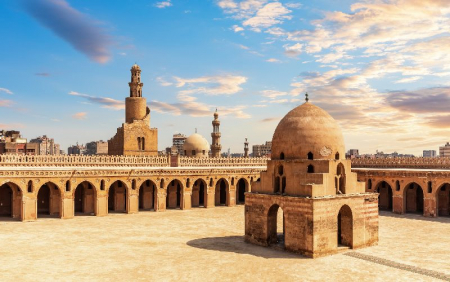
The Ibn Tulun Mosque, Cairo’s oldest well-preserved mosque, dates back to 879 CE. Famous for its vast square layout, intricate arches, and 128 ornate stucco windows, it remains a pinnacle of early Islamic architecture and a must-visit historical landmark.
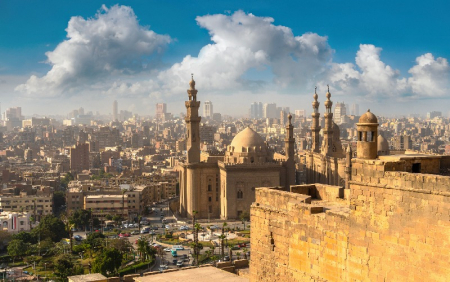
The Sultan Hassan Mosque, built in the 14th century, is a Bahri Mamluk architectural marvel in Cairo, renowned for its grand portal, extensive madrasas, and historic significance.

The Suez Canal, Egypt’s iconic waterway, connects Africa and Asia, handling thousands of ships yearly and shaping international trade.
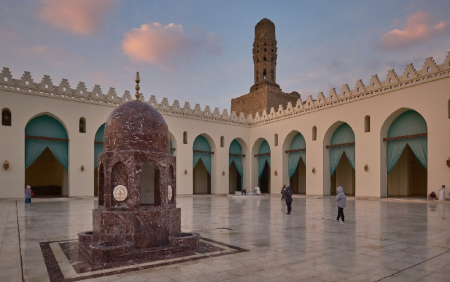
Al-Hakim Mosque, Cairo, is a stunning Fatimid-era mosque built between 990–1013 CE. Famous for its grand courtyard, distinctive minarets, and rich history, it remains a key cultural and religious landmark.
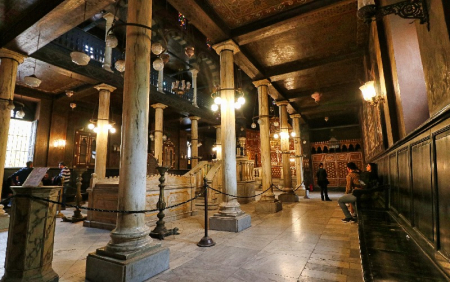
The Ben Ezra Synagogue, founded in the 11th century in Old Cairo, is Egypt’s oldest Jewish monument and the discovery site of the renowned Cairo Geniza.