Home
Home
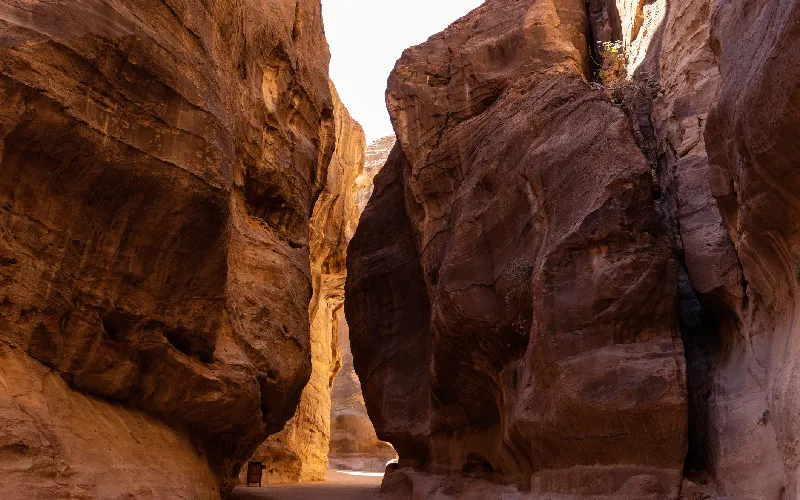
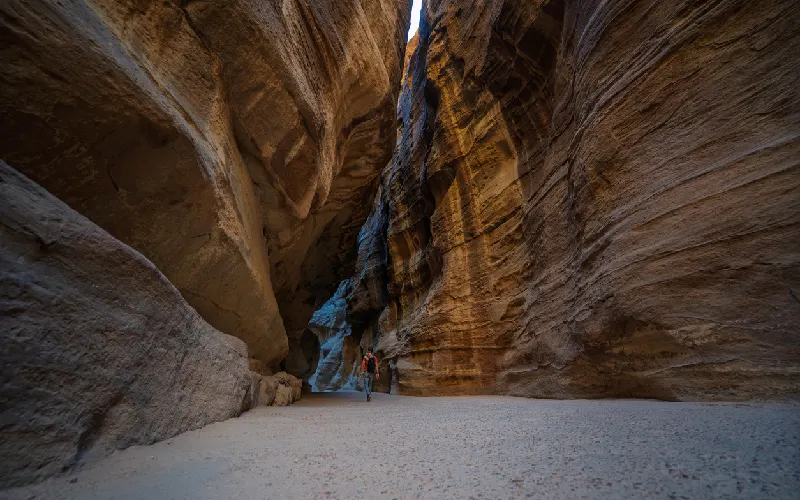
You walk into Petra through a crack in the earth. That's not a metaphor — the Siq is a genuine fissure in the sandstone, formed when tectonic forces pulled the rock apart, and for over a kilometre it narrows and turns until the sky is a thin ribbon overhead.
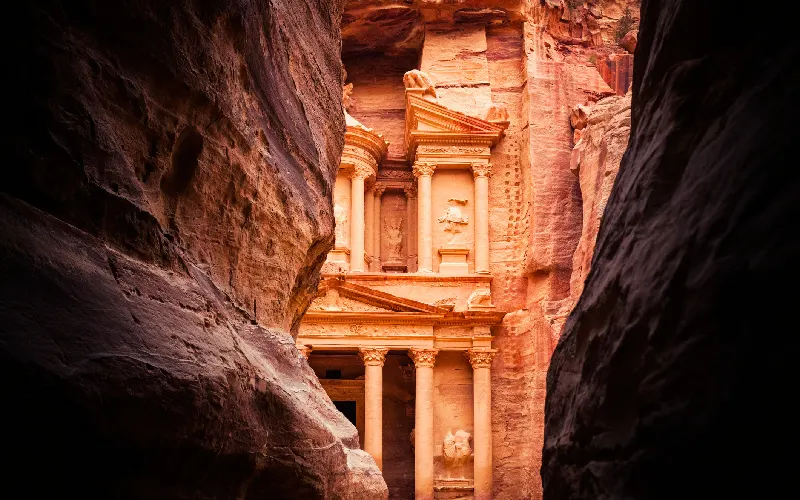
Then it opens, and the Treasury is there.
It is one of the great architectural arrivals anywhere, and almost none of it is accidental. Here's what the Siq actually is.
What Is the Siq?
The Siq is a narrow natural gorge that forms the main eastern entrance to the ancient city of Petra in southern Jordan. The name comes from the Arabic as-Sīq, meaning "the shaft."
- Length: approximately 1.2 kilometres
- Width: between roughly 3 and 12 metres at its narrowest points
- Height of walls: up to around 180 metres at the highest sections
- Gradient: a gentle downhill slope towards Petra
- Surface: partly original Nabataean paving, partly modern reconstruction
- Ends at: the Treasury (Al-Khazneh)
Getting to it takes a walk of around 700 to 800 metres from the visitor centre, past the Djinn Blocks and the Obelisk Tomb, before the gorge itself begins at a point marked by the remains of a monumental arch.
Siq Petra is one of the most searched phrases about the site, and the reason is simple: most people see the Treasury photograph first and then want to know what that dark frame around it is. The answer is the last few metres of the Siq.
How the Siq Formed
The Siq is often described as a canyon carved by water. That's only half right, and the distinction matters.
It began as a fracture. Tectonic movements associated with the Dead Sea Transform — the same fault system running the length of Jordan — pulled the sandstone block apart. The Siq is a split, not an excavation. You can see the evidence directly: at several points along the walls, the rock formations on the left and right sides mirror each other exactly, because they were once joined.
Water then shaped it. Once the fracture existed, flash floods from Wadi Musa poured through it, smoothing the walls, deepening the floor and rounding the edges over hundreds of thousands of years.
The rock is Umm Ishrin sandstone, laid down around 500 million years ago. Its colour varies from pale cream through orange and red to deep purple, banded by iron and manganese deposits. This is the same rock the Nabataeans carved their monuments from, and it explains why Petra's facades and the Siq walls share the same palette.
The narrowing effect comes from the fracture's geometry. In places the walls close to around three metres apart while rising 100 metres or more above you — a ratio that produces the sensation most visitors describe as the defining experience of the walk.
Technically it's neither in the strict geological sense — it's a fissure, and that's what makes it unusual. A canyon is cut downwards by a river eroding through rock. A gorge is a steep, narrow valley shaped by the same process. The Siq began as a tectonic split that already existed before water ran through it, and the mirrored rock formations on opposite walls prove the two sides were once in contact. Water widened and smoothed what the fault created; it did not create it. "Gorge" is the common usage and perfectly acceptable in ordinary speech, but the formation story is different from most places that carry the name.
What the Nabataeans Built Into It
The Siq looks natural. Much of what you walk through is not.
The Nabataeans arrived here around the 4th century BC and made this fissure the ceremonial approach to their capital. What they added is easy to miss unless you know to look.
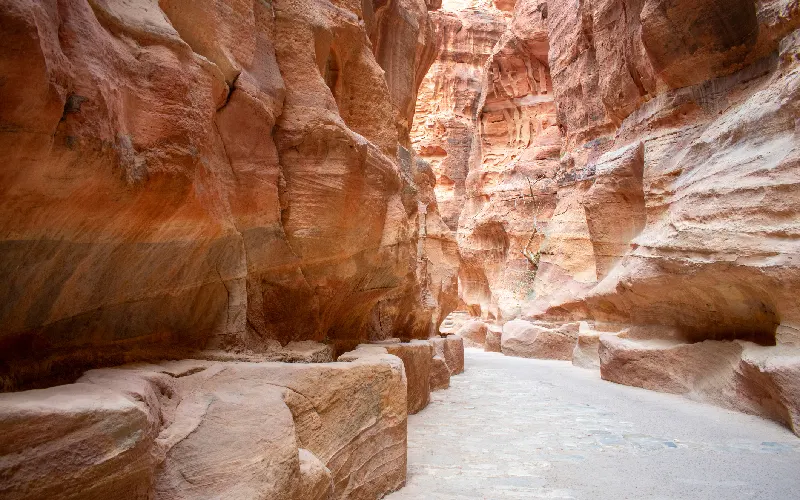
Paving. Substantial sections of the Siq floor were paved with stone slabs, laid to create a level processional surface. Original paving survives in stretches, and the rest has been reconstructed. Beneath it ran drainage.
Water channels. This is the Siq's most significant engineering feature. Channels were cut into the rock along both walls, carrying fresh water from the springs at Ain Musa into the city. On one side an open channel, on the other a system that in places used ceramic pipes. The gradient was calculated precisely enough to control flow rate — too fast and the pipes would erode, too slow and sediment would settle.
The dam and tunnel. Flash flooding was the Siq's permanent threat. The Nabataeans built a dam at the gorge entrance to block floodwater, and cut a tunnel — the Muthlim tunnel — through solid rock to divert the flow of Wadi Musa around the Siq entirely. The dam standing today is a modern reconstruction on the ancient foundations, built after a flood in the 1960s.
Votive niches and god blocks. Carved into the walls at intervals are small niches holding betyls — plain rectangular blocks representing Nabataean deities, particularly Dushara. These were not decoration. The Siq functioned as a sacred processional way, and travellers passing through would have made offerings.
The camel caravan relief. About halfway along, a weathered carving shows the legs and feet of a man leading two camels, at roughly life size. Only the lower portion survives, but its scale suggests the original figures stood taller than a person walking past.
The monumental arch. A free-standing arch once spanned the Siq at its entrance. It collapsed in 1896, and only the supporting abutments and niches remain on either wall.
Because Petra sits in a desert that receives very little annual rainfall, and what does fall arrives violently. The Nabataeans built a capital for tens of thousands of people in a place with no reliable surface water, which meant solving two opposite problems at once: capturing and transporting every drop of the springs and seasonal rain, while preventing flash floods from destroying the city. The Siq sat at the intersection of both. It was the conduit for the water supply and the natural funnel for floodwater, so it needed channels to carry one and a dam and tunnel to divert the other. The system worked for centuries, and its remains are among the most sophisticated hydraulic engineering surviving from the ancient world.
Customize Your Dream Vacation!
Get in touch with our local experts for an unforgettable journey.
Plan Your Trip
The Walk Through: What You Actually See
The Siq is not uniform. It changes character along its length, and the sequence is deliberate.
The entrance. The gorge begins abruptly. One moment you're in open ground with the Djinn Blocks behind you; the next the walls close in and the light drops.
The first half. Wider stretches alternate with narrow ones. The walls are heavily eroded, sculpted into rounded forms by water. This is where the water channels are most visible, running at roughly shoulder height along both sides.
The colours. Direct sunlight rarely reaches the floor, so the rock reads differently depending on where the sun sits. Mid-morning and mid-afternoon produce the strongest colour, when light bounces off the upper walls and fills the gorge with reflected orange.
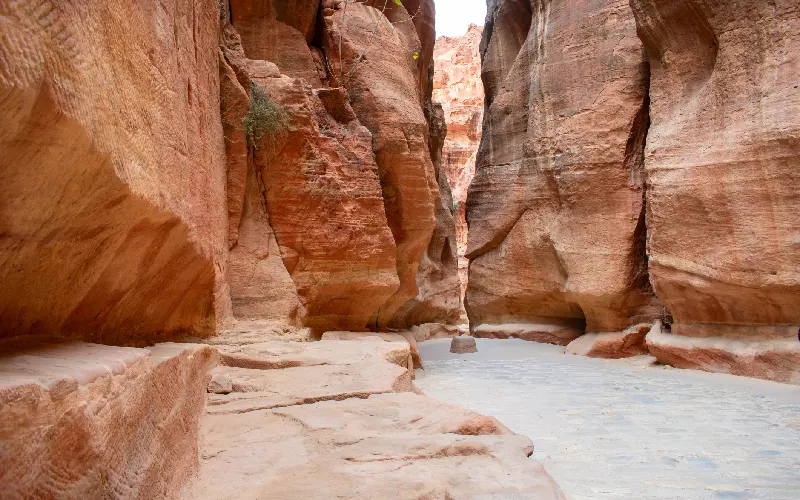
The narrowest points. In several sections the walls come within a few metres of each other. Looking up, the sky is reduced to a jagged line.
The final approach. The last 100 metres or so are the tightest. The gorge bends, then straightens, and a vertical sliver of light appears ahead — not sky, but sunlit sandstone.
The reveal. The Siq ends and the Treasury fills the gap. Because the gorge frames it so narrowly, you see the facade in pieces before you see the whole: a column, then the urn, then the entire 40-metre face at once.
Because the final bend in the Siq is angled, and the Treasury sits directly opposite the exit rather than off to one side. Approaching visitors have no line of sight until they are almost through — the rock wall blocks the view entirely, and then the gorge turns and the facade is straight ahead. Whether the Nabataeans chose this spot deliberately for that effect is debated, but the alignment is exact enough that most archaeologists consider it intentional. Petra was a trading capital that needed to impress arriving caravans, and this is the single most theatrical arrival in the ancient Near East.
The Siq's Role in Petra's History and Defence
The gorge was never just an entrance. It was infrastructure, ritual space and defence all at once.
As a trade route. Petra grew rich on the incense route, moving frankincense and myrrh from southern Arabia north towards the Mediterranean.
Caravans came through the Siq. The camel relief on the wall is a record of exactly that traffic, at the scale it happened.
As defence. A gorge three metres wide with 100-metre walls is close to impossible to force. A handful of defenders could hold it against a much larger force, and there is no way to bypass it without a long detour through difficult terrain. Petra's natural defences are the main reason it remained independent as long as it did, until Rome annexed the Nabataean kingdom in AD 106.
As sacred approach. The niches and betyls along the walls indicate the passage carried religious weight. Entering Petra was a transition, and the Siq was the threshold.
As rediscovery route. Petra was lost to the West for centuries after the Crusader period. When the Swiss traveller Johann Ludwig Burckhardt reached it in 1812, disguised and claiming to want to make a sacrifice at a nearby tomb, he entered through the Siq — the same walk visitors make today.
Safety, Flooding and Preservation Today
The Siq's greatest asset and greatest threat are the same thing: it channels water.
Flash flooding remains a genuine hazard. Rain falling on high ground kilometres away can send water through the gorge with almost no warning, and the confined walls mean there is nowhere to climb to. Serious flood incidents have occurred at Petra, most notably in 1963, and the site closes the Siq during heavy rain as a precaution.
Rockfall. The sandstone weathers, and blocks occasionally detach from the walls. Monitoring programmes track unstable sections, and consolidation work is carried out where movement is detected.
Erosion from visitors. Petra receives large visitor numbers, and the Siq is the entry point for nearly all of them. Foot traffic wears the original paving, and the horse-drawn carriages that operate along the gorge have been a subject of ongoing debate for the damage they cause to the surface and the stress they place on the animals.
Conservation approach. Work in the Siq focuses on stabilising rock faces, managing drainage, and protecting surviving original paving and water channels. As with any active site, the balance between access and preservation is continually renegotiated.
Around 20 to 30 minutes at a comfortable pace, covering roughly 1.2 kilometres on a gentle downhill gradient. The return walk is uphill and takes longer, particularly in heat.
Both. The fissure itself is natural, created by tectonic movement and then shaped by water. The paving, water channels, drainage, votive niches, dam and diversion tunnel are all Nabataean additions. The result is a natural formation heavily engineered for practical and ceremonial use.
Iron and manganese oxides within the Umm Ishrin sandstone produce bands of red, orange, purple and cream. The colours were laid down when the sediment formed around 500 million years ago and became visible when the rock split and eroded. Petra's nickname, the Rose City, derives from the same geology.
Horse-drawn carriages operate along the gorge and are the standard alternative for visitors unable to walk it. The experience is very different — the pace removes the gradual build that makes the approach effective, and the carriages are noisy in a confined space. Walking is the way the route was designed to be experienced.
The Treasury is the immediate reveal, but the Siq is only the entrance to a very large site. Beyond it the gorge opens into the Outer Siq, then the Street of Facades, the Roman theatre, the Royal Tombs, the colonnaded street, and eventually the long stair climb to the Monastery. Petra covers around 264 square kilometres in total.
Yes, though the Siq is the main one. A back route from Little Petra via the Wadi Muthlim tunnel and another trail from the village of Wadi Musa both reach the site, and hiking routes cross the surrounding hills. Historically the Siq's status as the sole practical approach was precisely what made Petra defensible.
A channel cut by the Nabataeans through solid rock, roughly 88 metres long, to divert the flow of Wadi Musa away from the Siq entrance during floods. It is one of the clearest surviving demonstrations of their hydraulic engineering, and it is still visible today.
Most famously in Indiana Jones and the Last Crusade, where the ride through the gorge and the arrival at the Treasury forms the climax. The sequence is responsible for a substantial share of Petra's global recognition, though it presents the Treasury's interior very differently from reality — the actual chamber behind the facade is a single empty room.




Learn about Jordan attractions, ancient history, and local traditions. Find must-visit places and start planning your unforgettable experience today.
Jordan's capital and largest city, Amman spreads across a landscape of hills with a history reaching back nine millennia — from Neolithic settlement to Roman Philadelphia to modern Arab capital.
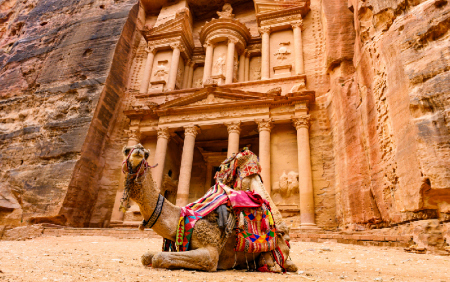
Petra is an ancient city carved into rose-red sandstone cliffs in southern Jordan, once the capital of the Nabataean civilisation and one of the most significant archaeological sites in the world — a UNESCO World Heritage Site and one of the New Seven Wonders of the World.
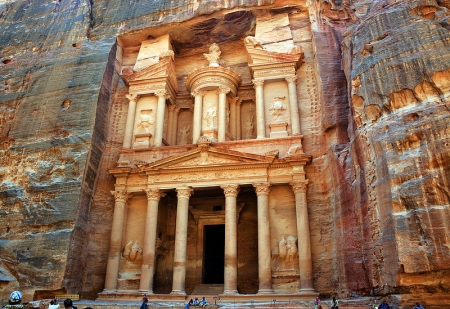
The Treasury (al-Khazneh) positioned opposite the main route into Petra. it was given by the local Bedouin tribes behind the belief that the urn on top of the front entrance contained the treasure of a pharaoh.
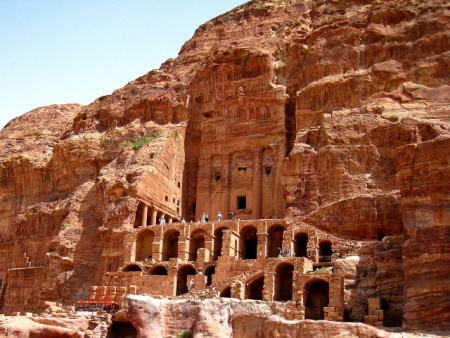
During any trip to Petra, you shouldn't miss the unpredictable Royal Tombs that took its name from the rich decoration. Know More!
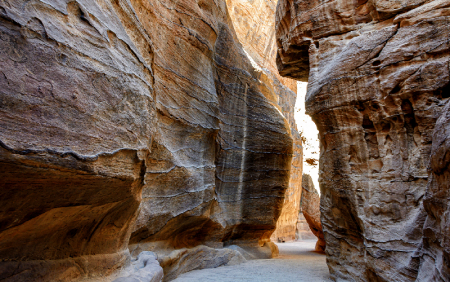
A 1.2-kilometre gorge with walls rising up to 180 metres, the Siq is Petra's main entrance — a natural rock fissure the Nabataeans turned into a processional way and a water system.
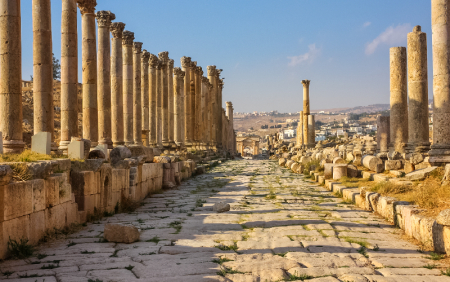
Jerash in northern Jordan is one of the best-preserved Roman cities outside Italy. A former member of the Decapolis league, it retains its colonnaded streets, temples, theatres and triumphal arches after nearly two thousand years.
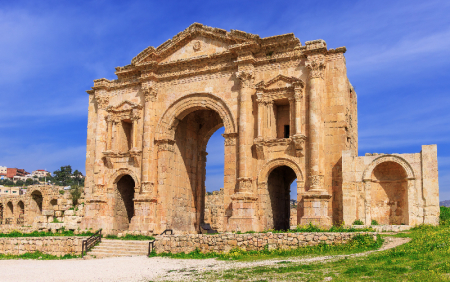
The monumental Roman gateway built to welcome Emperor Hadrian to ancient Gerasa in AD 129 — and still the most dramatic first sight in Jerash today.
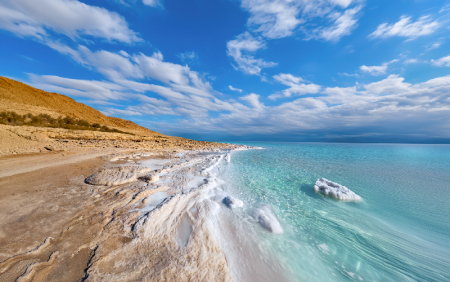
The Dead Sea is a hypersaline lake in the Jordan Rift Valley, sitting around 430 metres below sea level — the lowest point on Earth and one of the saltiest waters in the world. Its mineral-rich water and therapeutic mud have drawn health seekers for thousands of years.
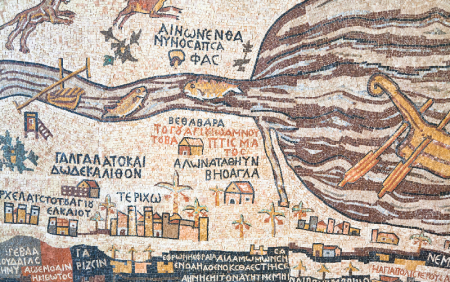
A sixth-century mosaic pavement in Madaba, Jordan, the Madaba Map is the oldest surviving cartographic image of the Holy Land — and the earliest detailed depiction of Jerusalem anywhere.
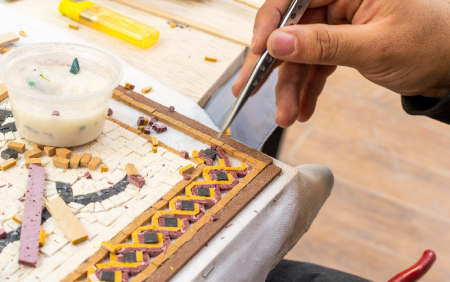
An ancient town on Jordan's King's Highway, Madaba holds the greatest concentration of Byzantine mosaics in the country — including the oldest surviving map of the Holy Land.
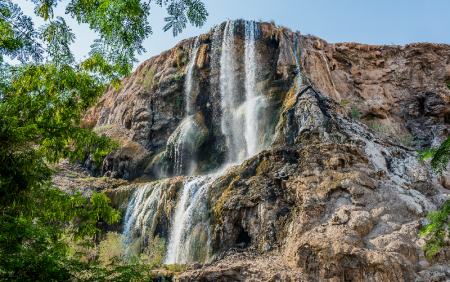
A chain of thermal waterfalls in a desert gorge below sea level, Ma'in Hot Springs has drawn bathers since antiquity — and appears on the sixth-century Madaba Map by name.
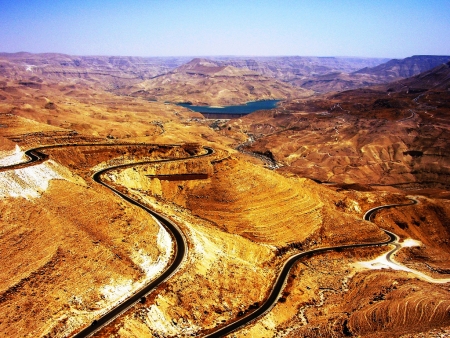
Mount Nebo is an elevated Mountain in Jordan, approximately 817 metres above sea level,.... Know More!
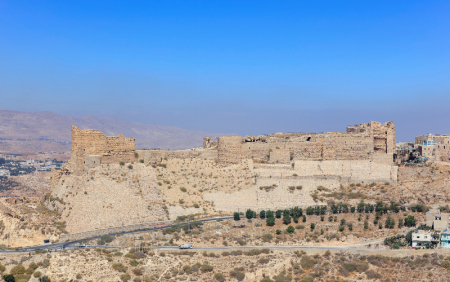
Built from the 1140s on a spur above the King's Highway, Kerak Castle is one of the largest Crusader fortresses in the Levant — and the setting for one of the strangest sieges in medieval history.
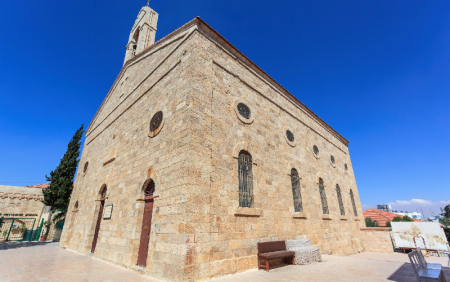
A working Greek Orthodox church in Madaba, Jordan, built in the 1890s over a Byzantine predecessor — and home to the sixth-century mosaic map of the Holy Land.

Mukawir (Machaerus) is an hour away and about 45 kms, away from Madaba on the Kings’ Highway. Know More !
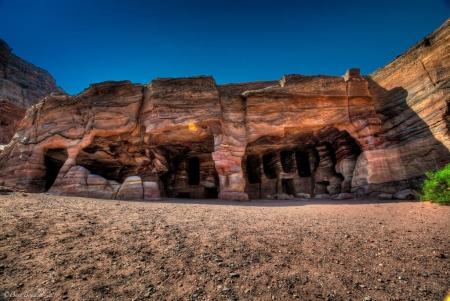
The Nabataeans (Nabateans) were an Arab people who lived in northern Arabia and the Southern Levant. They built the assumed capital city of Petra. Know more!
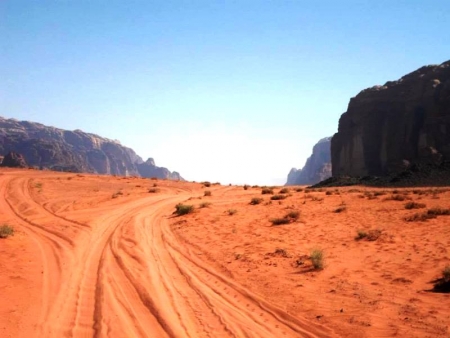
Lawrence of Arabia is a film directed by the global British director David Lean in 1962 and production of Sam Spiegel and starring Peter O'Toole role Lawrence.