Home
Home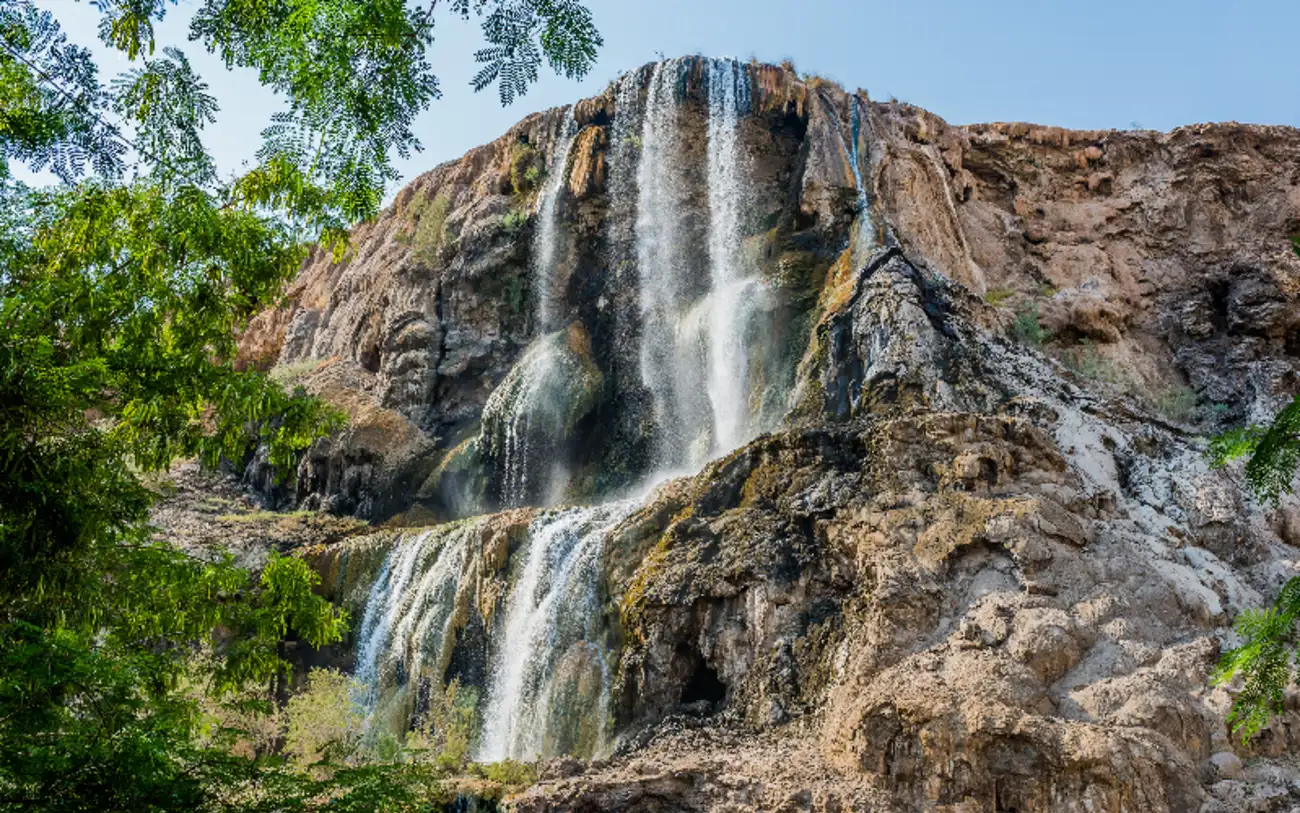
Hot water falling out of a cliff face in the middle of a desert canyon sounds like something that shouldn't exist. At Ma'in it does, and it has been doing so for as long as anyone has been writing things down about this part of the world.
The site is a series of thermal springs and waterfalls in a steep gorge west of Madaba, dropping through rock that is already well below sea level before the water even reaches the valley floor. Ancient writers named it. A sixth-century mosaic mapped it. Geologists explain it. Here is the full picture.
What Are the Ma'in Hot Springs?
Ma'in Hot Springs, known in Arabic as Hammamat Ma'in, is a geothermal spring system in the Madaba Governorate of central Jordan, where naturally heated mineral water emerges from rock fissures and cascades down a desert gorge as a series of hot waterfalls.
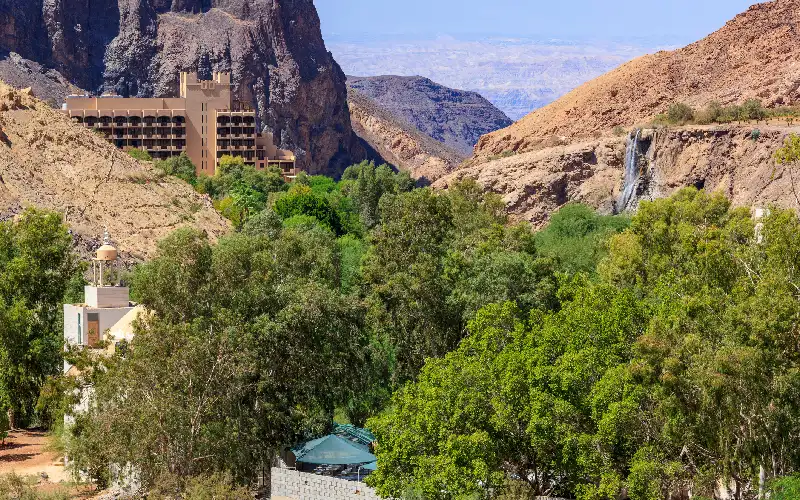
The site lies roughly 30 km southwest of Madaba and around 58 km southwest of Amman, set within Wadi Zarqa Ma'in, a deep canyon that runs westwards and drains into the Dead Sea.
The defining facts:
- Elevation: approximately 264 metres below sea level at the valley floor — one of the lowest inhabited points on earth outside the Dead Sea basin itself
- Number of springs: more than 60 individual hot and cold springs have been recorded within the wider valley system
- Water temperature: ranges from around 45°C to about 60°C depending on the source, with some vents reported higher
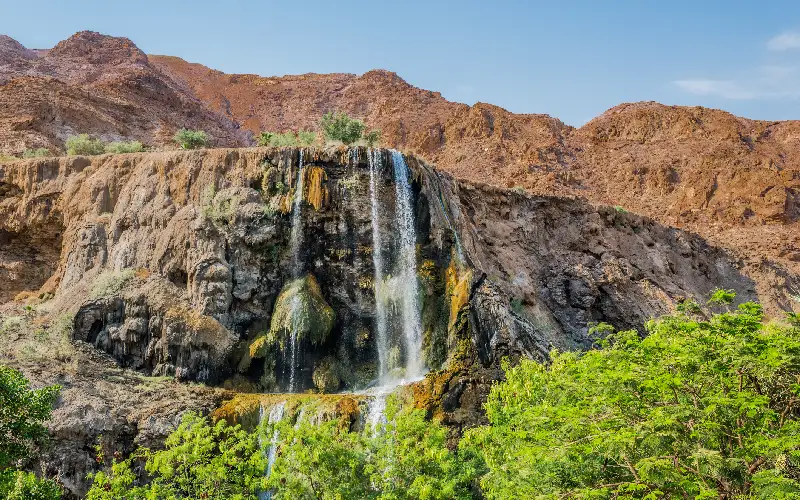
- Main waterfall: the most prominent cascade drops roughly 20 metres down a travertine-stained cliff
- Water type: thermal-mineral, carrying dissolved sulphates, chlorides, calcium, magnesium, sodium, potassium and hydrogen sulphide
- Drainage: the stream continues west through the gorge and empties into the Dead Sea
What makes Ma'in unusual among the world's thermal sites is the combination. Hot springs are common. Hot springs that arrive as waterfalls are not. Hot springs that arrive as waterfalls in an arid canyon several hundred metres below sea level, surrounded by near-tropical vegetation growing in a desert climate, are close to unique.
The name Hammamat Ma'in translates roughly as "the baths of Ma'in," and the "hammam" element is not decorative — bathing here is an activity with a documented history stretching back at least two thousand years.
Where the Hot Water Actually Comes From
The obvious assumption is volcanic activity. That assumption is wrong, and the real explanation is more interesting.
Jordan sits along the Dead Sea Transform, one of the major fault systems on the planet, where the Arabian plate slides northwards past the African plate. This is not a subduction zone and not a volcanic arc — it is a strike-slip boundary. But the crustal thinning and deep fracturing associated with the rift produce an elevated geothermal gradient: rock temperatures rise faster with depth here than they do under stable continental crust.
The water itself begins as rain.
Step one: recharge. Winter rainfall lands on the Jordanian highlands — the Madaba plateau and the uplands towards Karak, where elevations exceed 700 to 900 metres above sea level.
Step two: infiltration. That rainwater percolates down through permeable limestone and sandstone formations, entering deep aquifer systems.
Step three: heating. As it descends, the water is warmed by the surrounding rock. The deeper the circulation, the hotter it gets. Isotopic studies of Jordanian thermal waters indicate residence times underground measured in thousands of years for some of these systems.
Step four: mineralisation. Hot water is an aggressive solvent. Over that long journey it dissolves carbonates, sulphates and chlorides out of the rock it passes through, picking up the mineral load that defines it.
Step five: ascent. Where deep faults associated with the rift intersect the aquifer, the pressurised hot water finds a route back to the surface.
Step six: emergence. At Ma'in, those fractures open in the walls of the gorge — which, sitting hundreds of metres below sea level, cuts far enough down to intercept them. The water arrives already hot and falls.
Step seven: deposition. As it hits air and cools, dissolved calcium carbonate comes out of solution, coating the cliffs in the pale, banded travertine crust that gives the falls their characteristic look.
Because heat in the earth's crust does not require magma at the surface. The Dead Sea rift has stretched and thinned the crust along its length, which brings hotter deep rock closer to the surface than it would otherwise be. Water circulating several hundred to a few thousand metres down through that rock simply absorbs the ambient heat and carries it back up. The same mechanism produces thermal springs at other points along the rift on both sides. No eruption, no magma chamber — just deep circulation through warm rock and a fault system efficient enough to return the water quickly, before it has time to cool.
Callirrhoe and Baaru: The Ancient History of Hammamat Ma'in
Ma'in is not a site that was discovered. It was never lost.
The Jewish historian Josephus, writing in the first century AD, describes hot springs on the eastern side of the Dead Sea in two separate contexts. He records that Herod the Great, in the final stages of a painful illness, was carried to warm springs beyond the Jordan in an attempt to find relief. He also describes springs at a place he calls Baaras, near the fortress of Machaerus, noting waters of varying temperature — some scalding, some cold — and a valley reputed for medicinal properties.
Two ancient names attach to the thermal springs of this stretch of coast and escarpment:
- Callirrhoe (Greek Kallirrhoe, "beautiful flowing") — generally identified with the springs closer to the Dead Sea shore
- Baaru or Baaras — the springs higher in the escarpment, most commonly identified with Ma'in itself
The distinction matters, and it is one of the more debated points in the historical geography of the region, with scholars differing over exactly which ancient name maps onto which modern site.
What settles a good deal of it is a mosaic floor.
The Madaba Map, the sixth-century mosaic pavement in the Greek Orthodox Church of St George in Madaba, depicts the region east of the Dead Sea and labels the thermal springs in Greek. The map shows Therma Baarou — the hot springs of Baaru — as a named, mapped location, alongside a separate depiction of Callirrhoe near the shoreline. A Byzantine mosaicist working roughly 30 km away considered these springs significant enough to include and label on a map of the entire Holy Land.
That is a remarkable continuity. The same water that Herodian-era patients travelled to, that Josephus wrote about, and that a Byzantine artist set into a church floor is still emerging from the same fractures today.
Roman and Byzantine bathing culture treated thermal springs as infrastructure rather than novelty, and the region's springs would have functioned within that framework — places of treatment as much as leisure. Later Islamic-era medical writing on Jordan and Palestine continued to note the springs of the Dead Sea escarpment for their reputed properties.
Josephus states that Herod, gravely ill and beyond the help of his physicians, was taken across the Jordan to warm baths in the hope of a cure — and that the treatment failed. What Josephus does not do is give coordinates. The account is usually connected to the thermal springs of the eastern Dead Sea region, and both Callirrhoe and Ma'in have been proposed. Herod also built and fortified Machaerus, the hilltop fortress at nearby Mukawir, which sits close enough to make either candidate plausible. The honest position is that Herod visited hot springs in this immediate area; whether he bathed at Ma'in specifically or at the shoreline springs cannot be established from the sources.
Customize Your Dream Vacation!
Get in touch with our local experts for an unforgettable journey.
Plan Your Trip
What Is Actually in the Water
Thermal-mineral water is defined by chemistry, not just by temperature, and the composition of Jordan's rift-margin springs has been sampled and analysed repeatedly.
The waters at Ma'in are broadly characterised as warm to hot, moderately to highly mineralised, and carrying a distinct sulphurous element. Reported constituents include:
- Calcium and magnesium — from dissolution of limestone and dolomite formations
- Sodium and chloride — contributing to the water's salinity, though far below Dead Sea concentrations
- Sulphates and hydrogen sulphide — responsible for the faint eggy smell characteristic of the site
- Bicarbonates — which precipitate as travertine on contact with air
- Potassium and trace elements — in smaller quantities
- Radon — present in trace amounts, as at many deep-circulating thermal systems
The traditional reputation of these waters rests on balneotherapy — the therapeutic use of mineral bathing — which has a long history across the Mediterranean and Near East. Warm mineral water applied to the body produces several effects that are not in dispute: heat increases local blood flow, buoyancy reduces load on joints, and hydrostatic pressure can assist circulation. Sulphur-bearing waters have a particularly long association with skin conditions in traditional practice.
The wider Dead Sea region has been studied more intensively than most for climatotherapy and balneotherapy, and Jordan's thermal springs are frequently discussed within that literature. It is worth being precise about the distinction: the physical effects of warm mineral bathing are well established, while claims about specific cures for specific conditions vary enormously in the strength of evidence behind them. Anyone considering thermal bathing for a medical reason should treat it as a question for a qualified clinician rather than a matter of tradition.
Temperatures across the Ma'in system are not uniform because the springs do not share a single plumbing route. Different fractures tap water that has circulated to different depths and travelled different distances, so each vent arrives at its own temperature — and cooler shallow groundwater mixes in along the way, moderating some sources more than others. The result is a gradient across the site, from springs comfortable for extended immersion to vents hot enough to scald. As a general principle in thermal bathing anywhere, water above roughly 40°C limits safe immersion time considerably, and the risk is compounded by the site's below-sea-level heat and dry air. Dehydration, not the minerals, is the practical hazard.
The Gorge, the Falls and the Life Around Them
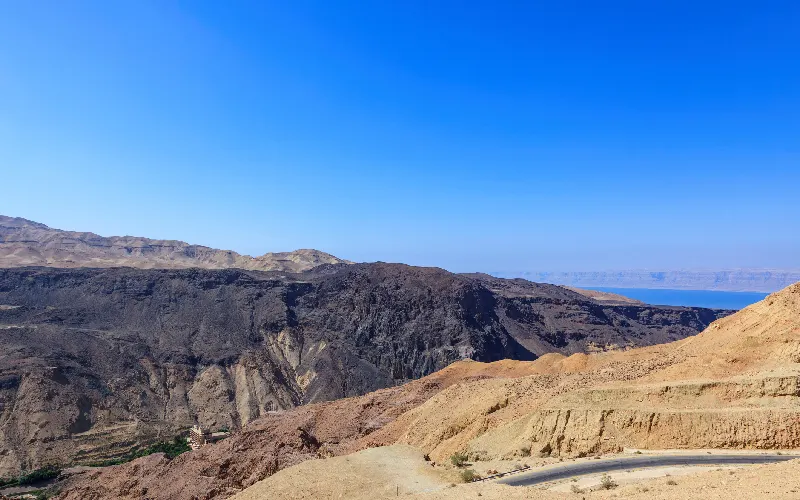
Wadi Zarqa Ma'in is a genuine desert canyon: sheer walls of limestone and sandstone, sparse vegetation on the slopes, and a floor that drops steadily westwards towards the Dead Sea rift.
Then the water arrives, and everything changes.
Along the watercourse, the constant supply of warm water in a hot, low-altitude environment produces a ribbon of vegetation utterly at odds with the surrounding terrain — reeds, tamarisk, oleander, palms and dense green growth clinging to the stream. This is the classic riparian oasis effect, and at Ma'in it is intensified by the thermal input, which keeps the microclimate warm even through the Jordanian winter.
The travertine formations are the site's signature geological feature. As calcium-saturated water aerates over the lip of each cascade, carbonate precipitates out and builds up in layered crusts and terraces. The process is continuous, meaning the physical shape of the falls is slowly, permanently changing.
The main cascade drops around 20 metres over a rounded travertine apron. Behind and around several of the falls, water has hollowed out recesses in the rock — small natural chambers where steam collects, functioning as rudimentary saunas.
Wildlife in the gorge reflects its position as a permanent water source in an arid zone. The valley system falls within a corridor known for raptors and migratory birds, and the escarpment of the Dead Sea rift as a whole is a significant flyway between Africa and Eurasia. Mammals recorded in the wider region include hyrax, ibex in the upper reaches, foxes and small carnivores.
Downstream, the wadi continues west and reaches the Dead Sea shore, where the freshwater-thermal outflow meets the hypersaline lake — a sharp ecological boundary and part of what makes the eastern Dead Sea escarpment such an unusual environment.
Only by drainage, not by source. The Dead Sea is fed by surface inflow and has become hypersaline through evaporation in a closed basin; its mineral profile is dominated by magnesium and potassium chlorides at extraordinarily high concentrations. Ma'in's water is meteoric in origin — rainfall that fell on the highlands and travelled underground — and its salinity is a small fraction of the lake's. The two share a geological setting and a hydrological endpoint, since the Ma'in stream ultimately empties into the Dead Sea, but the water arriving at the falls has no Dead Sea component in it. They are neighbours in the same rift, not the same system.
Ma'in Within Jordan's Wider Thermal and Historical Landscape
Ma'in does not stand alone. It belongs to a cluster of sites along the Dead Sea escarpment and the Madaba plateau that together tell a connected story of geology, scripture and settlement.
Zarqa Ma'in and the Zara springs lie downstream near the shoreline, forming the other half of the ancient Callirrhoe–Baaru pairing.
Mukawir (Machaerus) sits on a conical hilltop a short distance south — the Herodian fortress associated in Christian tradition with the imprisonment and death of John the Baptist, and a site whose commanding views over the Dead Sea explain exactly why it was fortified.
Madaba to the northeast holds the mosaic map that named these springs in the sixth century.
Mount Nebo, north of Madaba, is the ridge from which Moses is traditionally described as viewing the promised land.
The Dead Sea shoreline to the west completes the picture: the lowest exposed land surface on earth, and the reason the whole escarpment behaves the way it does.
Jordan has other thermal sites — including springs in tshorelinehe north near the Yarmouk valley and further south along the rift — but Ma'in is the one where the water arrives as a waterfall. That single geological accident, springs intersecting a gorge wall rather than a flat valley floor, is what has kept the site remarkable for two thousand years.
The valley floor sits at approximately 264 metres below sea level. That places it among the lowest points on land anywhere outside the immediate Dead Sea basin, and it is a direct consequence of the site's position within the Dead Sea rift.
No. The springs are mineral-bathing waters, not potable supply. Their dissolved mineral load — particularly sulphates, chlorides and hydrogen sulphide — is far above drinking water standards, and thermal spring water can also carry heat-tolerant microorganisms. Thermal springs of this type are used externally, not consumed.
Very little in temperature. Because the water is heated at depth by rock rather than by sunlight, it emerges at a broadly stable temperature year-round, regardless of season. Flow can vary more, since discharge ultimately depends on recharge from rainfall on the highlands, and multi-year drought conditions affect aquifer levels across Jordan.
Travertine — a form of calcium carbonate deposited when mineral-rich water loses carbon dioxide on contact with air, causing dissolved carbonate to precipitate out. It builds up in layers over time, forming the pale terraces, aprons and drapery shapes that characterise the cliff faces. The same process creates the terraced formations found at thermal sites worldwide.
The odour comes from hydrogen sulphide gas dissolved in the water, released as the water aerates at the surface. It forms underground through reactions between circulating groundwater and sulphur-bearing minerals in the rock, sometimes assisted by sulphate-reducing bacteria. The smell is strong at low concentrations, which is why it is noticeable even where the actual quantity of gas is small — and it is one of the standard signatures of a deep-circulating thermal system.
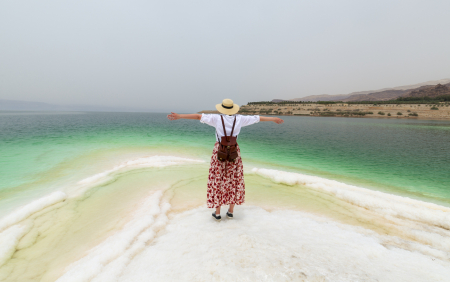


Learn about Jordan attractions, ancient history, and local traditions. Find must-visit places and start planning your unforgettable experience today.
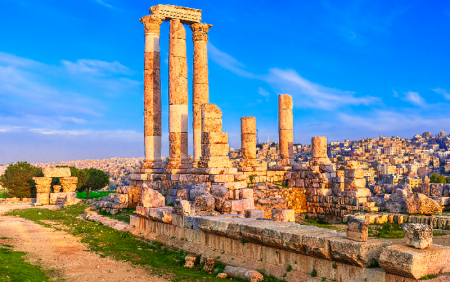
Jordan's capital and largest city, Amman spreads across a landscape of hills with a history reaching back nine millennia — from Neolithic settlement to Roman Philadelphia to modern Arab capital.
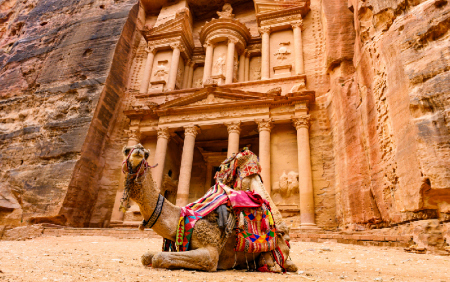
Petra is an ancient city carved into rose-red sandstone cliffs in southern Jordan, once the capital of the Nabataean civilisation and one of the most significant archaeological sites in the world — a UNESCO World Heritage Site and one of the New Seven Wonders of the World.
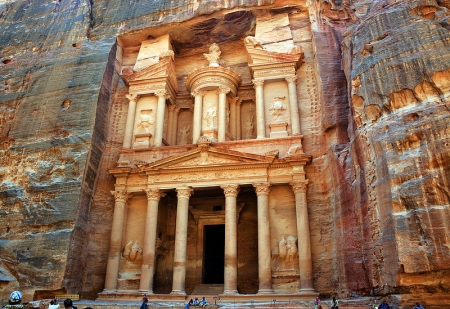
The Treasury (al-Khazneh) positioned opposite the main route into Petra. it was given by the local Bedouin tribes behind the belief that the urn on top of the front entrance contained the treasure of a pharaoh.
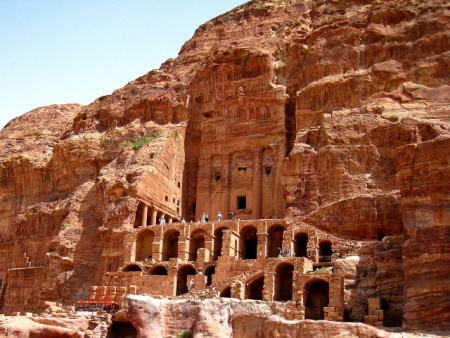
During any trip to Petra, you shouldn't miss the unpredictable Royal Tombs that took its name from the rich decoration. Know More!
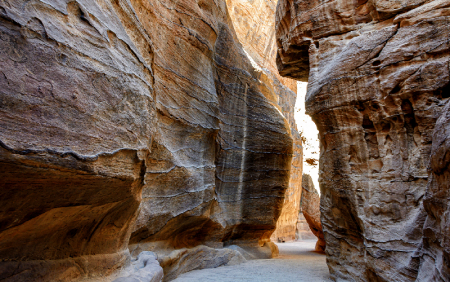
A 1.2-kilometre gorge with walls rising up to 180 metres, the Siq is Petra's main entrance — a natural rock fissure the Nabataeans turned into a processional way and a water system.
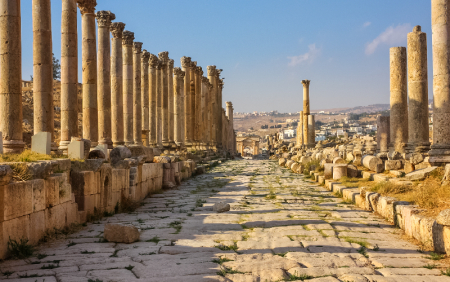
Jerash in northern Jordan is one of the best-preserved Roman cities outside Italy. A former member of the Decapolis league, it retains its colonnaded streets, temples, theatres and triumphal arches after nearly two thousand years.
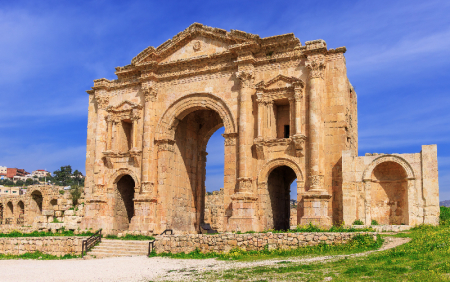
The monumental Roman gateway built to welcome Emperor Hadrian to ancient Gerasa in AD 129 — and still the most dramatic first sight in Jerash today.
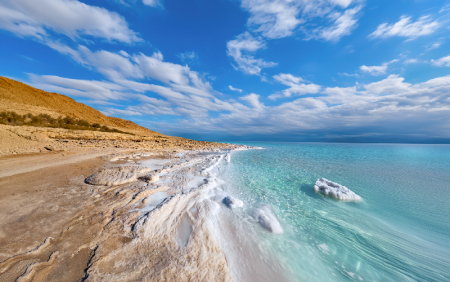
The Dead Sea is a hypersaline lake in the Jordan Rift Valley, sitting around 430 metres below sea level — the lowest point on Earth and one of the saltiest waters in the world. Its mineral-rich water and therapeutic mud have drawn health seekers for thousands of years.
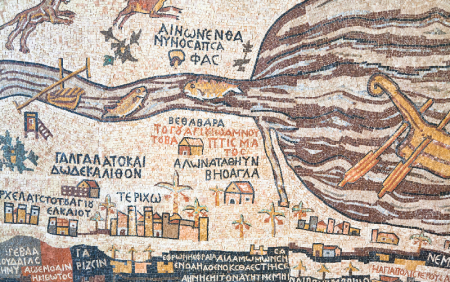
A sixth-century mosaic pavement in Madaba, Jordan, the Madaba Map is the oldest surviving cartographic image of the Holy Land — and the earliest detailed depiction of Jerusalem anywhere.
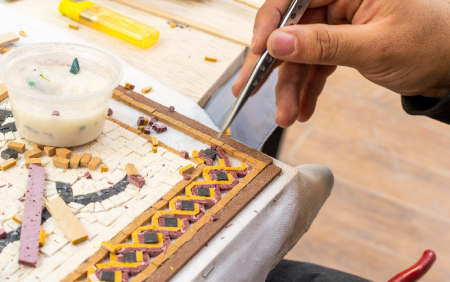
An ancient town on Jordan's King's Highway, Madaba holds the greatest concentration of Byzantine mosaics in the country — including the oldest surviving map of the Holy Land.
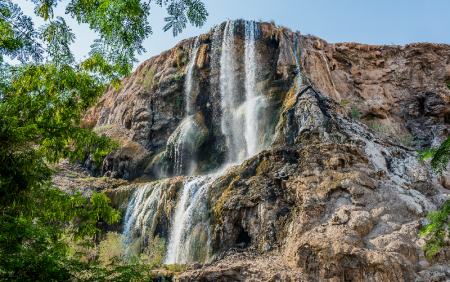
A chain of thermal waterfalls in a desert gorge below sea level, Ma'in Hot Springs has drawn bathers since antiquity — and appears on the sixth-century Madaba Map by name.
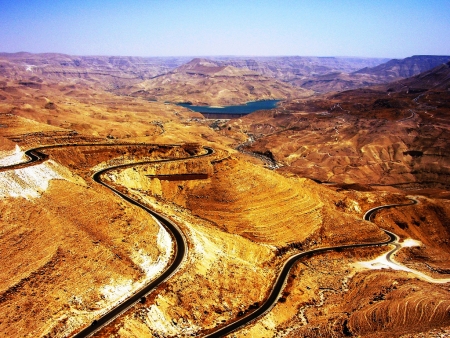
Mount Nebo is an elevated Mountain in Jordan, approximately 817 metres above sea level,.... Know More!
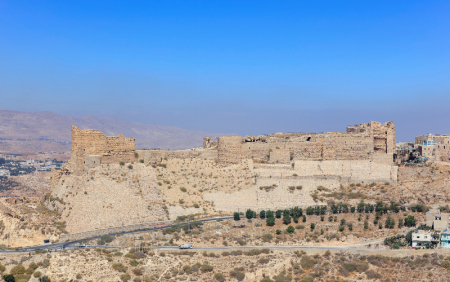
Built from the 1140s on a spur above the King's Highway, Kerak Castle is one of the largest Crusader fortresses in the Levant — and the setting for one of the strangest sieges in medieval history.
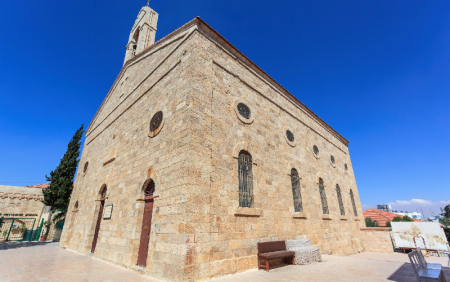
A working Greek Orthodox church in Madaba, Jordan, built in the 1890s over a Byzantine predecessor — and home to the sixth-century mosaic map of the Holy Land.

Mukawir (Machaerus) is an hour away and about 45 kms, away from Madaba on the Kings’ Highway. Know More !
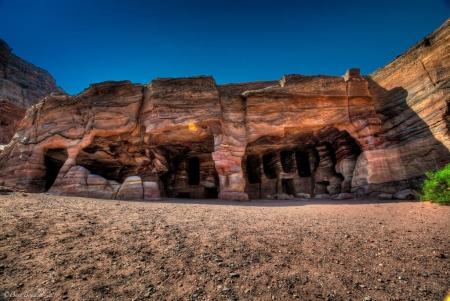
The Nabataeans (Nabateans) were an Arab people who lived in northern Arabia and the Southern Levant. They built the assumed capital city of Petra. Know more!
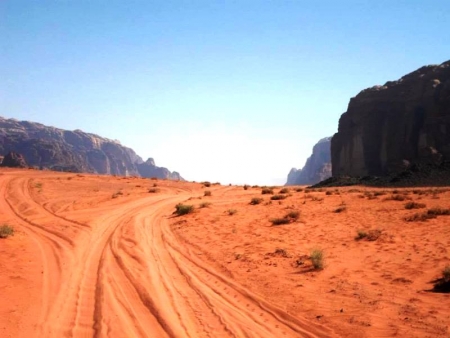
Lawrence of Arabia is a film directed by the global British director David Lean in 1962 and production of Sam Spiegel and starring Peter O'Toole role Lawrence.