Home
Home
There is a small stone church in a Jordanian town about thirty kilometres from Amman that receives visitors from all over the world. It is not large. It is not architecturally famous. Its congregation numbers in the hundreds.
What makes this small church extraordinary lies beneath your feet: its floor.
Set into the pavement of Saint George Greek Orthodox Church is a sixth-century mosaic map of the Holy Land — the oldest surviving map of the region in any form, and the earliest detailed depiction of Jerusalem that exists. It was found by builders who had no idea what they were digging through, and it survived largely because nobody knew it was there.
Here's the story of the church and what it holds.
What Is Saint George Greek Orthodox Church?
Saint George Greek Orthodox Church is a functioning Greek Orthodox parish church in Madaba, central Jordan, best known for the Byzantine mosaic map preserved in its floor.
The essentials:
- Location: central Madaba, roughly 30 km southwest of Amman
- Denomination: Greek Orthodox, under the Patriarchate of Jerusalem
- Built: 1890s, on the site of a Byzantine church
- Dedication: Saint George, one of the most widely venerated saints in Eastern Christianity
- Famous for: the Madaba Map, a sixth-century mosaic pavement
- Status: an active parish church, not a museum
That last point matters more than most visitors expect. St George's Greek Orthodox Church is not a preserved ruin or a heritage site with a congregation attached — it is a working church where a real community worships every week. The mosaic sits in a building that holds services, weddings, funerals and feast days.
The Church Beneath the Church
Understanding the modern building requires understanding what was there before it.
Madaba was a prosperous Byzantine town from roughly the fifth to the seventh centuries — a bishopric with a dense cluster of churches, and a local workshop tradition producing mosaic floors of exceptional quality. One of those churches stood on the site now occupied by St George's.
Then Madaba declined. Earthquakes, shifting trade routes and regional instability reduced the town to ruins over several centuries, and by the medieval period the site was largely deserted. The Byzantine church collapsed, and soil and rubble accumulated over its floor.
That burial is the reason the mosaic exists today. A pavement left exposed gets walked on, weathered, quarried for reuse or built over. A pavement sealed under debris is protected from all four.
The resettlement. In 1880, Christian families migrating north from Karak after local conflict settled on the ruin mound of Madaba. As they cleared ground for houses and churches, they began cutting into buried Byzantine floors across the town.
The discovery. In 1884, work began on a new Greek Orthodox church on the site of the old one. The builders cut into the ancient pavement — and uncovered a mosaic covered in Greek writing and pictures of cities. Portions were damaged or destroyed during that clearance, before anyone understood what was there.
The recognition. It took more than a decade for the wider world to learn about it. In the mid-1890s the discovery was reported to the Greek Orthodox Patriarchate in Jerusalem, and by 1897 scholars had begun publishing on it. The reaction was immediate — what had been treated as decorative rubble turned out to be a unique historical document.
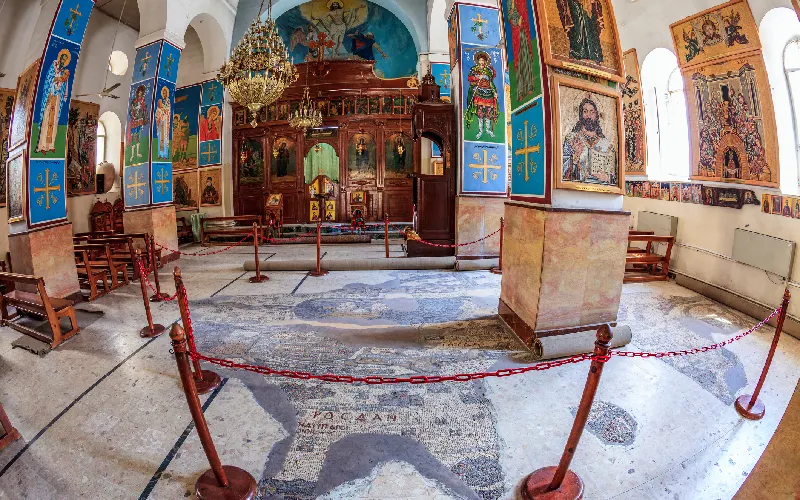
The modern church. The building standing today was completed in the 1890s, constructed directly over the mosaic with the pavement incorporated into its floor.
Because nobody was looking for it, and the people who found it weren't archaeologists. The builders in 1884 were constructing a church for a community that had just arrived and needed somewhere to worship. They encountered a decorated floor, which in Madaba is not unusual — mosaic pavements turn up across the town whenever anyone digs. Communication between a small Jordanian town and European scholarly circles was slow, and it took the involvement of the Patriarchate in Jerusalem to bring it to wider attention. By then some of the pavement had already been lost.
The Madaba Map: What Lies in the Floor
The mosaic itself dates to the sixth century AD, generally placed between around AD 542 and 570.
What it depicts: the Holy Land and surrounding territories as a geographic panorama, running from Lebanon in the north to the Nile Delta in the south, and from the Mediterranean coast eastwards into the desert.
Key features:
- More than 150 named places, labelled in Greek
- Cities shown as miniature aerial views, with walls, gates and identifiable buildings
- The Dead Sea with two boats afloat on it
- The Jordan River containing fish — including one shown turning back as it approaches the lethal salinity of the lake
- A lion pursuing a gazelle in the hills of Moab
- Date palms clustered around Jericho and Zoara
Jerusalem is the centrepiece and the reason for the map's fame. It's rendered far larger than its true proportion, with the city walls, a northern gate opening onto a plaza with a free-standing column, the colonnaded Cardo Maximus running north to south, and the Church of the Holy Sepulchre shown with steps, basilica and domed rotunda. This is the oldest detailed image of Jerusalem that survives anywhere.
The Nea Church, dedicated in AD 542, also appears — which is how the map can be dated as precisely as it is. A building dedicated in 542 cannot appear on a mosaic made before then.
Size and survival: the original is commonly reconstructed at roughly 21 metres by 7 metres, composed of an estimated two million individual tesserae. Something between a quarter and a third survives.
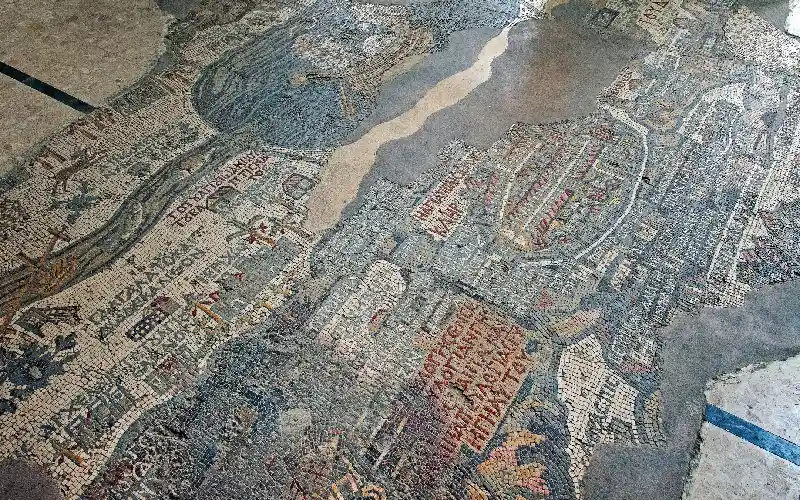
Because Byzantine Christian convention placed east at the top — the direction of sunrise, of Eden in Christian tradition, and of the altar in a church. Someone standing on the pavement and facing the sanctuary was looking the same way the map itself looks. North-at-the-top is a much later European convention and was never universal. This is also why visitors often find the map disorienting at first: the Mediterranean runs along the bottom edge rather than the left.
Customize Your Dream Vacation!
Get in touch with our local experts for an unforgettable journey.
Plan Your Trip
Inside the Church Today
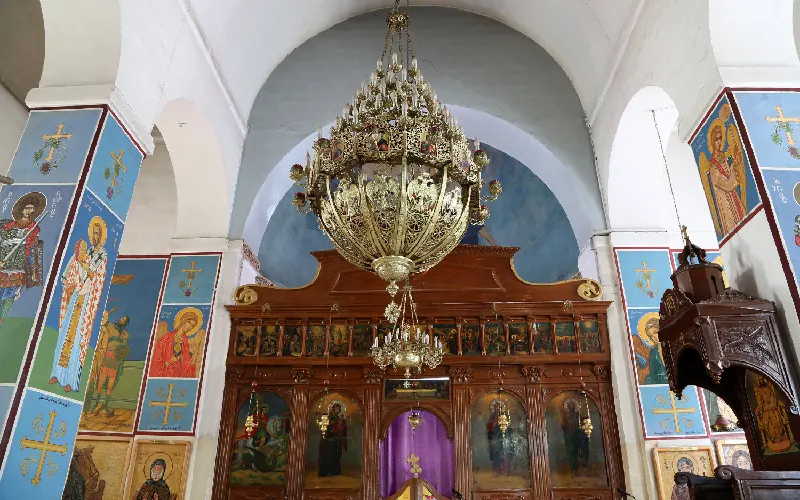
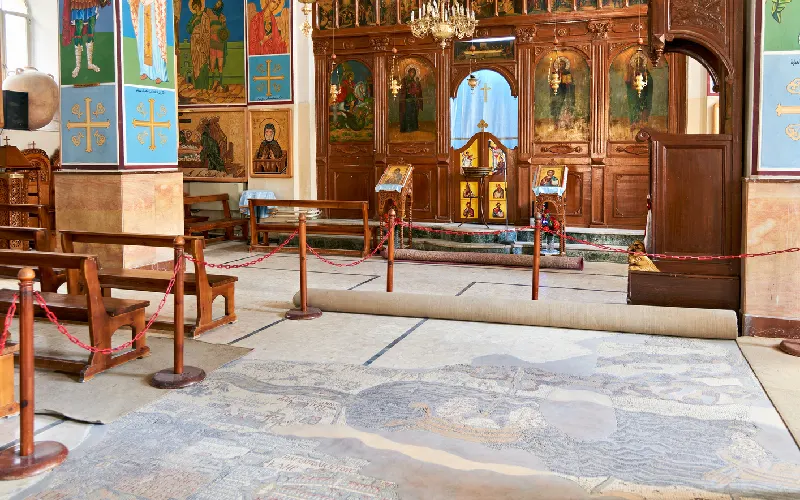
The building is modest by the standards of Orthodox architecture — a single-nave stone church with the mosaic occupying part of the nave floor.
What you find inside:
- The mosaic map, protected and viewable, occupying a section of the floor
- The iconostasis, the icon screen separating the nave from the sanctuary, characteristic of Orthodox churches
- Icons including depictions of Saint George, to whom the church is dedicated
- An explanatory display covering the map's discovery and interpretation
The interior is compact. Visitors and worshippers share the same space, and services take place around the mosaic rather than in a separate area.
The 1965 conservation campaign is what established the map's current presentation. Earlier attempts at protection had introduced distortions; the 1965 work stabilised what remained, corrected those problems, and set the framework for how the pavement is displayed and maintained today.
Conservation remains ongoing. The principal threats to any floor mosaic of this age are moisture rising through the substrate, salt crystallisation in the mortar bed, temperature fluctuation, and physical wear. Modern practice favours stabilising in place rather than lifting and relocating — the pavement's relationship to its building is itself part of the evidence.
Yes. St George Greek Orthodox Church, Madaba, Jordan holds regular services for a local Orthodox congregation, and the mosaic sits within a functioning place of worship rather than a museum. Madaba has one of the highest proportions of Christian residents of any town in Jordan, and the parish is a genuine community institution. Visitors are welcome, but the building's primary purpose is liturgical — services take precedence over sightseeing, and the church observes normal expectations of quiet and modest dress.
Why the Map Matters Beyond the Church
The significance of what sits in this floor runs along several independent lines.
As a historical record. The map preserves the sixth-century names of more than 150 places, many of them small settlements appearing in no other source with this degree of locational precision. For scholars reconstructing the settlement pattern of the late antique Near East, it is a primary document.
As an archaeological tool. For centuries, the course of Jerusalem's Byzantine main street and the location of the Nea Church were matters of speculation. Excavations in Jerusalem's Old City during the 1970s used the Madaba Map as a working reference — and found the colonnaded Cardo and the remains of the Nea broadly where the mosaic indicated. A church floor in Jordan successfully directed a twentieth-century excavation in another country.
As a work of art. Separate from its documentary value, the mosaic is a sophisticated piece of design, balancing text and image across a vast surface while animating it with small observed details.
As evidence of how people saw the world. The map shows a mental geography organised by theology: east at the top, holy places enlarged in proportion to their significance, scripture annotated onto the terrain. It tells us not just where things were but what mattered.
As the anchor of Madaba's identity. The town's reputation as Jordan's centre of mosaic heritage rests substantially on this pavement, and the conservation and craft traditions that grew up locally are partly a response to having custody of it.
Saint George's Place in Madaba's Wider Story
The church is the most famous of Madaba's mosaic sites, but it is one of many.
The Church of the Apostles holds a pavement featuring Thalassa, a personification of the sea, in a work that unusually names its mosaicist.
Hippolytus Hall, within the Madaba Archaeological Park, carries an entirely secular floor illustrating Greek mythology — the tragedy of Phaedra and Hippolytus, Aphrodite and Adonis, and personifications of the four seasons.
The Church of the Virgin Mary centres on an elaborate geometric medallion with a Greek inscription.
Umm ar-Rasas, around 30 km southeast, is a UNESCO World Heritage Site whose St Stephen's Church holds one of the largest and best-preserved mosaic floors in the region.
Mount Nebo, northwest of Madaba, contains hunting and pastoral mosaics of exceptional quality in the Memorial Church of Moses.
Madaba also still makes mosaics. The Madaba Institute for Mosaic Art and Restoration, established in the early 1990s, trains craftspeople in both historic technique and modern conservation science — an unusual case of a place preserving not just the objects but the skill that made them.
Saint George was a Roman soldier martyred in the early fourth century, traditionally under the emperor Diocletian, and he became one of the most widely venerated saints across the Christian East long before he became associated with England. He is a major figure in Orthodox tradition throughout the Levant, and churches dedicated to him are common across Jordan, Palestine, Syria and Lebanon. The dedication here reflects that regional devotion rather than any specific connection between the saint and Madaba.
The current structure dates from the 1890s, making it well over a century old but far younger than the mosaic it houses. It stands on the site of a Byzantine church that occupied the same ground roughly 1,300 years earlier.
No. The map occupies part of the nave floor, and only a fraction of the original mosaic survives — commonly estimated at a quarter to a third of what was laid in the sixth century. The rest of the church floor is ordinary paving.
Losses came in stages: damage when the Byzantine church was destroyed in antiquity, deterioration during Madaba's long abandonment, and a final round of accidental destruction during the 1884 building work, when the pavement was uncovered by people constructing rather than excavating. The surviving portion is mainly the central and southern part of the original.
Nothing comparable survives. Older maps exist from Mesopotamia and Egypt, and later Byzantine works depict places symbolically, but no other surviving floor mosaic attempts a systematic geographical map of a whole region at this scale with this density of labelled places.
It's unsigned, and no surviving inscription names the maker or the donor. This is normal for Byzantine pavements. What can be said is that it came from a local workshop tradition — Madaba and its region contain dozens of comparable mosaics from the same period, some dated by inscription and at least one naming its craftsman.
Photography policies at active places of worship vary and can change, and the church may restrict it during services or to protect the mosaic. As with any working church, it's best to check on arrival and follow whatever guidance is displayed.
Because importance determined size rather than scale did. Byzantine cartography of this kind was theological as much as geographical, and Jerusalem was the spiritual centre of the world it depicted. The city occupies a share of the surface far beyond its actual footprint — which is precisely why its internal detail is fine enough to have proved archaeologically useful.
Only the shared dedication. Saint George is venerated across both Eastern and Western Christianity, and churches bearing his name exist worldwide. The Madaba church belongs to the Greek Orthodox Patriarchate of Jerusalem and has no institutional connection to English churches of the same name — though the shared dedication does explain why the name is familiar to UK visitors.


Learn about Jordan attractions, ancient history, and local traditions. Find must-visit places and start planning your unforgettable experience today.
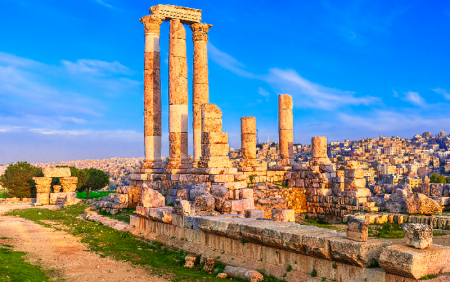
Jordan's capital and largest city, Amman spreads across a landscape of hills with a history reaching back nine millennia — from Neolithic settlement to Roman Philadelphia to modern Arab capital.
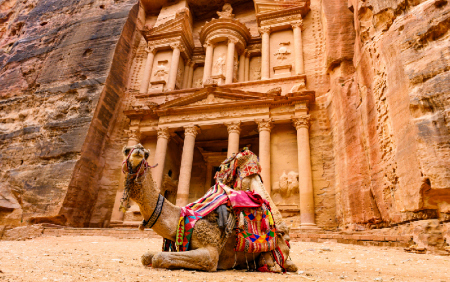
Petra is an ancient city carved into rose-red sandstone cliffs in southern Jordan, once the capital of the Nabataean civilisation and one of the most significant archaeological sites in the world — a UNESCO World Heritage Site and one of the New Seven Wonders of the World.
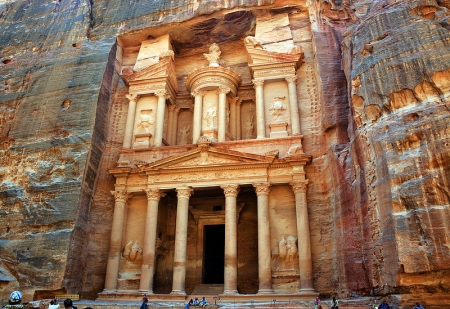
The Treasury (al-Khazneh) positioned opposite the main route into Petra. it was given by the local Bedouin tribes behind the belief that the urn on top of the front entrance contained the treasure of a pharaoh.
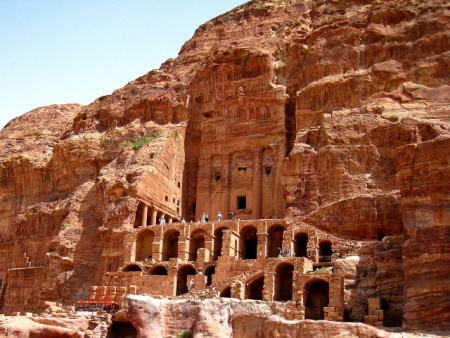
During any trip to Petra, you shouldn't miss the unpredictable Royal Tombs that took its name from the rich decoration. Know More!
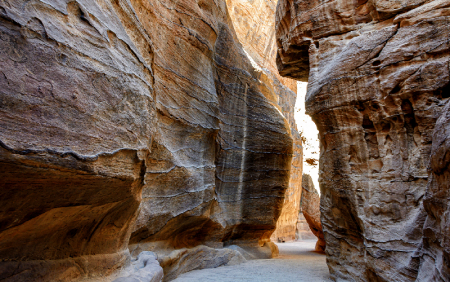
A 1.2-kilometre gorge with walls rising up to 180 metres, the Siq is Petra's main entrance — a natural rock fissure the Nabataeans turned into a processional way and a water system.
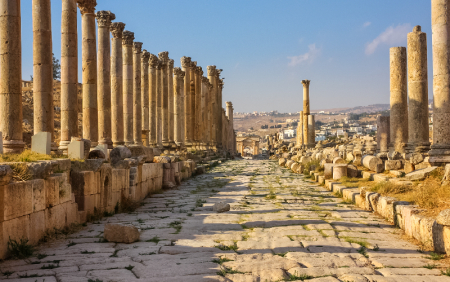
Jerash in northern Jordan is one of the best-preserved Roman cities outside Italy. A former member of the Decapolis league, it retains its colonnaded streets, temples, theatres and triumphal arches after nearly two thousand years.
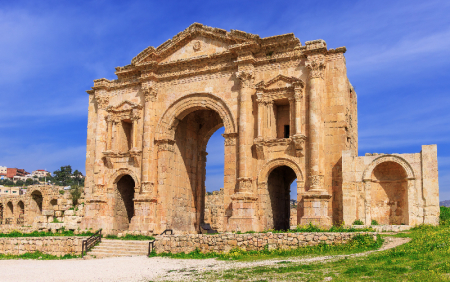
The monumental Roman gateway built to welcome Emperor Hadrian to ancient Gerasa in AD 129 — and still the most dramatic first sight in Jerash today.

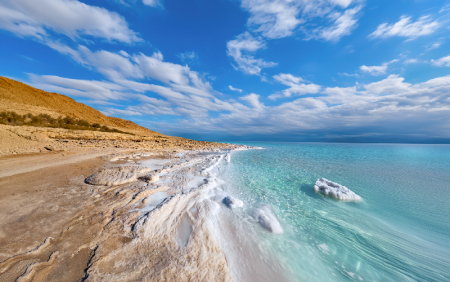
The Dead Sea is a hypersaline lake in the Jordan Rift Valley, sitting around 430 metres below sea level — the lowest point on Earth and one of the saltiest waters in the world. Its mineral-rich water and therapeutic mud have drawn health seekers for thousands of years.
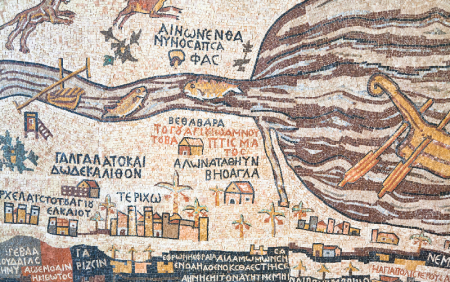
A sixth-century mosaic pavement in Madaba, Jordan, the Madaba Map is the oldest surviving cartographic image of the Holy Land — and the earliest detailed depiction of Jerusalem anywhere.
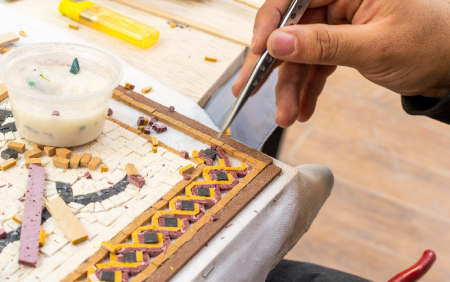
An ancient town on Jordan's King's Highway, Madaba holds the greatest concentration of Byzantine mosaics in the country — including the oldest surviving map of the Holy Land.
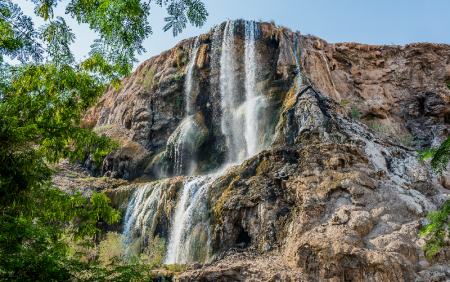
A chain of thermal waterfalls in a desert gorge below sea level, Ma'in Hot Springs has drawn bathers since antiquity — and appears on the sixth-century Madaba Map by name.
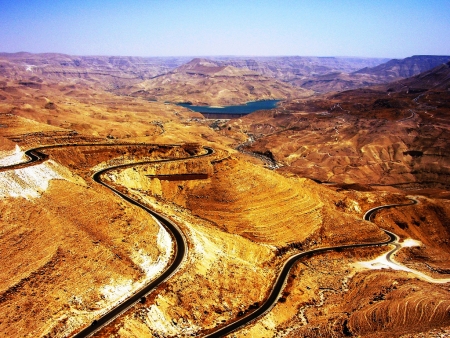
Mount Nebo is an elevated Mountain in Jordan, approximately 817 metres above sea level,.... Know More!
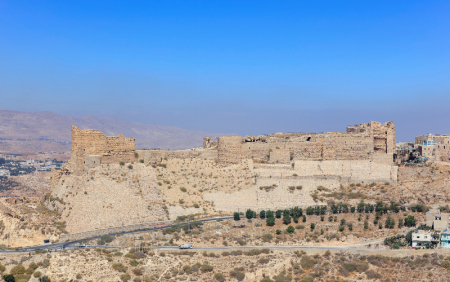
Built from the 1140s on a spur above the King's Highway, Kerak Castle is one of the largest Crusader fortresses in the Levant — and the setting for one of the strangest sieges in medieval history.
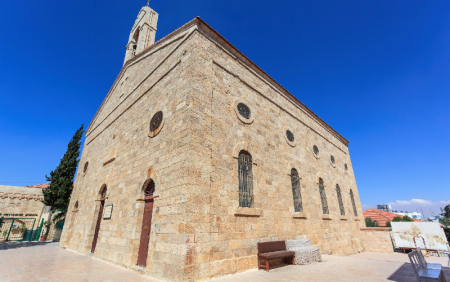
A working Greek Orthodox church in Madaba, Jordan, built in the 1890s over a Byzantine predecessor — and home to the sixth-century mosaic map of the Holy Land.

Mukawir (Machaerus) is an hour away and about 45 kms, away from Madaba on the Kings’ Highway. Know More !
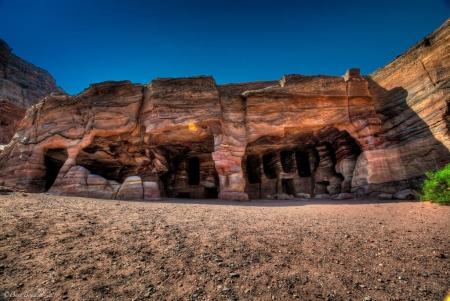
The Nabataeans (Nabateans) were an Arab people who lived in northern Arabia and the Southern Levant. They built the assumed capital city of Petra. Know more!
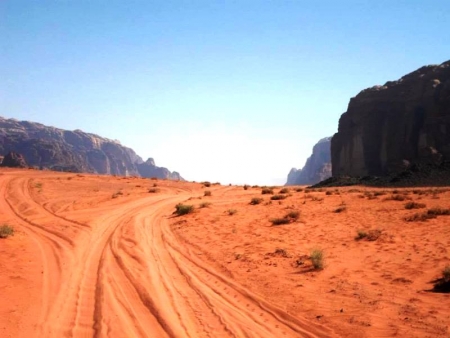
Lawrence of Arabia is a film directed by the global British director David Lean in 1962 and production of Sam Spiegel and starring Peter O'Toole role Lawrence.