Home
Home
You see it before you see anything else. Long before the columns, the oval plaza or the theatres come into view, a tall triple gateway rises out of the grass on the southern edge of the ruins — and that is the Arch of Hadrian, Jerash's opening statement. It was built to impress a visiting emperor almost 1,900 years ago, and it still does exactly the job it was designed to do.
Here's everything worth knowing before you walk through it.
What Is the Arch of Hadrian in Jerash?
The Arch of Hadrian in Jerash is a monumental Roman triumphal gateway built around AD 129–130 to honour the visit of Emperor Hadrian to the ancient city of Gerasa. It stands at the southern entrance to the archaeological site and is the first structure most visitors pass through.
The arch has three openings: one tall central archway flanked by two smaller side arches. Scholars believe it originally reached somewhere around 21 metres in height, which would have made it visible from a considerable distance across the valley. Today, after restoration work carried out in phases through the late twentieth century and completed in the mid-2000s, it stands as one of the best-preserved and most photographed monuments in Jordan.
You'll also see it called Hadrian's Arch, Jordan, the Triumphal Arch, or simply the South Gate arch — though that last name causes confusion, because the actual South Gate is a separate structure several hundred metres further north.
A few quick facts to anchor it in your mind:
- Where: Jerash, northern Jordan, roughly 48 km north of Amman
- Built: AD 129–130
- Built for: Emperor Hadrian's winter visit to Gerasa
- Style: Roman triumphal arch with local Nabataean-influenced detailing
- Openings: three (one central, two flanking)
- Position: around 460 metres south of the ancient city walls, standing alone
That last point is the strange one, and it turns out to be the most interesting thing about the whole monument. More on that shortly.
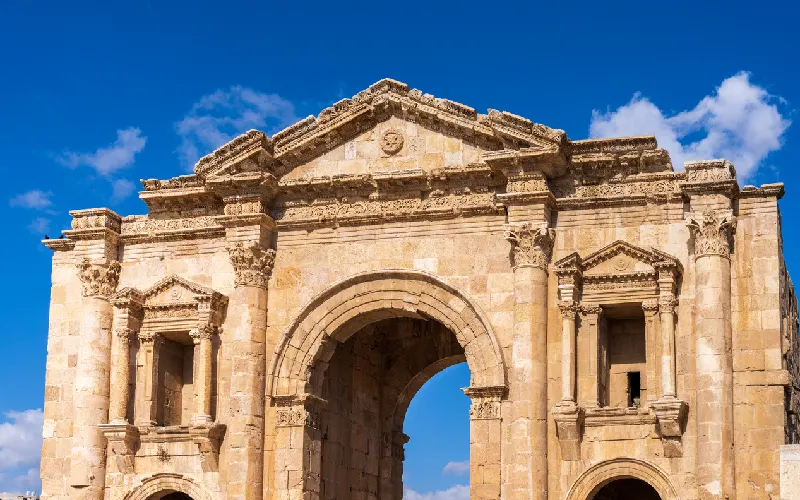
The Story Behind Hadrian's Arch: Why a City Built a Gate for an Emperor
Gerasa was one of the wealthiest cities of the Decapolis, the loose grouping of Greco-Roman cities scattered across what is now Jordan, Syria and the Palestinian territories. It grew rich on trade, olive oil and iron, and by the second century AD it had the money and the confidence to build on a serious scale.
Then came the news that Emperor Hadrian was touring the eastern provinces and would be spending the winter of AD 129–130 in the city.
For Gerasa, this was the ancient equivalent of a state visit combined with an investment summit. Hadrian was famously a builder — the man behind the wall across northern Britain, the rebuilt Pantheon, and an enormous villa at Tivoli. Cities that impressed him tended to do well afterwards. So Gerasa did what any ambitious Roman provincial city would do: it built him a gate.
The dedicatory inscription carved on the arch names Hadrian and dates the monument to his visit. The city council paid for it, and it was almost certainly finished in a hurry — a common feature of imperial visit architecture across the empire.
But the arch was never meant to stand alone. The plan appears to have been far more ambitious: extend the city walls southwards, absorb the arch into the new perimeter, and effectively double the size of Gerasa in the emperor's honour. New suburbs, a new southern quarter, a monumental approach road.
That expansion never happened. Funding, momentum or imperial attention ran out. And so the arch was left where it was — a grand front door to a city that never grew out to meet it. Walking the gap between the arch and the old South Gate today, you're crossing a Roman city that only ever existed on paper.
What to Look For: The Design Details Most Visitors Miss
Most people photograph the Arch of Hadrian, Jordan, and move on within five minutes. Slow down — the detailing here is genuinely unusual, and once you know what to look for, it's hard to unsee.
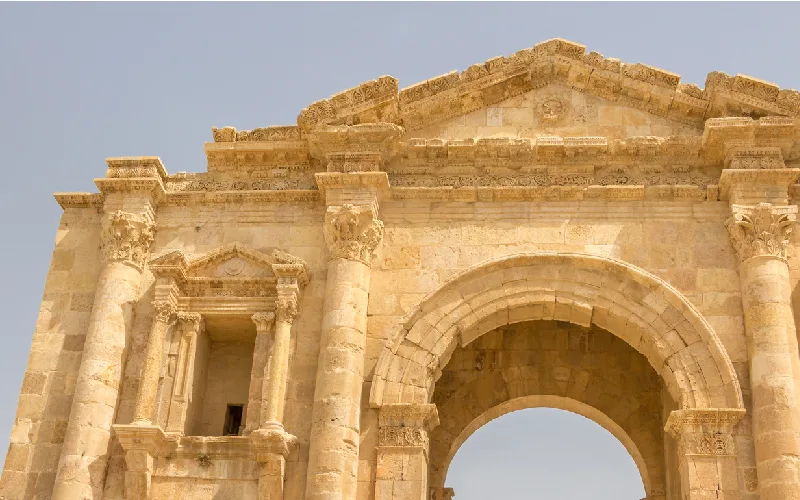
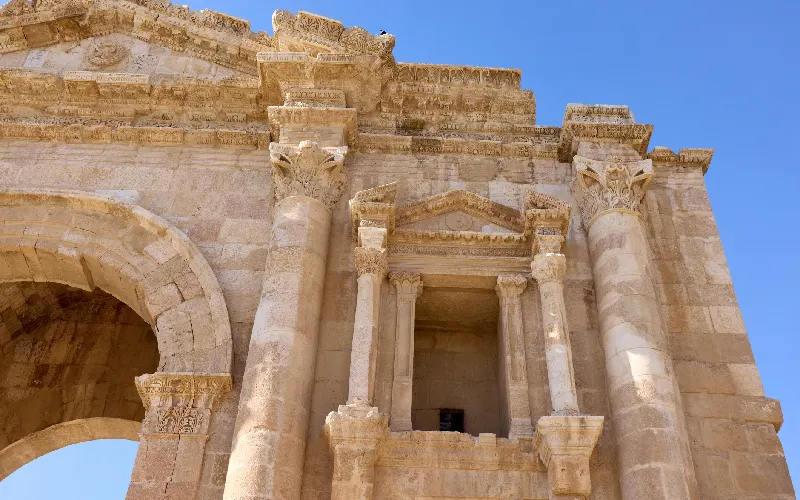
The acanthus leaf bases. Four engaged columns frame the archways. Look at the bottom of those columns rather than the top. Instead of a conventional Roman base, each column sits inside a carved wreath of acanthus leaves. This is the arch's signature quirk. Acanthus decoration normally belongs at the top of a Corinthian column, not the foot of it. The inversion is widely read as a Nabataean influence — a local architectural accent slipped into an otherwise thoroughly Roman monument. It's a small detail that tells you a lot about who was actually doing the carving.
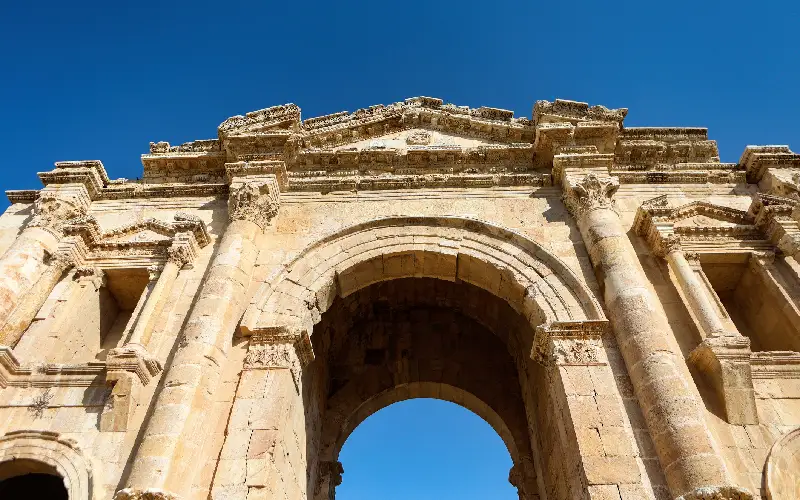
The central archway. The main opening rises roughly 11 metres. Stand directly underneath it, look up at the springing of the vault, and you get the clearest sense of the original scale.
The niches. Above each side arch sits a decorative niche, once likely holding statuary. The pedestals and framing survive; the statues do not.
The upper storey. What you see today is a partial reconstruction of a monument that originally carried a second level. Restorers rebuilt the surviving elements rather than inventing missing ones, so the arch reads as an honest ruin rather than a replica.
The interior chambers. The thick piers on either side contain small internal spaces, thought to have housed staircases giving access to the upper level.
The stone itself. Local limestone, honey-coloured, and it changes character dramatically through the day — pale and flat at noon, deeply golden in the last hour before sunset.
Customize Your Dream Vacation!
Get in touch with our local experts for an unforgettable journey.
Plan Your Trip
How to Visit the Arch of Hadrian Jerash: A Step-by-Step Guide
Here's a simple sequence that works for almost everyone, whether you're on a half-day trip from Amman or building Jerash into a longer northern Jordan loop.
Step 1 — Get to Jerash. The site sits about 48 km north of Amman, a drive of roughly 45 to 60 minutes on the main highway. Coming from the north, it's a comparable run down from Ajloun or Irbid. Public buses and shared taxis serve the town, but a private vehicle gives you far more control over your arrival time — which, as you'll see below, matters.
Step 2 — Arrive early. Gates typically open in the morning, earlier in summer than in winter. Arriving in the first hour of opening gives you the arch in soft light, empty of crowds, and at a temperature that makes the rest of the walk pleasant.
Step 3 — Start at the visitor centre. It sits close to the arch and gives you the site plan, orientation and the chronology of Gerasa. Five minutes here makes the next two hours make sense.
Step 4 — Approach the arch on foot, from the south. Don't cut around it. Walk straight at it from a distance so it grows in your field of view. That's the exact experience it was engineered to produce.
Step 5 — Walk through the central archway. Pause underneath. Look up, then look back through the opening at the landscape behind you.
Step 6 — Continue north towards the hippodrome. Just beyond the arch lies the ancient chariot-racing arena, one of the smaller hippodromes of the Roman world but remarkably intact, with surviving seating banks and starting gates.
Step 7 — Pass through the South Gate into the city proper. From here the site opens up: the Oval Plaza, the colonnaded Cardo Maximus, the temples and the theatres.
Step 8 — Loop back. Most visitors return the way they came, which means seeing the arch a second time in different light. Take a second set of photos — they're often better than the first.
Total walking time for the full site, unhurried, runs around two and a half to three hours. The arch itself deserves fifteen to twenty minutes.
Best Time to Visit and How to Photograph Hadrian's Arch
Best seasons. Spring (March to May) and autumn (September to November) are ideal. Spring brings wildflowers and green ground cover around the arch, which transforms the photographs. Autumn offers warm stone and clear air. Summer is hot and largely shadeless — go at opening time or late afternoon. Winter is quiet and atmospheric, but bring layers and expect the occasional rain.
Best hours. The first hour after opening and the final ninety minutes before closing. Midday light flattens the carving and washes out the limestone.
Photography tips, in order of usefulness:
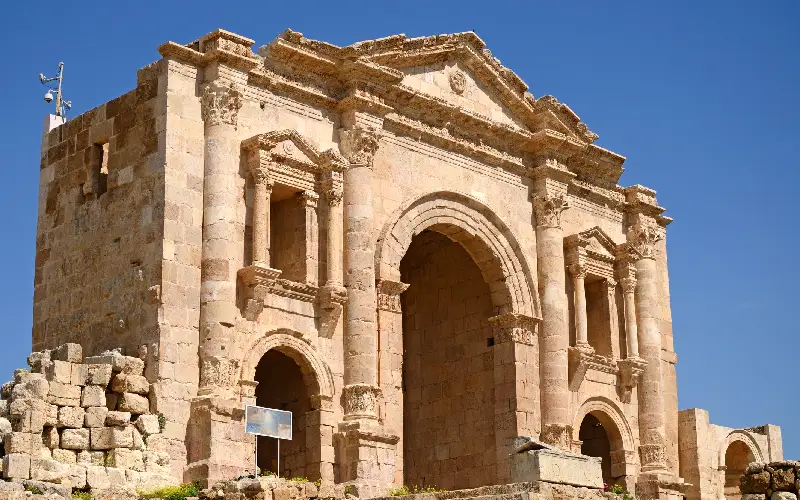
- Shoot from the south, low and wide. Get close to the base and angle up to exaggerate the height.
- Use the side arches as frames. Position a person or a distant column inside one of the smaller openings for scale and depth.
- Include a person. Nothing conveys the height of the arch like a human figure at the base of it.
- Come back at golden hour. Late light rakes across the acanthus carving and pulls out detail invisible at noon.
- Try a straight-on symmetrical composition, then break it deliberately with an off-centre angle. The arch works both ways.
A practical note on comfort: the ground between the arch and the city gate is uneven, and much of the site beyond is original Roman paving — beautiful, but slippery when polished by two millennia of foot traffic. Closed shoes with grip make a real difference. Bring water, a hat and sun protection in any season. Shade is scarce across most of the site.
What to See Beyond the Arch: Walking Deeper into Ancient Jerash
The arch is the overture, not the opera. Jerash is one of the largest and best-preserved Roman provincial cities anywhere, and the walk north from Hadrian's Arch delivers highlight after highlight.
The Hippodrome — immediately north of the arch. Once holding several thousand spectators for chariot races, its seating tiers and starting gates survive clearly enough that the layout reads instantly.
The South Gate — the actual entrance through the ancient walls, echoing the arch's decorative vocabulary at smaller scale.
The Oval Plaza — the single most striking space in Jerash. A vast asymmetrical piazza ringed by an unbroken colonnade, unusual in the Roman world for its shape. Photographed from the hill above, it's the image most associated with Jordan's Roman heritage.
The Cardo Maximus — the colonnaded main street running the length of the city, still bearing the ruts cut by cartwheels and the manhole covers of the Roman drainage system beneath.
The Temple of Artemis — dedicated to the patron goddess of Gerasa, approached by a monumental stairway. Its surviving columns are engineered to sway almost imperceptibly in the wind, a phenomenon guides love to demonstrate with a spoon or a fingertip.
The South Theatre — a well-preserved performance space with famously precise acoustics. Stand at the centre of the orchestra floor and speak normally; you'll hear yourself carried to the top row.
The Nymphaeum — an ornamental public fountain along the Cardo, once faced in marble and fed by the city's aqueduct.
The Byzantine churches — a cluster of later structures with surviving mosaic floors, evidence of the city's continuation long after Rome's grip loosened.
Add Jerash to a day that includes Ajloun Castle to the west, and you get Roman and Islamic-era Jordan in a single loop from Amman.
It dates to around AD 129–130, making it roughly 1,900 years old. It was constructed to mark Emperor Hadrian's stay in Gerasa during his tour of the eastern Roman provinces.
No — they're three separate monuments honouring the same emperor in three different cities. Hadrian was widely commemorated across the empire, so several arches carry his name. The Jerash arch is distinguished by its triple opening and its unusual acanthus-wreathed column bases.
Because Gerasa planned to expand southwards and never did. The arch was positioned to become the gateway of an enlarged city, with new walls eventually joining it. That expansion was abandoned, leaving the arch isolated roughly 460 metres beyond the existing walls.
Plan on two and a half to three hours to walk the site properly, plus travel time from Amman of about an hour each way. If you want to linger at the theatres or explore the Byzantine churches, half a day is more comfortable.
The arch itself sits on relatively level ground near the entrance and is reachable without difficulty. The wider site is harder — uneven ancient paving, steps and gradients feature throughout, particularly on the approach to the Temple of Artemis. Visitors with mobility limitations can still experience the arch, hippodrome and South Gate area comfortably, then choose how far north to continue.
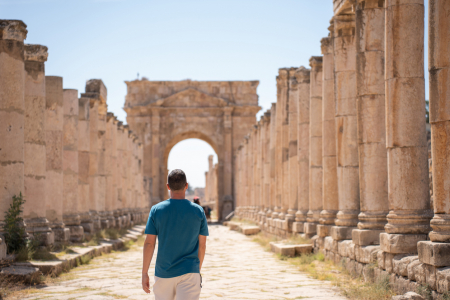


Learn about Jordan attractions, ancient history, and local traditions. Find must-visit places and start planning your unforgettable experience today.
Jordan's capital and largest city, Amman spreads across a landscape of hills with a history reaching back nine millennia — from Neolithic settlement to Roman Philadelphia to modern Arab capital.
Petra is an ancient city carved into rose-red sandstone cliffs in southern Jordan, once the capital of the Nabataean civilisation and one of the most significant archaeological sites in the world — a UNESCO World Heritage Site and one of the New Seven Wonders of the World.
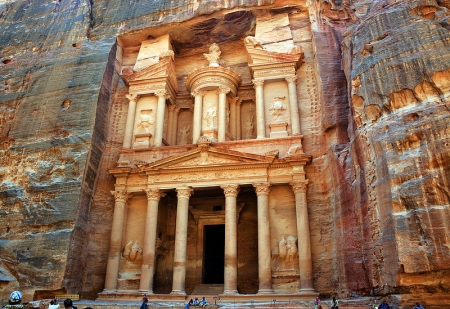
The Treasury (al-Khazneh) positioned opposite the main route into Petra. it was given by the local Bedouin tribes behind the belief that the urn on top of the front entrance contained the treasure of a pharaoh.
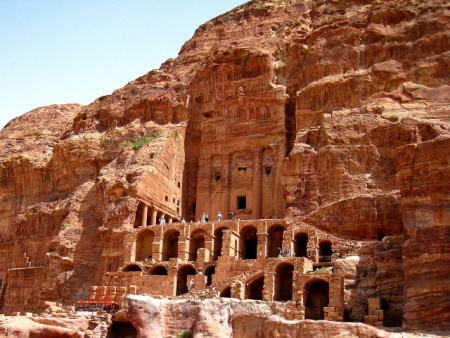
During any trip to Petra, you shouldn't miss the unpredictable Royal Tombs that took its name from the rich decoration. Know More!
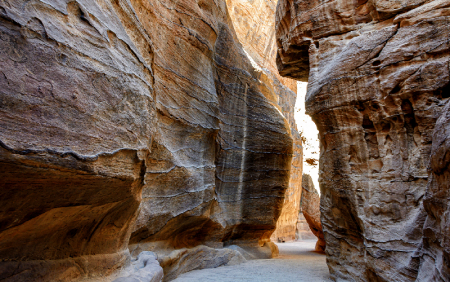
A 1.2-kilometre gorge with walls rising up to 180 metres, the Siq is Petra's main entrance — a natural rock fissure the Nabataeans turned into a processional way and a water system.
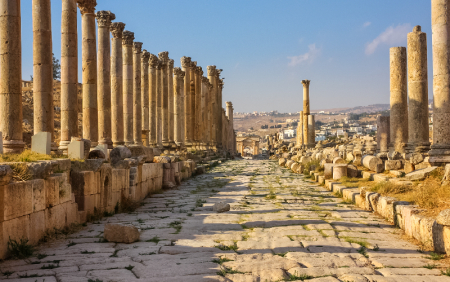
Jerash in northern Jordan is one of the best-preserved Roman cities outside Italy. A former member of the Decapolis league, it retains its colonnaded streets, temples, theatres and triumphal arches after nearly two thousand years.
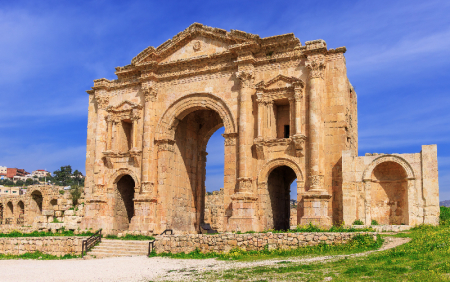
The monumental Roman gateway built to welcome Emperor Hadrian to ancient Gerasa in AD 129 — and still the most dramatic first sight in Jerash today.
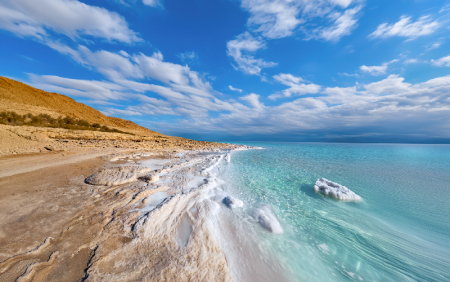
The Dead Sea is a hypersaline lake in the Jordan Rift Valley, sitting around 430 metres below sea level — the lowest point on Earth and one of the saltiest waters in the world. Its mineral-rich water and therapeutic mud have drawn health seekers for thousands of years.
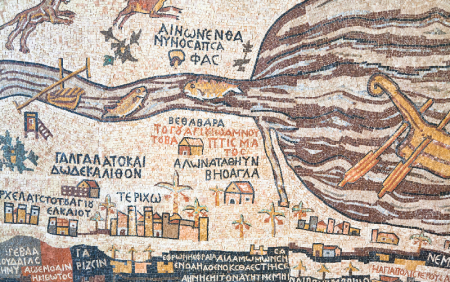
A sixth-century mosaic pavement in Madaba, Jordan, the Madaba Map is the oldest surviving cartographic image of the Holy Land — and the earliest detailed depiction of Jerusalem anywhere.
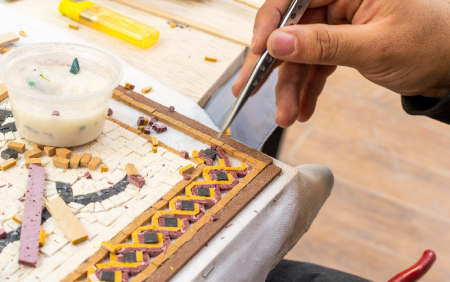
An ancient town on Jordan's King's Highway, Madaba holds the greatest concentration of Byzantine mosaics in the country — including the oldest surviving map of the Holy Land.
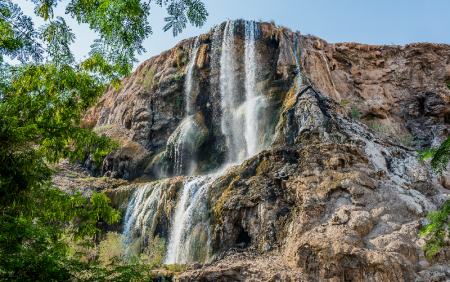
A chain of thermal waterfalls in a desert gorge below sea level, Ma'in Hot Springs has drawn bathers since antiquity — and appears on the sixth-century Madaba Map by name.
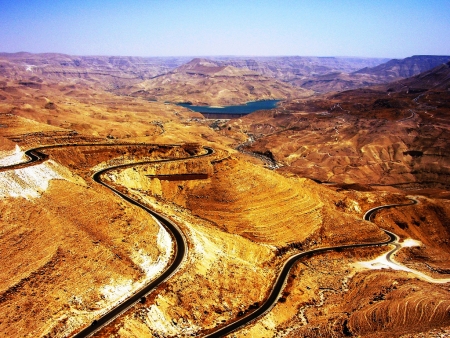
Mount Nebo is an elevated Mountain in Jordan, approximately 817 metres above sea level,.... Know More!
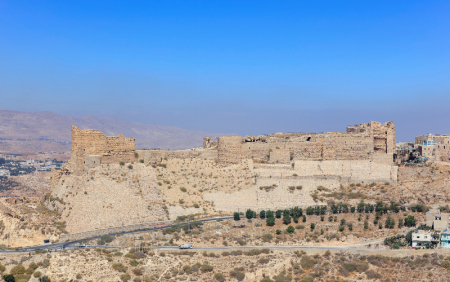
Built from the 1140s on a spur above the King's Highway, Kerak Castle is one of the largest Crusader fortresses in the Levant — and the setting for one of the strangest sieges in medieval history.
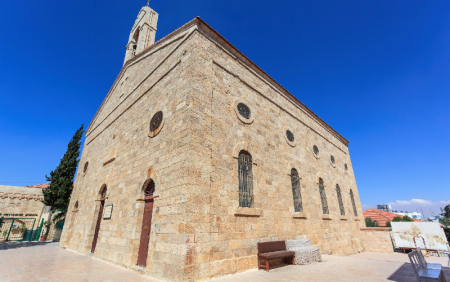
A working Greek Orthodox church in Madaba, Jordan, built in the 1890s over a Byzantine predecessor — and home to the sixth-century mosaic map of the Holy Land.

Mukawir (Machaerus) is an hour away and about 45 kms, away from Madaba on the Kings’ Highway. Know More !
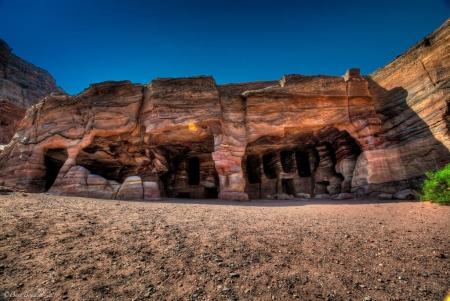
The Nabataeans (Nabateans) were an Arab people who lived in northern Arabia and the Southern Levant. They built the assumed capital city of Petra. Know more!
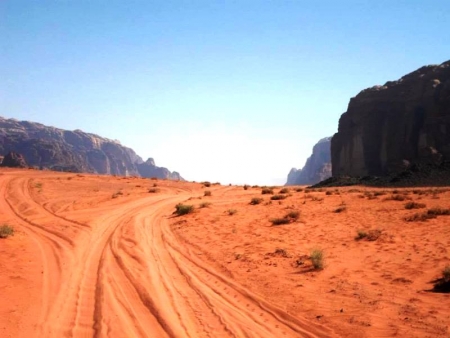
Lawrence of Arabia is a film directed by the global British director David Lean in 1962 and production of Sam Spiegel and starring Peter O'Toole role Lawrence.