Home
Home
Jerash is an ancient archaeological city located in the Gilead highlands of northern Jordan, approximately 48 kilometres north of the capital Amman. Known in antiquity as Gerasa, it ranks among the best-preserved examples of Roman provincial urban planning in the entire world, preserving an extraordinary collection of temples, colonnaded streets, theatres, public baths, triumphal arches, and civic plazas within an archaeological zone of exceptional completeness and historical depth.
The ancient city of Jerash Jordan sits alongside the modern town of the same name, separated by a stretch of ancient city walls that mark the boundary between two thousand years of continuous human settlement. While the modern town functions as the administrative centre of Jerash Governorate, the ancient ruins constitute one of the Middle East's most significant archaeological sites and Jordan's second most visited tourist destination after Petra.
The Historical Origins of Jerash
The earliest evidence of human settlement at the site of Jerash dates to the Neolithic period, indicating continuous occupation of this fertile highland location for thousands of years before the city achieved its greatest prominence. The site's position within a well-watered agricultural valley, fed by the Chrysorhoas River — known today as Wadi Jerash — provided the natural resources necessary to support permanent settlement across successive civilisations.
The city's recorded history begins with the Hellenistic period, when the region came under the influence of Alexander the Great following his conquest of the Persian Empire in the fourth century BCE. The settlement developed significantly under the Ptolemaic and Seleucid dynasties that succeeded Alexander's empire, acquiring the Greek name Antioch on the Chrysorhoas during the Seleucid period, reflecting its status as a planned Hellenistic urban centre.
The transformation of Gerasa into one of the ancient world's most architecturally accomplished cities began in earnest following the Roman general Pompey's reorganisation of the eastern Mediterranean in 63 BCE. The incorporation of the city into the Roman province of Syria, and subsequently into the league of cities known as the Decapolis, provided the political stability, economic connectivity, and administrative resources that enabled the extraordinary building programme visible in the Jerash Roman ruins today.
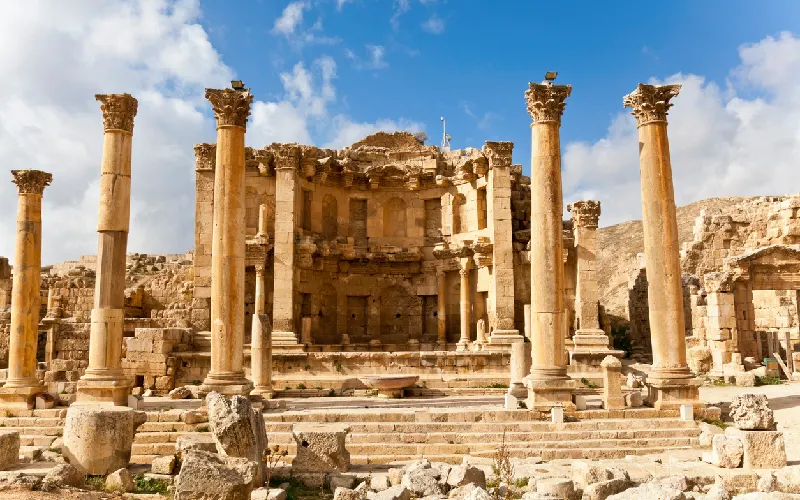
Human settlement at the site of Jerash dates to the Neolithic period, making the location continuously occupied for thousands of years. The city achieved its greatest architectural development during the Roman period, roughly from the first through the third centuries CE, though its recorded urban history begins with the Hellenistic period in the fourth century BCE.
Jerash and the Roman Decapolis
The Decapolis was a loose confederation of ten Greco-Roman cities in the eastern Mediterranean, linked by shared cultural traditions, commercial relationships, and political alignment with Rome rather than by formal political union. Gerasa was among the most prosperous and architecturally significant members of this grouping, which also included Philadelphia — modern Amman — Damascus, Gadara, and Scythopolis.
Membership of the Decapolis provided Gerasa with access to the broader economic networks of the Roman Empire and the cultural prestige associated with Greco-Roman urban civilisation. The city's position along important trade routes connecting Arabia with the Mediterranean world generated substantial commercial wealth that financed successive phases of monumental construction throughout the first and second centuries CE.
The reign of Emperor Hadrian, who visited Gerasa in 129 CE, marked a particular high point in the city's development. The triumphal arch constructed at the city's southern entrance to commemorate his visit — now known as Hadrian's Arch — remains one of the most impressive surviving monuments at Jerash and one of the finest examples of Roman triumphal architecture in the Near East.
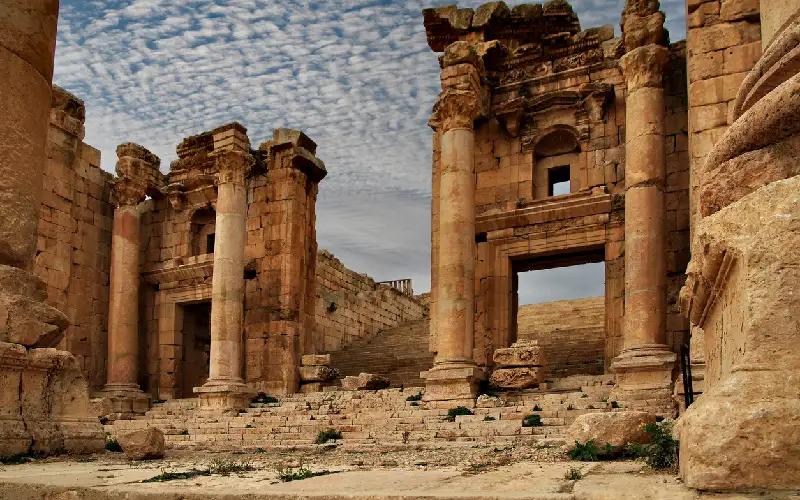
The Decapolis was a grouping of ten Greco-Roman cities in the eastern Mediterranean sharing cultural, commercial, and political ties with Rome. Jerash — ancient Gerasa — was among its most prominent members due to its prosperity, strategic location along Arabian trade routes, and ambitious programme of monumental architecture that reflected the city's wealth and Roman cultural identity.
Customize Your Dream Vacation!
Get in touch with our local experts for an unforgettable journey.
Plan Your Trip
The Architecture and Urban Planning of Roman Gerasa
The Jerash Roman ruins preserve what is widely regarded as the most complete example of Roman provincial urban planning surviving anywhere in the world outside Italy. The city's layout follows the standard Roman grid system of intersecting main streets — the cardo maximus running north to south and the decumanus running east to west — overlaid onto a landscape that required considerable engineering ingenuity to accommodate.
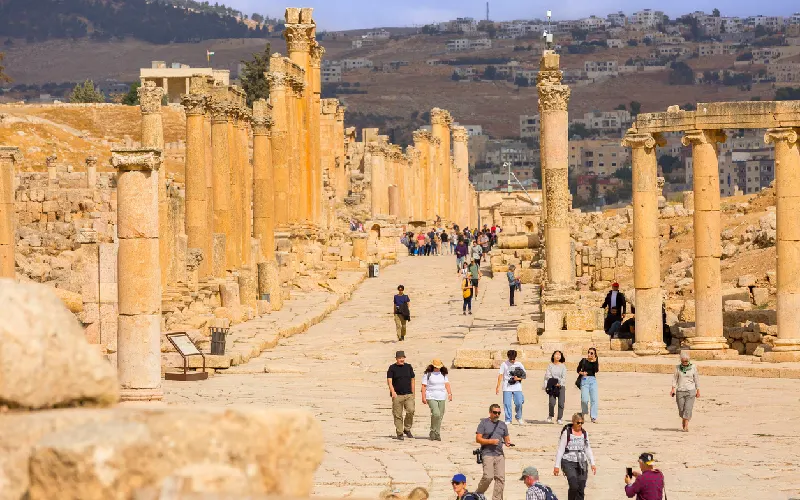
The cardo maximus of Jerash is particularly remarkable for its preservation, stretching for approximately 800 metres through the heart of the ancient city and still paved with the original Roman stone slabs, bearing the wheel ruts of ancient vehicles. The street is flanked by hundreds of columns — most still standing — that once supported covered colonnades providing shade and shelter for the commercial and civic activity that animated this central artery of urban life.
The Oval Plaza, or Forum, at the southern end of the cardo represents one of the most architecturally unusual spaces in the Roman world. Its distinctive elliptical shape — unique among known Roman forums — is surrounded by a colonnade of 56 Ionic columns and connected to both the cardo and the Temple of Zeus, creating a transitional civic space of considerable visual drama. The precise reasoning behind the elliptical design remains a subject of scholarly discussion, with proposed explanations ranging from practical topographic constraints to deliberate architectural symbolism.
The city's two theatres — the larger South Theatre and the smaller North Theatre — are among the best-preserved Roman performance venues in the Near East. The South Theatre, with a seating capacity of approximately 3,000 spectators, retains much of its original seating and stage architecture and remains acoustically functional, hosting the annual Jerash Festival of Culture and Arts.
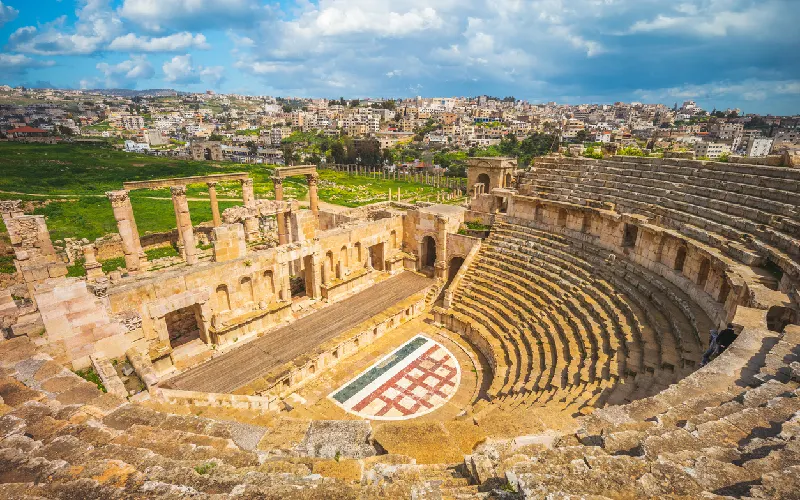
Several factors contributed to the exceptional preservation of the Jerash Roman ruins. The city was gradually abandoned following the decline of trade routes and a series of destructive earthquakes, causing it to be buried rather than systematically dismantled for building materials as happened at many other ancient sites. Its rediscovery in the nineteenth century prompted early archaeological attention, and systematic excavation and conservation work has continued across the twentieth and twenty-first centuries.
The Major Monuments of Jerash Jordan
Hadrian's Arch Constructed in 129 CE to commemorate the visit of Emperor Hadrian, this triumphal arch stands at the southern entrance to the ancient city and originally marked a planned but never completed extension of the urban boundary. Rising to a height of approximately 21 metres, it features three passageways flanked by engaged columns and preserves much of its original decorative stonework.
The Temple of Artemis Dedicated to Artemis, the patron goddess of Gerasa, this temple represents the grandest religious monument in the ancient city. Approached via a monumental staircase and propylaea from the cardo, it occupies a dominant hilltop position commanding views across the entire urban area. Eleven of its original columns remain standing, their capitals exhibiting the subtle engineering refinement of slightly loose stones that cause them to sway perceptibly in strong wind — a feature that has long fascinated visitors and engineers alike.
The Temple of Zeus The Temple of Zeus occupies a prominent position overlooking the Oval Plaza and represents one of the earliest major Roman religious buildings at Gerasa, with origins in the first century CE. Its elevated position and association with the king of the Olympian gods reflect its primacy within the city's religious topography.
The Nymphaeum The Nymphaeum is an ornamental public fountain dedicated to the nymphs, positioned along the cardo between the two main temple complexes. Its elaborately decorated two-storey facade, originally faced with coloured marble and decorated with sculptural elements, exemplifies the Roman tradition of transforming functional civic infrastructure into monumental architectural displays.
The Byzantine Churches The transformation of Gerasa into a Christian city during the Byzantine period produced an extraordinary concentration of church architecture within the ancient urban fabric. More than a dozen Byzantine churches have been identified at Jerash, several preserving remarkable mosaic floor pavements that rank among the finest examples of Byzantine decorative art in Jordan. The Cathedral, the Church of St Theodore, and the interconnected churches of SS Cosmas and Damian, St John, and St George are among the most significant.
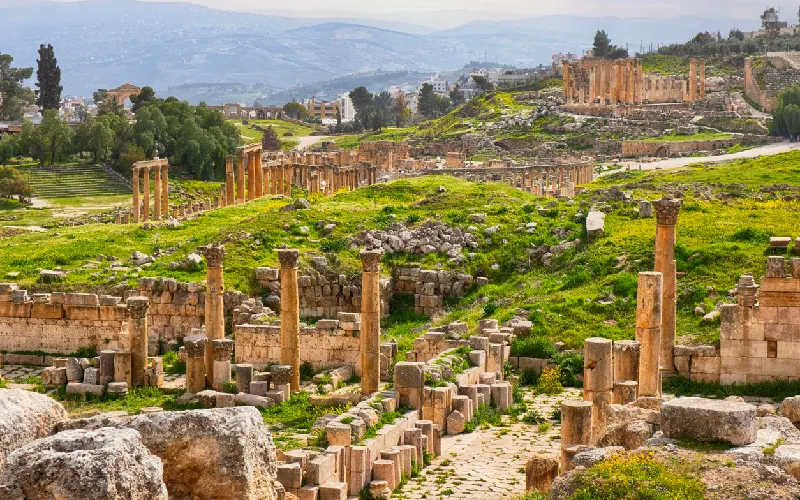
The Decline and Rediscovery of Gerasa
The prosperity of Roman Gerasa began to decline from the third century CE onward, as shifting trade patterns, economic difficulties across the Roman Empire, and political instability reduced the city's commercial importance. The catastrophic earthquake of 749 CE caused widespread structural damage throughout the settlement and effectively ended the city's urban continuity as a major inhabited centre, though limited occupation continued into the medieval Islamic period.
The ruins remained largely buried and forgotten by the outside world until the early nineteenth century, when European travellers and scholars began documenting the site. The German orientalist Ulrich Jasper Seetzen visited in 1806, followed by subsequent European expeditions that recognised the exceptional significance of what lay beneath the accumulated soil of centuries. Systematic archaeological excavation began in the early twentieth century and has continued with increasing sophistication to the present day, progressively revealing the full extent and complexity of the ancient urban landscape.
Jerash in the Modern Context
Today Jerash Jordan functions as one of the most significant archaeological tourism destinations in the Middle East, receiving hundreds of thousands of visitors annually from across the world. The site is managed by the Jordanian Department of Antiquities, which oversees ongoing excavation, conservation, and visitor management across the extensive archaeological zone.
The annual Jerash Festival of Culture and Arts, established in 1981, uses the ancient city's monuments as the backdrop for performances of music, dance, theatre, and poetry from Jordan and the wider Arab world. Held during summer months within the South Theatre and other ancient venues, the festival has become one of the most prestigious cultural events in the region and demonstrates the continuing vitality of Jerash as a living cultural space rather than merely a preserved historical site.
Archaeological research at Jerash continues to produce significant discoveries, with ongoing excavations revealing new information about the city's Hellenistic origins, domestic architecture, economic organisation, and post-Roman occupation. The site represents one of the most intensively studied archaeological landscapes in the Near East and continues to contribute substantially to scholarly understanding of Roman provincial urbanism and the cultural history of the ancient Levant.
erash is located in the Gilead highlands of northern Jordan, approximately 48 kilometres north of Amman. It is the administrative centre of Jerash Governorate and is easily accessible from the capital by road, making it one of the most convenient day trip destinations from Amman for visitors to Jordan.
The Jerash Festival of Culture and Arts is an annual summer cultural event held within the ancient city, using monuments including the South Theatre as performance venues. Established in 1981, it features music, dance, theatre, and poetry from Jordan and the wider Arab world and is considered one of the most prestigious cultural festivals in the Middle East.
Jerash and Petra represent very different but complementary experiences of Jordan's ancient heritage. Petra is the capital of the Nabataean civilisation — a rock-cut desert city of extraordinary visual drama. Jerash preserves the most complete Roman provincial city in the Near East, with colonnaded streets, temples, and theatres that together create an unparalleled picture of Roman urban life. Jerash is generally considered Jordan's second most visited archaeological site after Petra.
Emperor Hadrian's visit to Gerasa in 129 CE is the most celebrated historical association, commemorated by the triumphal arch that still bears his name. The city also appears in early Christian records and was the seat of a Byzantine bishop, reflecting its continued importance through late antiquity.
The main colonnaded street and Oval Plaza of Jerash are relatively accessible, with broad paved surfaces suitable for most visitors. However, the Temple of Artemis, the South Theatre, and several other monuments involve significant stair climbing on ancient stone steps. Visitors with limited mobility can still experience a substantial portion of the site from the main civic areas without ascending to the hilltop temple complexes.


Learn about Jordan attractions, ancient history, and local traditions. Find must-visit places and start planning your unforgettable experience today.
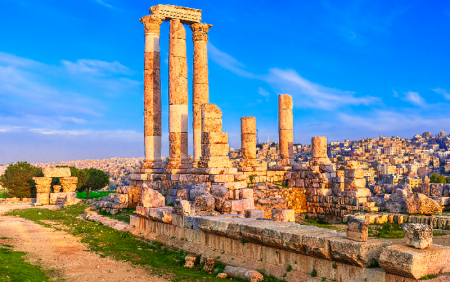
Jordan's capital and largest city, Amman spreads across a landscape of hills with a history reaching back nine millennia — from Neolithic settlement to Roman Philadelphia to modern Arab capital.
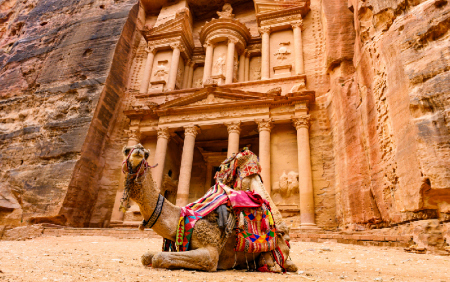
Petra is an ancient city carved into rose-red sandstone cliffs in southern Jordan, once the capital of the Nabataean civilisation and one of the most significant archaeological sites in the world — a UNESCO World Heritage Site and one of the New Seven Wonders of the World.
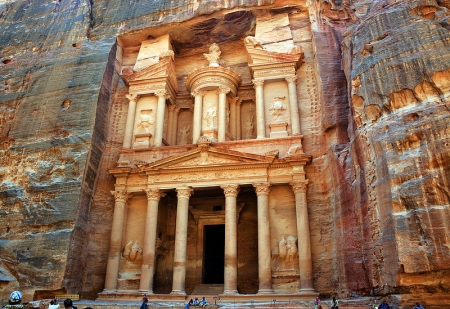
The Treasury (al-Khazneh) positioned opposite the main route into Petra. it was given by the local Bedouin tribes behind the belief that the urn on top of the front entrance contained the treasure of a pharaoh.
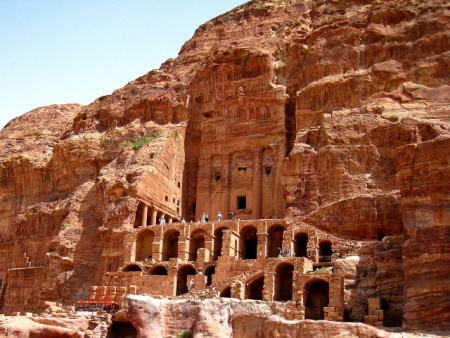
During any trip to Petra, you shouldn't miss the unpredictable Royal Tombs that took its name from the rich decoration. Know More!
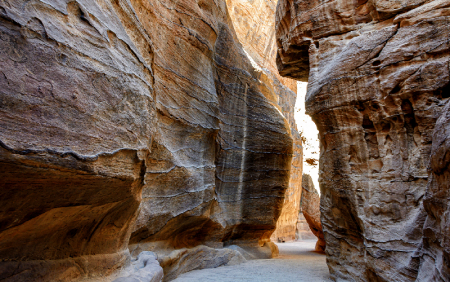
A 1.2-kilometre gorge with walls rising up to 180 metres, the Siq is Petra's main entrance — a natural rock fissure the Nabataeans turned into a processional way and a water system.
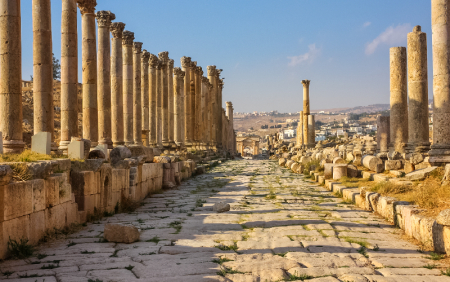
Jerash in northern Jordan is one of the best-preserved Roman cities outside Italy. A former member of the Decapolis league, it retains its colonnaded streets, temples, theatres and triumphal arches after nearly two thousand years.
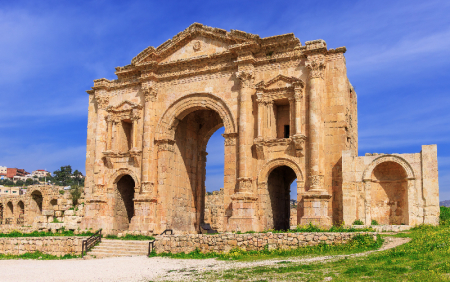
The monumental Roman gateway built to welcome Emperor Hadrian to ancient Gerasa in AD 129 — and still the most dramatic first sight in Jerash today.
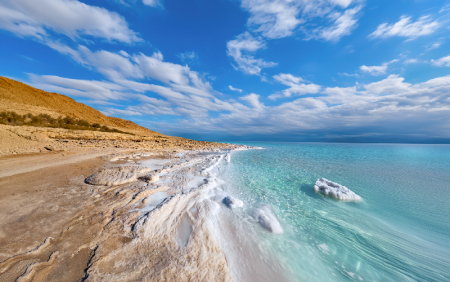
The Dead Sea is a hypersaline lake in the Jordan Rift Valley, sitting around 430 metres below sea level — the lowest point on Earth and one of the saltiest waters in the world. Its mineral-rich water and therapeutic mud have drawn health seekers for thousands of years.
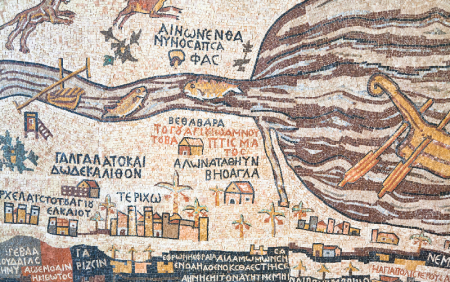
A sixth-century mosaic pavement in Madaba, Jordan, the Madaba Map is the oldest surviving cartographic image of the Holy Land — and the earliest detailed depiction of Jerusalem anywhere.
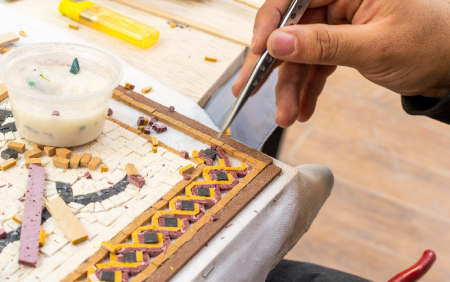
An ancient town on Jordan's King's Highway, Madaba holds the greatest concentration of Byzantine mosaics in the country — including the oldest surviving map of the Holy Land.
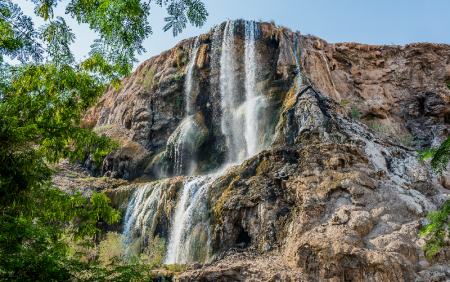
A chain of thermal waterfalls in a desert gorge below sea level, Ma'in Hot Springs has drawn bathers since antiquity — and appears on the sixth-century Madaba Map by name.
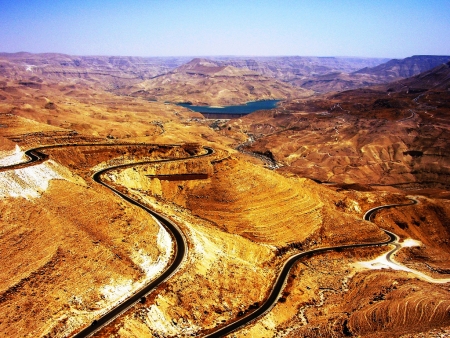
Mount Nebo is an elevated Mountain in Jordan, approximately 817 metres above sea level,.... Know More!
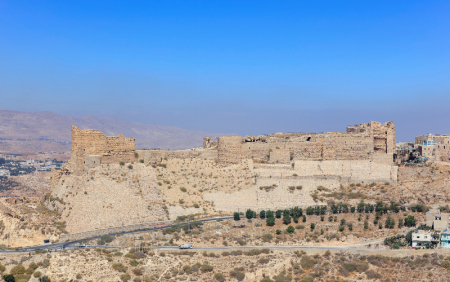
Built from the 1140s on a spur above the King's Highway, Kerak Castle is one of the largest Crusader fortresses in the Levant — and the setting for one of the strangest sieges in medieval history.
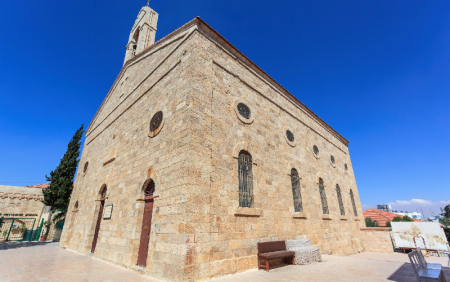
A working Greek Orthodox church in Madaba, Jordan, built in the 1890s over a Byzantine predecessor — and home to the sixth-century mosaic map of the Holy Land.

Mukawir (Machaerus) is an hour away and about 45 kms, away from Madaba on the Kings’ Highway. Know More !
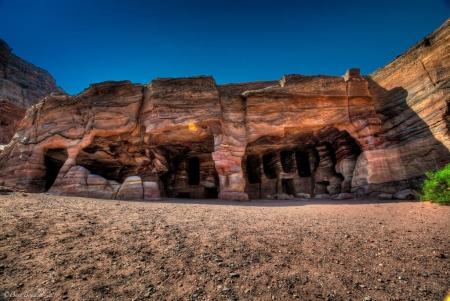
The Nabataeans (Nabateans) were an Arab people who lived in northern Arabia and the Southern Levant. They built the assumed capital city of Petra. Know more!
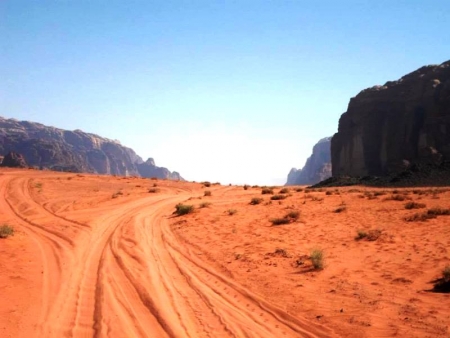
Lawrence of Arabia is a film directed by the global British director David Lean in 1962 and production of Sam Spiegel and starring Peter O'Toole role Lawrence.