Home
Home
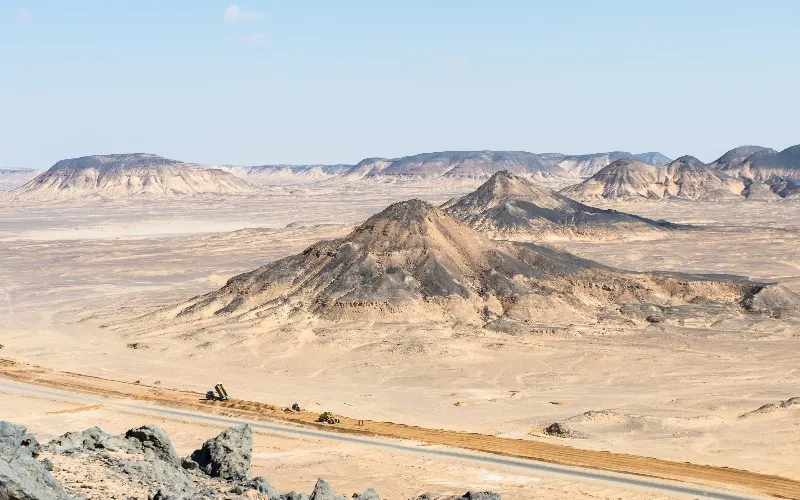
The Black Desert in Egypt captivates visitors with its surreal landscape of volcano-shaped mounds spread across approximately 30 km (19 mi) in the western region of the country. Characterized by its distinctive dark appearance, this geological wonder stands in stark contrast to the surrounding golden sands. The unique coloration comes primarily from basalt sills that cap most of the mounds, giving them their characteristic black hue.
Indeed, these impressive formations vary significantly in size, composition, and shape, with some reaching heights of up to 100 meters (328 feet). While some mounds display the dark tones of iron quartzite, others reveal more reddish hues due to their iron sandstone surface rocks. Located about five hours from Cairo, the Black Desert begins approximately 50km south of Bawiti, where the desert floor dramatically shifts from beige to black. At the desert's periphery, volcanic hills provide evidence of dark volcanic dolerite eruptions dating back to the Jurassic period, some 180 million years ago.
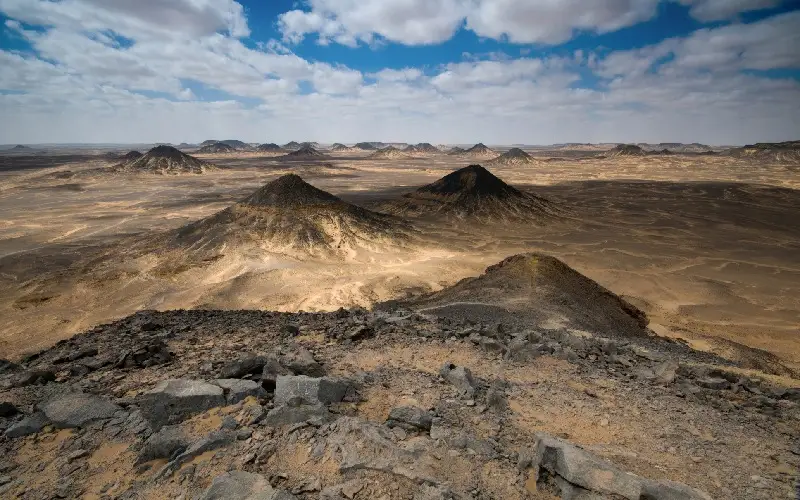
The Black Desert is a unique geological formation in western Egypt, characterized by volcano-shaped mounds spread across approximately 30 km. It gets its name from the dark appearance of these mounds, which are capped by basalt sills resulting from ancient volcanic activity.
Geological Origins of the Black Desert
The geological story of the Black Desert began approximately 180 million years ago during the early Jurassic period. Initially, this region emerged from a prehistoric sea through tectonic uplift. The underlying structure rests upon a Precambrian basement complex forming the northern extension of the African Shield, consisting primarily of granitic and gneissic rocks dating back over 600 million years.
Formation during the Jurassic period
During the Mesozoic era, particularly the Jurassic to Early Cretaceous period (around 180-140 million years ago), the area experienced extensional tectonics associated with the initial rifting of the proto-Tethys Ocean. This tectonic phase created structural highs and basins through normal faulting, allowing for the deposition of thick sedimentary sequences. The process included the widespread formation of Nubian Sandstone, a continental to shallow-marine sandstone layer that blanketed the basement across the broader Western Desert.
Role of volcanic activity and basalt sills
The most defining geological event for the Black Desert's unique appearance occurred through volcanic activity millions of years ago. Ancient volcanic cones erupted, spewing basalt and dark volcanic dolerite across the landscape. These eruptions spread black ash and molten lava over vast areas, covering hills and sand with a dark, ashen appearance.
Furthermore, the region contains dome-shaped volcanic mounds distributed along approximately 30 kilometers of desert. Most of these mounds are capped by basalt sills that give the desert its characteristic black color. The scattered volcanic hills are remnants of these eruptions, creating what some observers compare to a landscape filled with volcanoes. One notable formation is Al-Marsous Mountain, a crater-like structure with basaltic pillars.
Iron sandstone and quartzite variations
The mounds throughout the Black Desert display considerable variation in composition. Some are primarily dark, consisting of iron quartzite, while others exhibit more reddish coloration where the surface rocks consist of iron sandstone. These ferruginous sandstones can reach an average iron content of 20 weight percent.
Additionally, weathering processes have significantly shaped the composition and distribution of these rocks. The breakdown of dolerite and basalt into fine black powder and coarse pebbles occurs through deflationary erosion, which removes finer particles. This process leaves behind a lag deposit—a veneer of dark, armored pebbles and powder that enhances the desert's distinctive monochromatic appearance. The contrast between the golden sands and the black volcanic stones creates a dramatic visual effect across the landscape. Experience these extraordinary volcanic formations and breathtaking desert landscapes on an unforgettable Egypt Desert Tour, where millions of years of geological history come to life in one of the country's most spectacular natural wonders.
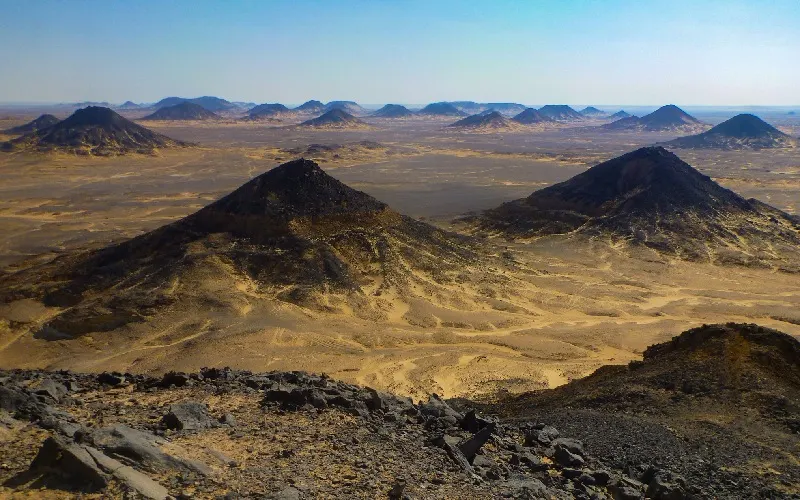
The Black Desert's geological origins date back to the Jurassic period, approximately 180 million years ago. It was formed through a combination of tectonic uplift, volcanic activity, and the deposition of basalt and dark volcanic dolerite across the landscape.
Fossils and Ancient Life in the Region
Remarkable fossil discoveries throughout the Black Desert region provide a window into a dramatically different ecological past. Paleontological evidence suggests this now-barren landscape once supported diverse plant and animal communities, creating a stark contrast to its current appearance.
Discovery of fossilized woodlands
Scattered across the Black Desert, researchers have uncovered several fossilized woodland sites that stand as silent testimony to a greener past. These petrified remains indicate that substantial forests once thrived in what is now an arid environment. Notably, the fossil content of the Bahariya Formation, which underlies parts of the Black Desert region, is renowned not only for its vertebrate remains but also for its wealth of fossil plants in different preservational states. Among these discoveries, petrified stems (rhizomes) of ferns have been documented from Late Cretaceous (Cenomanian) beds in the Bahariya Oasis. Moreover, the region contains rich fossil beds that include extinct marine fossils and occasionally petrified wood, making them among the Black Desert's most scientifically valuable features.
Evidence of ancient shrubs and vegetation
Beyond woodlands, the Black Desert has yielded substantial evidence of diverse ancient plant communities. Remains of shrubs and fossilized woodlands indicate the region once "wore a dress of greenery and freshness". According to scientific studies, plant remains in the area include species like Paradoxopteris stromeri, Weichselia reticulata, Nelumbites, and various other plant genera including Magnoliaephyllum and Ficophyllum. The palynofloras (fossil pollen and spores) from the early Cenomanian Bahariya Formation are dominated by pteridophytic spores, gymnosperm and angiosperm pollen. Essentially, these diverse sporomorph assemblages reflect the nature of parent vegetation that once populated the area.
What these fossils reveal about past climates
The fossil record offers compelling insights into the paleoclimate that once prevailed in the Black Desert. Most importantly, the presence of abundant plant remains suggests that this desert has once been a "plentiful, fruitful land providing various herbivorous and carnivorous animals, even dinosaurs, with food and shelter". The occurrence of charcoal as evidence of repeated wildfires aligns with paleoclimatic interpretations for the Bahariya Formation, which suggest a tropical warm and semi-arid climate with a marked dry season. Consequently, the mixed composition of palynofloral assemblages reflects various depositional situations with weak marine influence.
The climate of Egypt during the Cenomanian period has been reconstructed as "generally warm and humid punctuated by phases of considerably drier conditions of varying duration". This climate variation helps explain how high biomass ecosystems, in which abundant and diverse vertebrates roamed, could have existed in what is now barren desert.
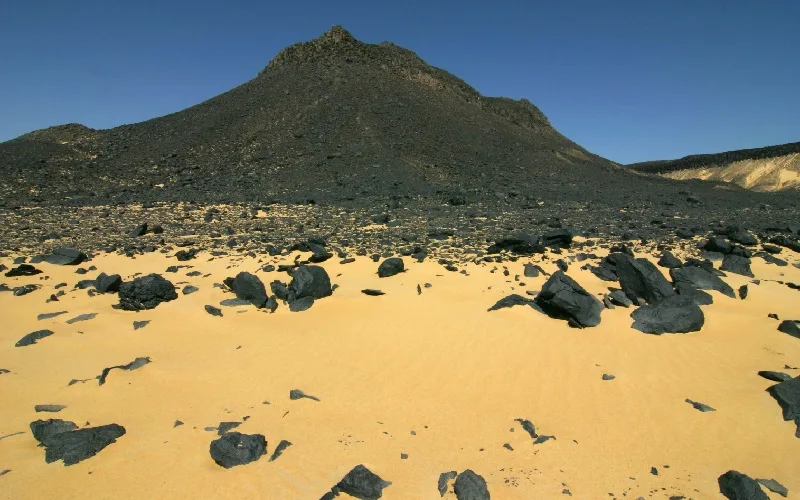
Researchers have uncovered fossilized woodlands, petrified fern stems, and remains of various plant species in the Black Desert. These fossils indicate that the region once supported diverse plant and animal communities, including dinosaurs, in a much greener environment.
Customize Your Dream Vacation!
Get in touch with our local experts for an unforgettable journey.
Plan Your TripThe Black Desert as a Natural Reserve
A significant paleontological discovery transformed the status of Egypt's Black Desert, elevating its recognition as a site of exceptional scientific importance. This formerly ordinary desert landscape subsequently gained protected status, primarily because of its remarkable paleontological treasures.
Dinosaur skeleton discovery and its impact
In 2000, paleontologists unearthed fossils of the second-largest dinosaur in the world at Tall El Dast and El Maghrafa. This discovery of the Paralititan stromeri remains, estimated to be 94 million years old, highlighted the region's extraordinary paleontological value. Later, researchers from Mansoura University discovered another significant dinosaur species named Mansourasaurus shahinae, which provided crucial evidence connecting African dinosaurs with their European and Asian relatives.
Official declaration as a protected area in 2010
Following these remarkable discoveries, the Black Desert was officially designated a natural reserve in 2010. This protection came through a Prime Minister's decree that encompassed specific areas within the Bahariya Oasis, including the Black Desert, Al-Dast, Al-Maghrafa, and British Mountain. The protected zone spans approximately 109 km², established under Egypt's Law No. 102 of 1983.
Scientific importance of the reserve status
The reserve status offers vital protection for the area's unique geological formations—especially the iron-rich basalt hills—as well as its sparse biological diversity. This legal safeguard helps prevent habitat degradation through restricted access zones for unique volcanic formations and fossil sites. The conservation efforts balance preservation with sustainable access, addressing threats such as illegal fossil hunting and unregulated off-road vehicle use that erode fragile rock structures.
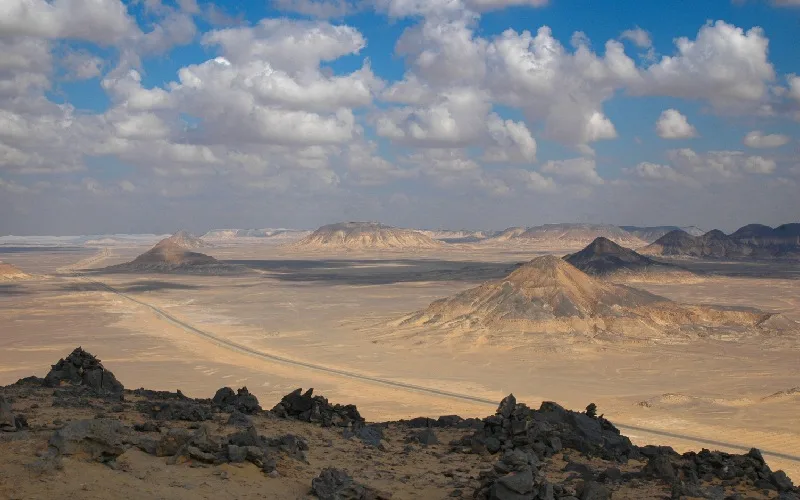
Yes, the Black Desert was officially declared a natural reserve in 2010. This protected status was established following significant paleontological discoveries, including dinosaur fossils, and aims to preserve the area's unique geological formations and fossil records.
Cultural and Scientific Relevance
Beyond its geological and paleontological significance, the Black Desert maintains a rich cultural heritage and scientific value that extends into contemporary times.
Historical use by Bedouin tribes
For centuries, Bedouin communities have maintained a presence in Egypt's desert regions, including the Black Desert. These Arabic-speaking nomadic peoples traditionally herded animals through desert territories, migrating seasonally between areas. The Bedouins specifically utilized the Black Desert as grazing grounds for their sheep. Their tribal society follows a patriarchal structure with extended families led by sheikhs who receive counsel from tribal elders. Throughout history, many Bedouin groups established symbiotic relationships with settled areas—sometimes raiding caravans and villages or alternatively providing protection. However, following World War I, modern Middle Eastern states extended authority over previously ungovernable regions, compelling Bedouin tribes to adapt their traditional lifestyles.
Black Desert in academic geological studies
The Black Desert remains valuable for scientific inquiry despite its harsh environment. Archeologists have documented numerous sites across similar basalt-covered "Black Deserts" in the region, revealing evidence of prehistoric settlements, hunting installations called "desert kites," funerary monuments, and rich corpora of inscriptions and petroglyphs. Recent research demonstrates considerable diversity in site layout and clear shifts in habitation patterns over time. Notably, increasing evidence suggests the region once supported humans, animals, and plants more abundantly than today's arid conditions would suggest.
Representation in modern media and games
In contemporary culture, the Black Desert has inspired creative works. Most prominently, it serves as the inspiration for the Valencia region in the popular MMORPG "Black Desert Online". The game features diverse geography, peoples, cultures, and architecture throughout its world. This representation offers rare positive portrayals of Middle Eastern-inspired settings and characters in gaming media.
The Black Desert has inspired elements in popular media, most notably serving as inspiration for the Valencia region in the MMORPG "Black Desert Online." It has also been a subject of academic geological studies and continues to be of cultural importance to Bedouin communities who have historically used the area for grazing.
The Black Desert is a striking geological record of Egypt’s volcanic and tectonic history, shaped over millions of years since the Jurassic period. Its black basalt-capped hills contrast sharply with surrounding sands, offering valuable insight into ancient Earth processes. Fossil discoveries reveal that this now-arid region once supported rich ecosystems, with evidence of prehistoric plants and dinosaurs, including the groundbreaking discovery of Paralititan stromeri. Designated a protected natural reserve in 2010, the Black Desert preserves both its unique landforms and fossil heritage. Beyond science, it remains culturally significant to Bedouin communities and continues to inspire modern media, standing as a powerful window into Egypt’s deep prehistoric past.
The Black Desert lies between the Bahariya Oasis and the White Desert in Egypt’s Western Desert. It begins about 50 km south of Bawiti and serves as a transitional zone between the lighter sands of the surrounding deserts.
Yes, the Black Desert is accessible to visitors, usually as part of guided desert safari tours from Bahariya Oasis. Due to its remote terrain, travel is typically done using 4x4 vehicles with experienced local guides.
While the White Desert is known for its chalk formations and bright limestone sculptures, the Black Desert is defined by dark basalt-capped hills and volcanic rocks. Together, they showcase two dramatically different geological histories within close proximity.
The hills resemble volcanic cones, but they are not true volcanoes. Instead, they are sedimentary formations capped by hardened basalt from ancient volcanic intrusions, giving the appearance of extinct volcanoes.
The ideal time to visit is between October and April, when temperatures are cooler and more suitable for desert exploration. Summer months can be extremely hot and are generally avoided for extended outdoor activities.

As a UK passport holder, you'll discover that obtaining an Egyptian visa is a straightforward process, with multiple options designed to accommodate various travel purposes and durations.

El Fayoum, located one hour south of Cairo, is considered one of Egypt's most peaceful places and one of the most greenish oases in Egypt's desert

Bahariya is one of the more appealing of the desert circuit oasis, and it's also the easiest to access, being just 365 kilometers from Cairo.

Farafra Oasis showcases the White Desert's dramatic chalk formations, therapeutic hot springs, and volcanic Black Desert. This remote Egyptian oasis, 627 km from Cairo, offers authentic Bedouin culture and stunning desert landscapes.

Dakhla Oasis spans 2,000 km² in Egypt's Western Desert, 350 km from the Nile. This UNESCO-listed site showcases Pharaonic heritage and traditional communities with 75,000 residents.

Kharga Oasis, Egypt's largest desert oasis, spans 160 km west of the Nile. This UNESCO nominee features the Temple of Hibis and preserves ancient caravan route heritage as the most modernized western oasis with 87,482 residents.


Siwa Oasis is a lush desert oasis below sea level, known for its natural springs, palm groves, ancient oracle, and preserved Berber culture.

Egypt’s Black Desert is a striking natural wonder marked by black volcanic hills, basalt formations, and surreal landscapes shaped by ancient volcanic activity and millions of years of erosion.

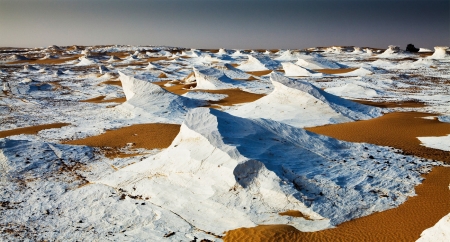
The White Desert is a protected natural area in Egypt near Farafra Oasis, known for its white limestone formations created by erosion over millions of years.

Crystal Mountain Egypt is a breathtaking natural landmark located between Bahariya and Farafra oases in the White Desert. Known as the “Jewel of the Desert,” it features clusters of sparkling quartz crystals formed over millions of years, making it one of the rarest geological formations in the world.