Home
Home
Wadi Al Hitan, located 150 kilometers southwest of Cairo, houses the world's largest whale graveyard with approximately 1,000 fossils dating back 40 million years. This UNESCO World Heritage Site (2005) spans 200 square kilometers and preserves complete skeletons of prehistoric Basilosaurus and Dorudon species, with the largest reaching 21 meters in length. The exceptionally preserved fossils showcase the evolutionary transition from land to sea mammals, featuring archaeoceti skeletons with both flippers and hind limbs. First discovered in 1902, Wadi Al Hitan remains a globally significant site for paleontological research into whale evolution.
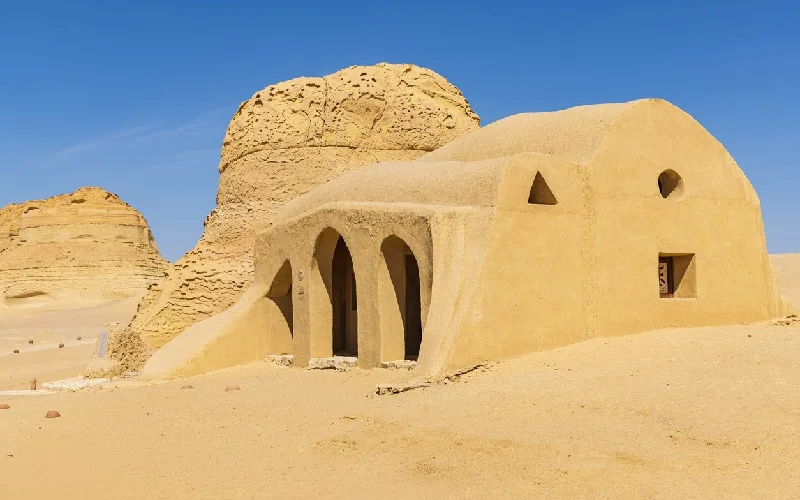
The discovery and early exploration of Wadi Al Hitan
The paleontological significance of Wadi Al Hitan began to emerge when the first fossil skeletons of whales were discovered in the winter of 1902-03. This groundbreaking find came through the work of H. J. L. Beadnell of the Geological Survey of Egypt, who unearthed the initial whale fossils that would eventually revolutionize our understanding of cetacean evolution.
Initial fossil finds in 1902
The earliest discoveries at Whale Valley Egypt marked the beginning of what would later be recognized as an extraordinary paleontological treasure. In 1905, Beadnell discovered Basilosaurus, the first fossil whale from the region. These initial finds were remarkable, though their full significance wasn't immediately apparent. The fossils discovered at Wadi Al Hitan tended to raise more questions than answers, particularly regarding the evolutionary transition from land mammals to marine creatures. The preservation quality of these early specimens was exceptional, with some fossils maintaining intact stomach contents.
Why the site remained untouched for decades
Following the initial discoveries, Wadi Al Hitan Egypt experienced an extended period of scientific neglect. For approximately 80 years, the site attracted relatively little interest from the scientific community. This lack of attention was primarily attributable to the extreme difficulty of accessing the remote desert location. Without modern vehicles capable of navigating the harsh terrain, the site remained essentially unexplored, its secrets buried beneath the shifting sands of the Western Desert.
Renewed interest in the 1980s and beyond
Scientific interest in Fayoum Whale Valley resurged in the 1980s, coinciding with the increasing availability of four-wheel drive vehicles that made the remote location more accessible. This technological advancement allowed paleontologists to reach the site more easily, sparking a new era of exploration and discovery. Between 1983 and 2007, nine expeditions led by Egyptian and American paleontologists systematically explored the area.
During this period of renewed exploration, researchers found and mapped approximately 400 whale and sea cow skeletons throughout the valley. The fossil whales of Wadi Al Hitan were first comprehensively mapped in the 1980s and 1990s during expeditions led by Professor Gingerich from the University of Michigan. However, at that time, no complete skeletons were collected due to both the remote location and the considerable size of the whale remains.
Unfortunately, the increasing accessibility of the site also attracted fossil collectors who removed many bones, prompting conservationists to call for protective measures. In response to these concerns, Wadi Al Hitan was designated as a Special Protected Area within the Wadi El-Rayan Protected Area in 1997.
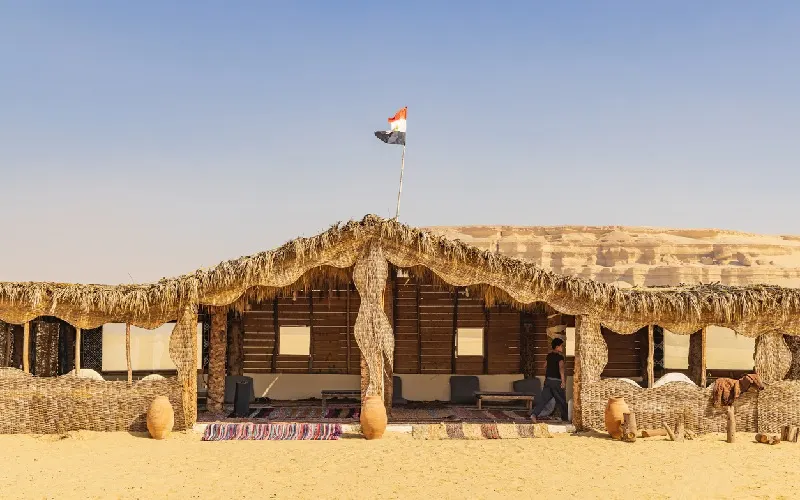
The first whale fossils at Wadi Al Hitan were discovered in 1902 by H. J. L. Beadnell. However, the site remained largely unexplored for about 80 years due to its remote location and difficult access. Interest in the area was renewed in the 1980s when four-wheel drive vehicles made the site more accessible to researchers.
Fossils that changed our understanding of whale evolution
The fossil whales at Wadi Al Hitan stand as crucial evidence in understanding cetacean evolution. Paleontologists have uncovered more than 400 ancient whale skeletons since the early 20th century, representing some of Earth's most significant evolutionary transitions.
Basilosaurus and Dorudon skeletons
The two most prevalent whale species found at Whale Valley Egypt are Basilosaurus isis and Dorudon atrox. Basilosaurus, measuring up to 60 feet (18 meters) long, earned its misleading name "king lizard" because scientists initially mistook it for a marine reptile. This massive predator possessed a long snout armed with pointed incisors and sharp cheek teeth, enabling it to crush the skulls of smaller whales before consuming them. Dorudon, significantly smaller at 11-15 feet in length (comparable to a modern beluga whale), featured a nearly complete skull among its fossil remains.
Presence of hind limbs in ancient whales
Perhaps the most remarkable aspect of these fossils is their anatomical evidence of evolutionary transition. Unlike modern whales, these archaeocetes possessed small yet distinct hind limbs. These appendages were too diminutive for walking—merely inches long on creatures weighing several tons—yet they provide irrefutable evidence of whales' terrestrial ancestry. Modern whales still retain vestiges of these structures; examination of contemporary whale anatomy reveals tiny bones embedded deep within their flesh—remnants of what were once pelvic bones, femurs, and tibias.
Sea cows, crocodiles, and other marine life
Whale Valley contains an impressive array of other marine creatures alongside the cetacean remains. The ecosystem preserved at the site includes three species of sirenians (sea cows), ancient turtles, bony fishes, sharks, rays, and crocodiles. Some Basilosaurus fossils contain remains of prey animals precisely where their stomachs would have been located, including crabs, sawfish, and even smaller whales.
The significance of the 1989 legged whale discovery
In 1989, researchers from the University of Michigan and the Egyptian Geological Museum made a groundbreaking discovery—Basilosaurus skeletons with intact hind limbs, feet, and toes. This finding provided definitive evidence confirming what had previously been scientific speculation: whales had indeed evolved from land-dwelling mammals. University of Michigan paleontologist Philip Gingerich, who uncovered these tiny appendages, remarked: "We had sometimes joked about walking whales. When we found what we did in Egypt, we thought, 'That's not a joke anymore'".
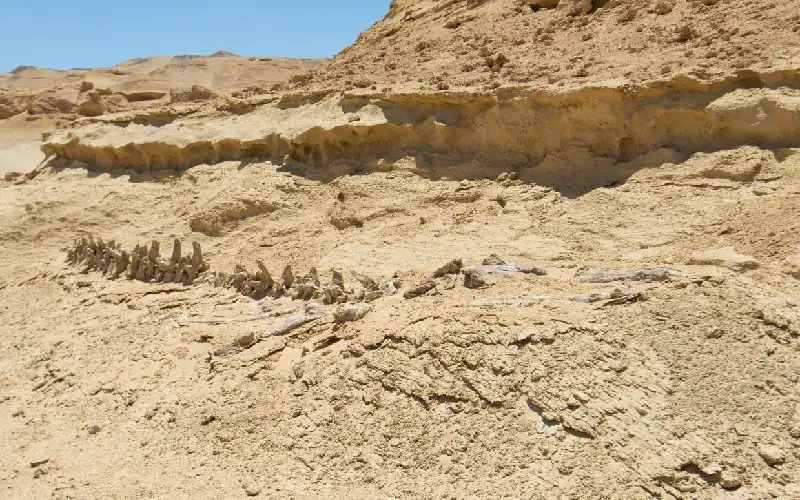
The discovery of whale fossils with small but distinct hind limbs at Wadi Al Hitan provided definitive evidence that whales evolved from land-dwelling mammals. This finding, particularly notable in the 1989 discovery of Basilosaurus skeletons with intact hind limbs, feet, and toes, revolutionized our understanding of whale evolution.
Customize Your Dream Vacation!
Get in touch with our local experts for an unforgettable journey.
Plan Your TripGeological formations and what they reveal
The geological foundations of Wadi Al Hitan comprise three distinct Eocene-aged formations that collectively narrate the area's transition from deep sea to shallow waters.
Gehannam Formation: deep marine mudstones
The oldest layer at Fayoum Whale Valley, the Gehannam Formation (approximately 40-41 million years old), consists primarily of gray calcareous shale with interbedded marl and glauconitic sandstone. Reaching about 30 meters in thickness, this formation represents deep marine conditions and contains numerous basilosaurid whales and protosirenid sea cows.
Birket Qarun Formation: sandstone fossil beds
The middle unit, Birket Qarun Formation, contains most of the whale fossils found at Whale Valley Egypt. Measuring approximately 90 meters thick, it predominantly features yellowish open marine sandstones alternated with thin-bedded sandy coquina and bioturbated layers filled with gastropods and shell fragments.
Qasr el Sagha Formation: lagoonal environment
Forming the tops of higher cliffs, the Qasr el Sagha Formation represents a lagoonal environment characterized by dark mudstones alternating with shell-rich limestones[191]. At approximately 180 meters thick, this formation contains fewer vertebrate fossils but exhibits a rich invertebrate fauna.
How erosion shaped the fossil landscape
Wind and water erosion have sculpted the site's distinctive scenery, creating spectacular cliffs and buttes. This ongoing natural process simultaneously exposes new fossils while potentially threatening others, revealing "new" discoveries as others become buried beneath shifting sands.
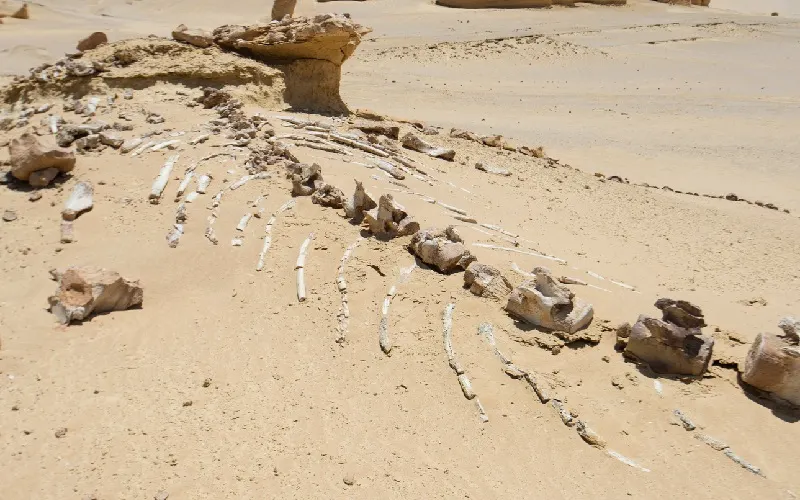
Wadi Al Hitan's geology consists of three distinct Eocene-aged formations: Gehannam, Birket Qarun, and Qasr el Sagha. These formations represent a transition from deep sea to shallow waters, preserving a rich variety of marine life fossils. The ongoing erosion process continues to reveal new fossils while shaping the site's distinctive landscape.
Why Wadi Al Hitan is a UNESCO World Heritage Site
In 2005, UNESCO officially designated Wadi Al Hitan as a World Heritage Site, recognizing its unparalleled value in demonstrating whale evolution. This designation acknowledges the site as the most significant location globally for illustrating one of evolution's iconic stories: the transition of whales from land animals to marine mammals.
Exceptional preservation and fossil density
The Valley houses fossils of approximately 1,000 whales, with pieces accessible throughout the 200-square-kilometer area. Remarkably, some specimens maintain intact stomach contents, allowing scientists to determine precisely what these ancient creatures consumed. The fossils exceed comparable sites worldwide in concentration, quality, and accessibility.
Reconstructing ancient ecosystems
Altogether, the extensive fossil collection enables researchers to reconstruct prehistoric environmental conditions with extraordinary accuracy. Alongside whales, preserved sharks, crocodiles, sawfish, turtles, and even a primitive elephant provide a comprehensive snapshot of the ancient Tethys Ocean ecosystem.
Legal protection and conservation efforts
Consequently, Egypt implemented robust protection measures under Law 102/1983 for Nature Protectorates, specifically safeguarding geological features. The site operates within Wadi El-Rayan Protected Area, established by Prime Ministerial Decree No. 2954/1997. Hence, management strategies include vehicle restrictions, controlled footpaths, and regular monitoring by trained staff.
Global scientific importance
In light of these exceptional attributes, scientists consider Wadi Al Hitan the planet's most valuable reference point for studying whale evolution. The site's 2018 inclusion on the IUCN Green List of Protected Areas further confirms its global significance. Moreover, ongoing discoveries, such as the complete Basilosaurus skeleton found in 2015, continue to enhance our understanding of ancient marine life.
UNESCO designated Wadi Al Hitan as a World Heritage Site in 2005 due to its exceptional concentration, quality, and accessibility of early whale fossils. The site is considered the most significant location globally for illustrating whale evolution from land animals to marine mammals, and it allows for accurate reconstruction of ancient marine ecosystems.
Wadi Al Hitan stands as an unparalleled repository of paleontological treasures that have fundamentally altered scientific understanding of cetacean evolution. The remarkable preservation of approximately 1,000 whale fossils, particularly the Basilosaurus and Dorudon specimens with vestigial hind limbs, provides definitive evidence of whales' terrestrial ancestry. These fossils, first discovered in 1902 yet largely unexplored until the 1980s, tell a compelling story of evolutionary transition that occurred approximately 40 million years ago.
The site's three distinct geological formations—Gehannam, Birket Qarun, and Qasr el Sagha—collectively narrate the environmental transformation from deep marine conditions to shallow waters. Natural erosion processes have both revealed new specimens and created the distinctive landscape visible today. This exceptional concentration of well-preserved fossils led to UNESCO World Heritage designation in 2005, acknowledging Whale Valley as the most significant location worldwide for documenting whale evolution.
Scientists consider Wadi Al Hitan an invaluable global reference point due to its comprehensive fossil record. Beyond whale skeletons, the site preserves numerous marine creatures including sea cows, crocodiles, sharks, and rays. Therefore, researchers can reconstruct ancient Tethys Ocean ecosystems with remarkable accuracy. Egyptian authorities have implemented protective measures to ensure this paleontological treasure remains intact for future scientific study. Undoubtedly, Wadi Al Hitan will continue to yield important discoveries that enhance our understanding of evolutionary history and ancient marine life for generations to come.
Wadi Al Hitan is home to the world's largest concentration of well-preserved whale fossils, with approximately 1,000 individual specimens. The site is particularly notable for its Basilosaurus and Dorudon skeletons, which provide crucial evidence of whales' evolutionary transition from land to sea.
In addition to whale fossils, Wadi Al Hitan contains remains of various marine creatures including sharks, rays, bony fish, turtles, crocodiles, and sea snakes. These fossils help scientists reconstruct the complete ancient marine ecosystem that existed 40 million years ago when the area was covered by the Tethys Sea.
The Fossil and Climate Change Museum, opened at the site, showcases the geological history of the area and displays some of the most significant fossils found at Wadi Al Hitan. The museum's unique design was built to blend with the desert landscape while providing educational exhibits about whale evolution and ancient climate conditions.
Basilosaurus was a large serpentine whale reaching up to 21 meters in length, while Dorudon was smaller, measuring about 5 meters. Both belonged to the archaeoceti group—the earliest fully aquatic whales. Despite their names, they were whales, not reptiles, and still retained small hind limbs from their land-dwelling ancestors.
Approximately 40 million years ago during the Eocene epoch, Wadi Al Hitan was submerged beneath the Tethys Sea—a shallow tropical ocean. The area featured warm waters teeming with marine life, coral reefs, and mangrove swamps along its ancient coastlines, creating ideal conditions for diverse marine ecosystems.
Yes, Wadi Al Hitan is protected as part of the Wadi El-Rayan Protected Area and is managed by Egypt's Ministry of Environment. Conservation efforts include restricting vehicle access to designated routes, monitoring fossil sites, and limiting visitor numbers to approximately 1,000 annually to minimize impact on this irreplaceable paleontological treasure.

As a UK passport holder, you'll discover that obtaining an Egyptian visa is a straightforward process, with multiple options designed to accommodate various travel purposes and durations.

El Fayoum, located one hour south of Cairo, is considered one of Egypt's most peaceful places and one of the most greenish oases in Egypt's desert

Bahariya is one of the more appealing of the desert circuit oasis, and it's also the easiest to access, being just 365 kilometers from Cairo.

Farafra Oasis showcases the White Desert's dramatic chalk formations, therapeutic hot springs, and volcanic Black Desert. This remote Egyptian oasis, 627 km from Cairo, offers authentic Bedouin culture and stunning desert landscapes.

Dakhla Oasis spans 2,000 km² in Egypt's Western Desert, 350 km from the Nile. This UNESCO-listed site showcases Pharaonic heritage and traditional communities with 75,000 residents.

Kharga Oasis, Egypt's largest desert oasis, spans 160 km west of the Nile. This UNESCO nominee features the Temple of Hibis and preserves ancient caravan route heritage as the most modernized western oasis with 87,482 residents.


Siwa Oasis is a lush desert oasis below sea level, known for its natural springs, palm groves, ancient oracle, and preserved Berber culture.

Egypt’s Black Desert is a striking natural wonder marked by black volcanic hills, basalt formations, and surreal landscapes shaped by ancient volcanic activity and millions of years of erosion.

The White Desert is a protected natural area in Egypt near Farafra Oasis, known for its white limestone formations created by erosion over millions of years.

Crystal Mountain Egypt is a breathtaking natural landmark located between Bahariya and Farafra oases in the White Desert. Known as the “Jewel of the Desert,” it features clusters of sparkling quartz crystals formed over millions of years, making it one of the rarest geological formations in the world.