Home
Home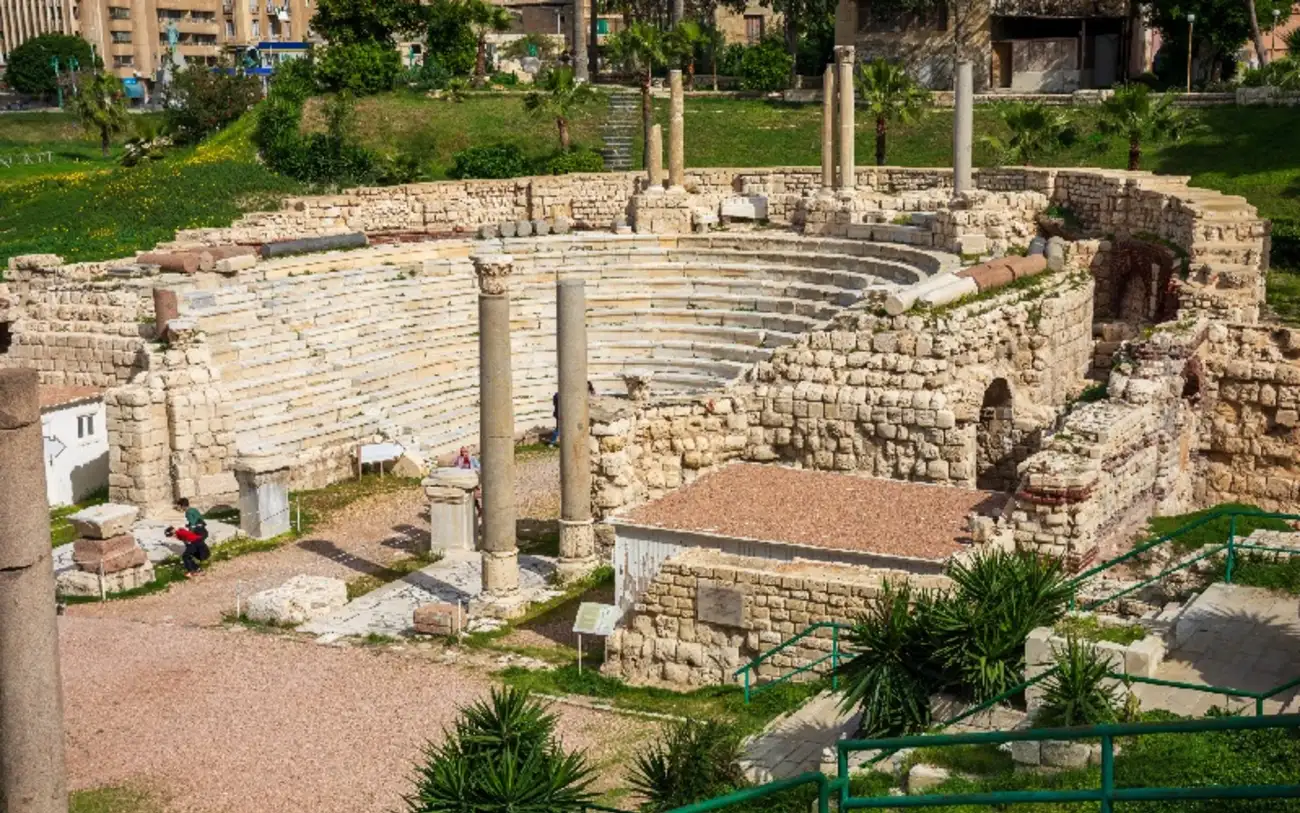
The Roman amphitheatre in Alexandria is a unique archaeological landmark, accidentally discovered in 1960 during excavations for Alexander the Great’s tomb. Built in the 4th century AD, it is the only circular Roman theatre in Egypt, accommodating around 600–700 spectators on 13 rows of European white marble seats. The amphitheatre, part of the Kom el-Dikka complex, also features granite columns imported from Aswan and was actively used through the Roman, Byzantine, and early Islamic periods. Its preservation offers valuable insight into Alexandria’s rich cultural and architectural history.
The Roman Amphitheater in Alexandria is the only circular Roman theater discovered in Egypt. It features 13 rows of European white marble seating and can accommodate 500-600 spectators. The structure also includes granite columns imported from Aswan and specialized compartments with domed ceilings.
The accidental discovery that changed Alexandria's history
Construction crews clearing ground for new government housing had no idea they were about to rewrite Alexandria's archaeological record. That fateful day in 1960 marked the beginning of what would become one of Egypt's most significant urban excavations, ultimately revealing the sprawling Kom El-Dikka complex with its theatrical centerpiece—though the path from construction site to archaeological wonder proved anything but straightforward.
How the Roman amphitheater was found in 1960
Workers first noticed unusual stone formations protruding through the sandy soil, patterns too regular and refined to be natural rock. These weren't the scattered ruins typical of Alexandria's many building sites—something far more substantial lay beneath their feet. Each layer of earth removed revealed additional clues: curved stone arrangements, deliberately placed blocks, and the telltale signs of ancient craftsmanship.
The excavation site occupied what had once been a densely populated residential quarter, requiring excavators to work around modern infrastructure while protecting delicate ancient materials. Marble fragments emerged first, followed by larger architectural elements that gradually revealed the amphitheater's distinctive semicircular profile. The preservation quality amazed archaeologists—centuries of sand and debris had created a protective cocoon around the buried structure.
Role of the Polish-Egyptian excavation team
An international partnership soon formed to tackle this unexpected archaeological windfall. Polish specialists brought cutting-edge conservation methods and systematic documentation techniques that proved essential for handling such a complex site. Their expertise in stone restoration and architectural analysis complemented the Egyptian team's deep understanding of local building traditions and historical context.
Egyptian archaeologists contributed crucial insights into Alexandria's urban development patterns and construction materials, particularly the identification of stone sources and building techniques specific to the region. This collaborative approach yielded remarkable results—over several decades, the joint mission methodically uncovered not only the amphitheater but an entire ancient civic district.
The team's careful recording methods captured every detail, from individual stone placements to soil composition changes, creating an invaluable archive that continues to inform scholarly research today.
Initial misidentification and early interpretations
First impressions can deceive even experienced archaeologists. The excavation team initially classified the structure as an odeon—a smaller, roofed venue designed for musical performances rather than dramatic productions. The semicircular seating arrangement and size seemed to support this interpretation, fitting established patterns for such buildings throughout the Roman world.
Further investigation revealed architectural features that didn't align with typical odeon construction. The horseshoe-shaped auditorium, specific acoustic properties, and seating capacity pointed toward a different function entirely. Archaeological evidence gradually reshaped their understanding, leading to the correct identification as a Roman amphitheater.
Dating the structure presented similar challenges. Initial assessments placed construction in the 2nd century AD, but detailed analysis of building materials and techniques pushed this timeline forward by two centuries. The 4th century AD dating positioned the amphitheater within Alexandria's later Roman period, when the city remained a vibrant cultural hub despite political changes across the Mediterranean. This chronological shift illuminated previously unknown aspects of Alexandria's urban evolution and cultural continuity during a pivotal era in ancient history.
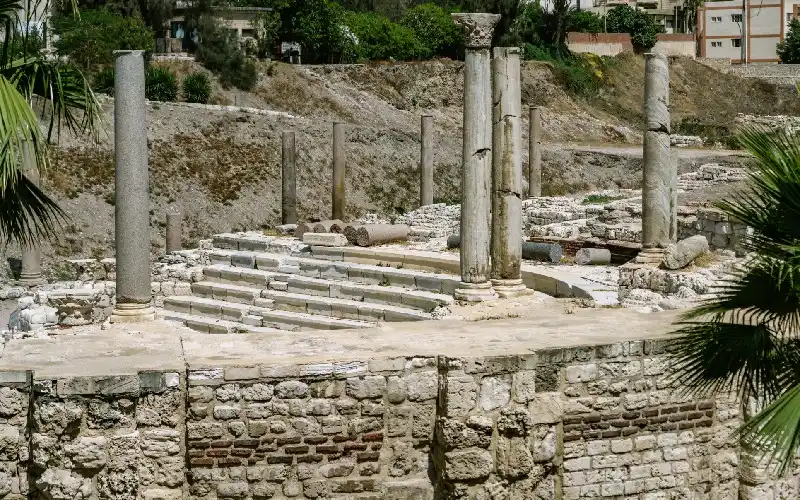
The Roman Amphitheater in Alexandria was accidentally discovered in 1960 during an excavation searching for the tomb of Alexander the Great. It was found by workers preparing for the construction of government housing in Alexandria's central district.
Inside the Roman amphitheater: structure and design
Standing within this ancient venue reveals the masterful engineering that shaped Alexandria's theatrical jewel. The horseshoe-shaped structure spans 33.5 meters in diameter, showcasing Roman architectural ingenuity adapted to Egypt's unique environmental demands. Every element speaks to careful planning and skilled craftsmanship that has endured for over sixteen centuries.
Thirteen rows of marble seating
European white marble cascades down in thirteen precisely arranged tiers, each row bearing Roman numerals and letters that once guided spectators to their designated places. These numbered seats accommodated 500-600 audience members, though unlike their hillside counterparts elsewhere in the empire, this theater rises from an artificial foundation rather than natural terrain. Thick white limestone walls support the entire seating arrangement, reinforced by a secondary wall system connected through graceful archways—hallmarks of Roman engineering from the 2nd through 4th centuries.
Granite columns and domed compartments
Five exclusive compartments crown the upper reaches, once reserved for Alexandria's most distinguished citizens—wealthy merchants, government officials, and visiting dignitaries. Massive granite columns, quarried in distant Aswan and transported hundreds of miles down the Nile, support elaborate domed ceilings above these privileged spaces. These architectural features served practical and acoustic purposes, shielding occupants from Alexandria's sometimes harsh Mediterranean climate while enhancing the theater's sound projection.
The orchestra and sound-enhancing architecture
At the theater's heart lies the orchestra—a performance space adorned with exquisite Roman mosaic floors that rank among the finest surviving examples of their kind. Twin marble columns frame this central area where musicians and performers once captivated audiences. The entire structure functions as a sophisticated acoustic instrument, its curved walls creating natural sound chambers that amplified even whispered words to the farthest seats. Different seating elevations scatter and diffuse sound waves, eliminating harsh echoes while ensuring crystal-clear audibility throughout the venue.
Use of recycled materials from older buildings
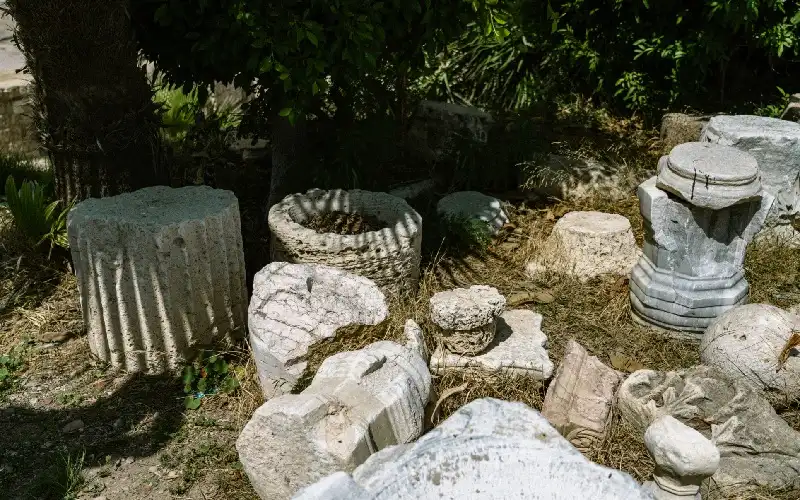
Construction materials tell their own story of Alexandria's rich architectural heritage. Pink granite steps contrast beautifully with the pristine white marble above, while scattered statues and ornate column capitals suggest incorporation of elements from earlier Roman structures. This thoughtful mixture of marble, granite, and limestone reflects not only Alexandria's position as a major Mediterranean trading hub but also the practical Roman approach to building—using the finest available materials regardless of their original purpose.
Customize Your Dream Vacation!
Get in touch with our local experts for an unforgettable journey.
Plan Your TripA theater through time: changing roles across empires
The amphitheater's remarkable longevity speaks to both its solid construction and adaptive design, serving Alexandria's evolving cultural needs across three centuries of imperial rule. Archaeological evidence traces the structure's active life from the 4th century through the early 7th century AD, each era reshaping this architectural marvel to reflect the changing character of the city.
Roman period: musical and poetic performances
Alexandria's Roman-era amphitheater functioned primarily as an odeum during the 4th and 5th centuries, hosting the musical competitions and poetic recitations that defined cultured entertainment of the period. The orchestra's acoustic properties and carefully planned seating arrangement created an intimate setting perfectly suited to these refined performances. Graffiti carved into the marble seats reveals another layer of the theater's social life—spectators celebrated chariot racing victories here, though the races themselves took place elsewhere due to spatial constraints. Wrestling matches and musical contests filled the performance schedule, though the complete roster of entertainments remains tantalizingly incomplete in the archaeological record.
Byzantine era: public meetings and lectures
Around 500 AD, Alexandria's changing political landscape demanded new functions from its ancient theater. Byzantine administrators transformed the venue into a formal conference hall, where governmental assemblies and public meetings took precedence over entertainment. Architectural modifications included adding a roof and reshaping the auditorium into its current horseshoe configuration, creating what became known as the auditorium maximum—the largest enclosed space within the entire Kom El-Dikka complex. This period witnessed the theater's evolution into an academic venue, hosting public orations and rhetorical demonstrations that connected it to Alexandria's enduring reputation as a center of learning.
Early Islamic period: decline and neglect
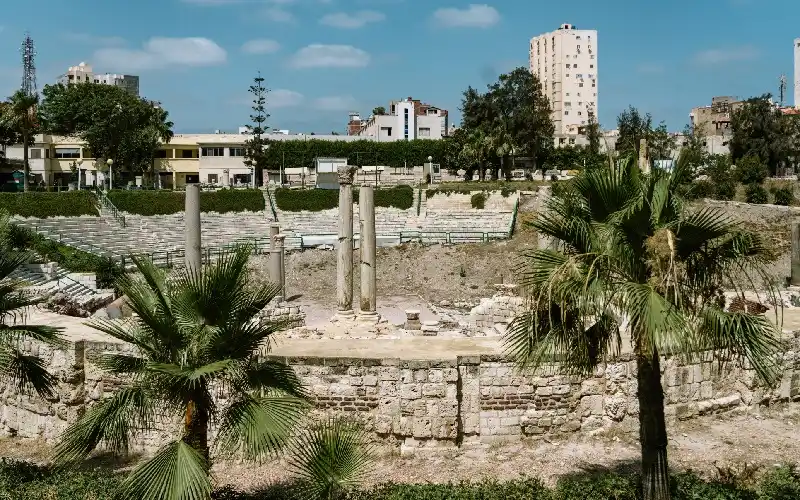
Alexandria's golden age as a Mediterranean cultural hub began its slow decline after the 7th century. The amphitheater, along with many of the city's grand public buildings, gradually fell into abandonment as Islamic rule shifted administrative and cultural focus elsewhere. Once-magnificent structures throughout the city succumbed to neglect and decay. Centuries of accumulating sand and debris eventually buried this remarkable theater completely, preserving its architectural details in a protective embrace that lasted until modern archaeological techniques finally returned it to the light.
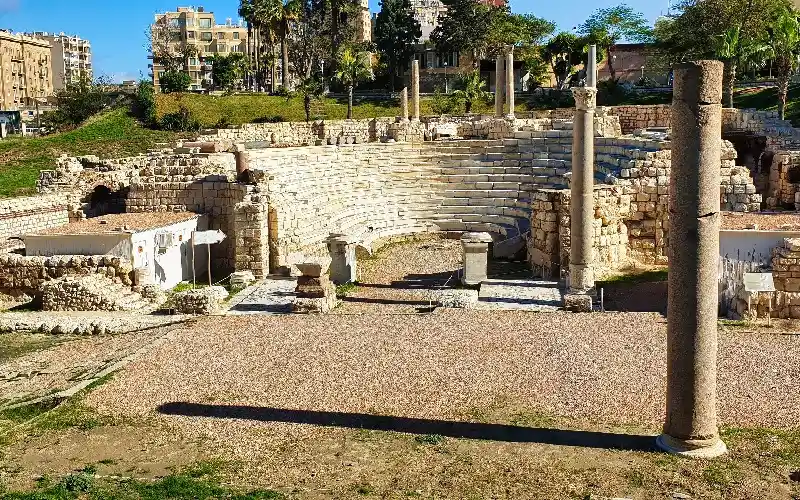
Initially used for musical and poetic performances during the Roman era, the amphitheater was later repurposed as a conference hall for public meetings and lectures in the Byzantine period. It fell into disuse and neglect during the early Islamic era.
The amphitheater within the Kom El-Dikka complex
The Roman amphitheater represents just one jewel in a crown of ancient structures that together formed the bustling heart of late antique Alexandria. Kom El-Dikka unfolds as a complete civic ecosystem, where each building served distinct yet interconnected purposes in daily urban life.
Connection to the bath complex and cistern
Steps away from the theater's marble seats, archaeologists uncovered the remains of a magnificent Imperial bath complex dating to the 4th century. These weren't modest neighborhood facilities—the structure housed expansive bathing chambers designed to serve hundreds of visitors each day, complemented by gymnasia where Alexandrians maintained their physical fitness and public latrines that accommodated the social needs of the community.
Water flowed through an ingenious network of furnaces and heating systems, all fed by strategically positioned cisterns. The crown jewel of this water infrastructure was a substantial masonry reservoir—remarkably, the only above-ground water storage facility discovered within Alexandria proper. Together, these interconnected facilities created what can only be described as the administrative and social nucleus of the late ancient city.
The academic auditoria and ancient education
Hidden within the complex lies perhaps the most extraordinary discovery of all: twenty-two lecture halls methodically arranged along a graceful colonnaded portico. Nowhere else in the Mediterranean world have archaeologists encountered such a complete ancient educational facility. Each auditorium featured carefully carved stone benches for pupils, with a raised platform reserved for instructors—collectively these spaces could accommodate between 500 and 600 eager students.
These halls provide tangible evidence of Alexandria's celebrated status as antiquity's premier learning destination, often called the "Oxford" of the ancient world. Here, aspiring scholars pursued rigorous studies in rhetoric, jurisprudence, philosophy, and most notably, medical sciences that would influence healing practices across the empire.
Villa of the Birds and preserved mosaics
Tucked among the public monuments stands a private residence that captures the domestic elegance of Roman Alexandria. The "Villa of the Birds" earned its charming name from an extraordinary mosaic floor that depicts nine distinct avian species—pigeons strutting across tessellated surfaces alongside peacocks, parrots, quail, and water hens.
This stunning artwork spans 110 square meters of preserved flooring, though fire damage in the late third century left visible scars that ancient restorers carefully repaired. The villa represents the sole surviving example of three grand residences that once defined this neighborhood's residential character, offering precious glimpses into how Alexandria's wealthy citizens lived amid the city's public grandeur.
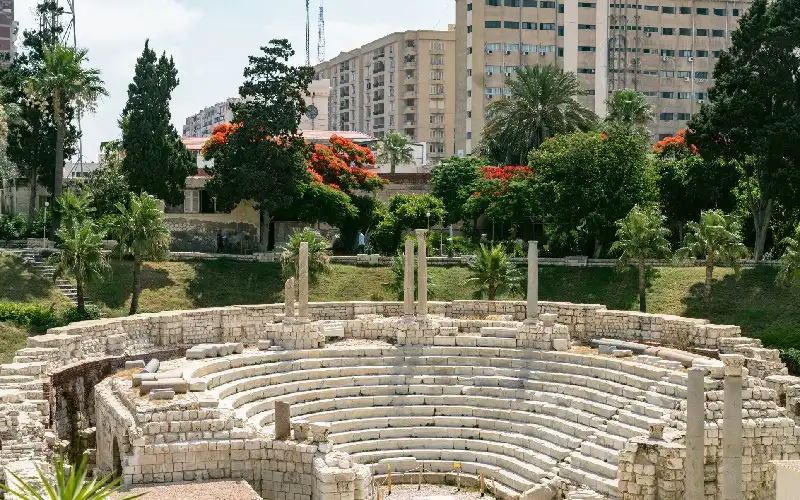
The Kom El-Dikka complex, where the amphitheater is located, also includes an Imperial bath complex, a series of 22 lecture halls known as academic auditoria, and the "Villa of the Birds" - a Roman residence with preserved mosaics.
The Roman amphitheatre in Alexandria is more than a theatre—it is a vital archaeological window into the city’s past. Used across Roman, Byzantine, and early Islamic periods, the structure showcases marble seating, granite columns, and evidence of Alexandria’s far-reaching trade and craftsmanship. Its excavation revealed an entire ancient district, including lecture halls, bath complexes, and mosaic-adorned residences, illustrating the vibrant civic and cultural life of late antiquity. Discovered accidentally in 1960 by a Polish-Egyptian team, the amphitheatre connects modern visitors to Alexandria’s golden age, demonstrating how unexpected discoveries can illuminate history and preserve the city’s rich heritage.
The amphitheater's curved structure creates a natural reverberant chamber that amplifies sounds. The varied seating heights act as sound diffusion mechanisms, preventing distracting frequency buildups and enhancing speech intelligibility, making it ideal for performances and lectures.
The amphitheater was constructed during the 4th century AD, in the late Roman period, as part of Alexandria’s cultural and civic development under Roman rule.
The amphitheater could accommodate approximately 500–600 spectators, providing seating in 13 rows of marble for various public events.
The amphitheater was built using European white marble for seating, granite columns from Aswan, and local limestone for structural support, demonstrating a combination of local and imported resources.
Yes, the amphitheater is part of the Kom El-Dikka archaeological site in Alexandria and is accessible to the public. Visitors can explore the theater along with surrounding lecture halls, mosaics, and bath complexes.
It is the only surviving circular Roman theater in Egypt, providing rare insights into Roman entertainment, Byzantine adaptation of public spaces, and urban life in ancient Alexandria.

The Library of Alexandria in Egypt was a legendary center of learning, housing hundreds of thousands of scrolls and attracting renowned scholars, making Alexandria the intellectual capital of the ancient world.

Explore Alexandria’s 4th-century Roman amphitheatre, a unique circular theatre with marble seating and historical significance spanning Roman, Byzantine, and Islamic eras.

Pompey’s Pillar is a 26.85-meter Roman column in Alexandria, dedicated to Emperor Diocletian, and stands as one of the largest monolithic columns ever built.

The Catacombs of Kom El Shoqafa are Alexandria's largest Roman necropolis, discovered in 1900. This 35-meter deep burial complex blends Egyptian, Greek, and Roman styles across three underground levels, dating from the 2nd-4th centuries CE.
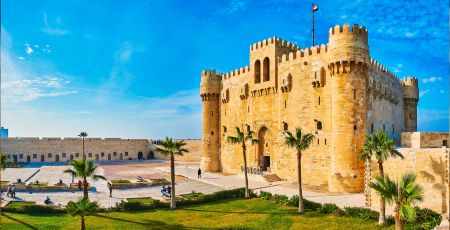
Located on the very Grounds of the ancient lighthouse in Alexandria , the Citadel & fort of Sultan Qaitbay is a landmark of the coastal city of Alexandria is filled with history and amazing details for you to DIscover.

El Alamein is a historic WWII battleground 100km west of Alexandria where decisive 1942 battles turned the war's tide. Today it features war memorials and museums alongside New El Alamein City, a modern smart city development opened in 2018.

Alexandria, founded by Alexander the Great in 331 BC, is Egypt's legendary Mediterranean seaport. Once home to the ancient Great Library and Pharos Lighthouse, this historic city of 5.3 million residents blends remarkable ancient wonders with vibrant modern coastal culture.