
 Home
Home
The Unfinished Obelisk in Aswan stands as Ancient Egypt’s most ambitious, yet incomplete, architectural endeavor. Commissioned by Queen Hatshepsut during the 18th dynasty, it would have reached 41.75 meters and weighed over 1,000 tons, making it the largest obelisk ever attempted. Cracks discovered in the granite halted its construction, leaving it partially carved in the quarry. Today, it serves as a remarkable archaeological record, revealing ancient Egyptian quarrying techniques, tool marks, and construction methods. This abandoned monument offers unique insight into the ingenuity, ambition, and practical challenges of one of history’s greatest civilizations.
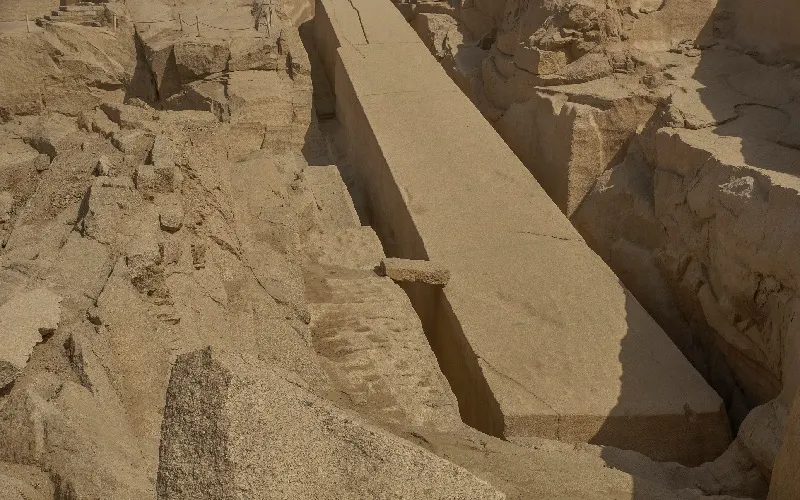
The Unfinished Obelisk is the largest known ancient obelisk, located in the granite quarries of Aswan, Egypt. It was commissioned during the reign of Queen Hatshepsut in the 18th dynasty but was abandoned due to cracks appearing in the granite during carving.
The Vision Behind the Unfinished Obelisk
Ancient Egyptians called these towering monuments "tekhenu"—literally meaning "to pierce the sky"—a name that captures the profound spiritual purpose behind every carved stone pillar that rose from temple grounds across the kingdom. These were never simple architectural features, but rather powerful declarations of divine authority and religious devotion, each one a sacred bridge between mortal earth and celestial heavens.
Why obelisks were important in ancient Egypt
Ra, the sun god, received the highest honor through these monumental stone expressions of worship. Each obelisk represented a petrified sunbeam, capturing the eternal light of Ra within granite that would endure for millennia. Temple architects positioned them in pairs at sacred entrances, creating literal thresholds between ordinary human spaces and the divine realm beyond. Their soaring height became a visual prayer, reaching upward to establish direct communication between earthly worshippers and their gods.
The pyramidion crowning each obelisk held extraordinary significance within this sacred design. Craftsmen sheathed these pyramid-shaped caps in gleaming gold or electrum, creating surfaces that blazed with reflected sunlight at dawn and dusk. This golden peak represented the benben stone from Egyptian creation stories—the primordial mound that first broke through the waters of chaos when the world began. Through this symbolic connection, every obelisk became a cosmic axis linking the underworld, mortal realm, and heavenly domain.
Queen Hatshepsut's architectural ambitions
Hatshepsut ruled Egypt for more than two decades during the early 18th Dynasty, establishing herself as one of history's most prolific builders. Her architectural projects spanned the kingdom—temples rose under her direction, trading expeditions returned with exotic materials, and obelisk after obelisk proclaimed her devotion to the gods and her legitimacy as pharaoh.
Her earlier monuments at Karnak Temple already demonstrated remarkable scale, with paired obelisks reaching 30 meters skyward and weighing 320 tons each. Yet the unfinished monument would have dwarfed even these impressive achievements. Standing 42 meters tall and weighing 1,200 tons, this single obelisk would have established a new benchmark for royal ambition and divine favor.
Intended symbolic and religious significance
Karnak Temple likely awaited this massive monument, where it would have dominated the sacred landscape as the ultimate expression of Hatshepsut's reign. Every dimension carried spiritual meaning beyond mere political statement.
The completed obelisk would have channeled Ra's divine energy earthward, blessing the kingdom through its sacred geometry and solar alignment. Like all obelisks, it would have functioned as an axis mundi—a cosmic pillar connecting separate planes of existence within Egyptian cosmology. Its unprecedented size reflected not only architectural mastery but also Hatshepsut's determination to create an eternal legacy worthy of the gods.
Egyptian religious belief held that divine spirits actually inhabited these stone monuments, making each obelisk a living presence within temple grounds. Through this monument, Hatshepsut sought permanent residence among the gods themselves, while simultaneously extending divine protection over her entire kingdom.
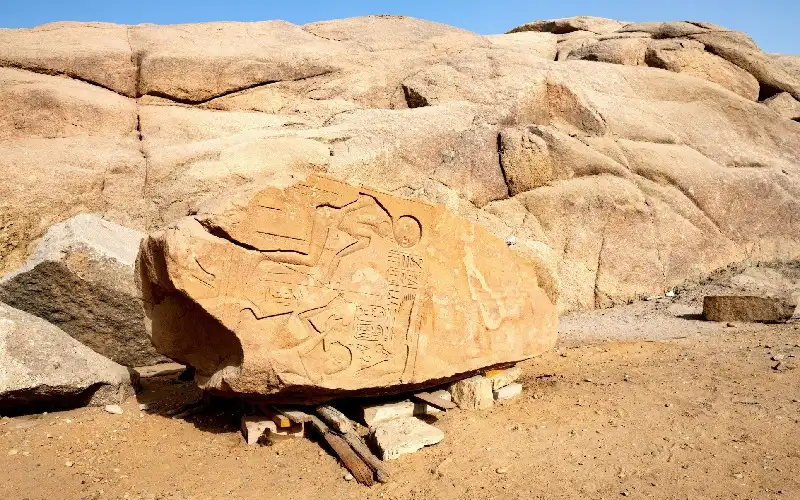
Obelisks held great religious and symbolic significance in ancient Egypt. They were seen as solar symbols dedicated to Ra, the sun god, and represented petrified sunbeams. Obelisks also symbolized the connection between earth and heaven, and were believed to channel divine energy.
Material and Engineering Challenges
The formidable task of extracting this monolithic giant from Aswan's bedrock began with understanding the very substance from which it would emerge—a stone whose properties would both enable and ultimately doom the ambitious project.
Properties of Aswan granite
Red Aswan Granite forms the geological foundation of this extraordinary undertaking, its distinctive composition revealing why ancient quarrymen chose this particular stone for their most ambitious monuments. The granite's structure weaves together reddish feldspar crystals with quartz, plagioclase, and biotite, creating a material of remarkable resilience. Laboratory analysis demonstrates this stone possesses a compressive strength of 140 MPa—four times greater than modern concrete—while maintaining brittleness that allows for clean fracturing without plastic deformation.
The granite's elasticity modulus reaches 5.4 GPa, granting exceptional resistance to lateral forces and making it particularly suited for monuments designed with height-to-width ratios spanning 9 to 12. These precise engineering properties explain why Egyptian architects consistently returned to Aswan quarries for their most prestigious projects, despite the logistical challenges of transporting such massive stones northward along the Nile.
Difficulties in carving a single stone block
Ancient Egyptian obelisk construction demanded something unprecedented in modern building—complete extraction of a monument from a single, unbroken piece of stone. This monolithic approach created engineering challenges that would test the limits of human ingenuity. The sheer scale of the undertaking becomes apparent when considering that any structural weakness discovered during quarrying could instantly render months of painstaking labor worthless.
The site itself tells the story of this engineering gamble. Workers had carved deep trenches around the intended obelisk when disaster struck—cracks appeared that could not be overcome, forcing abandonment of the entire project. Such discoveries highlight the constant tension between ambition and material reality that defined ancient Egyptian construction.
How ancient tools shaped massive monuments
The arsenal of tools employed by Aswan quarrymen reveals ingenuity born from necessity, each implement carefully selected for specific stages of the extraction process:
Dolerite pounding balls served as the primary excavation tool, these volcanic stones possessing hardness superior to granite itself. Archaeological evidence reveals the painstaking pace of this work—individual craftsmen could remove merely 5-10 cubic centimeters of granite per hour through constant pounding.
Copper implements combined with quartz sand created an abrasive system for detailed work, allowing artisans to achieve smooth surfaces despite copper's relative softness compared to granite.
Wooden wedge systems provided the crucial final step in separation. Workers carved precise slots, inserted seasoned wooden wedges, then saturated them with water. The expanding wood generated tremendous pressure along predetermined fracture lines, enabling controlled splitting of granite sections.
Each technique left distinctive marks that remain visible today, creating an permanent record of ancient engineering methodology frozen within the stone itself.
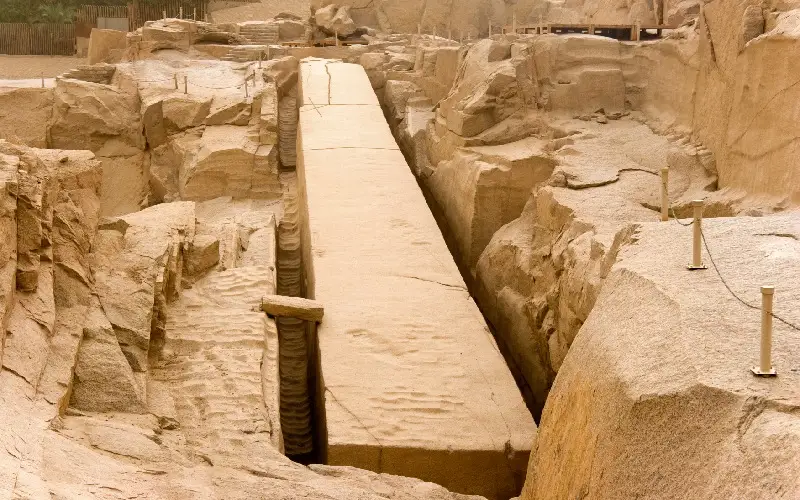
If completed, the Unfinished Obelisk would have been approximately 41.75 meters (137 feet) tall and weighed between 1,090 to 1,200 tons, making it the largest obelisk ever created in ancient Egypt.
Customize Your Dream Vacation!
Get in touch with our local experts for an unforgettable journey.
Plan Your TripThe Moment of Abandonment
The granite quarries of Aswan witnessed a pivotal moment when ancient Egyptian engineering met its match. Workers had labored for months, perhaps years, gradually freeing the colossal obelisk from its rocky cradle when disaster struck in the form of structural defects that would doom the entire enterprise.
Discovery of fatal cracks
Deep within the Red Aswan Granite, nature had hidden a treacherous flaw. A substantial crack emerged running lengthwise through the obelisk's body, its jagged path spelling certain doom for the monument's future. Smaller fractures appeared elsewhere across the stone's surface, each one a testament to the granite's hidden weaknesses. Ancient engineers understood the implications immediately—a 1,200-ton monolith bearing such flaws could never withstand the stresses of transport, erection, or the relentless march of time. These fractures would only worsen, eventually rendering any completed obelisk a dangerous liability rather than an eternal symbol of divine power.
Decision-making in ancient construction projects
What followed reveals the remarkable pragmatism of ancient Egyptian builders. Rather than continue with a compromised monument, they made the difficult choice to abandon their massive undertaking. Evidence suggests they briefly attempted to salvage smaller objects from the damaged stone, but even these efforts proved futile. This decision demonstrates something profound about ancient Egyptian values—structural perfection mattered more than recovering sunk costs or meeting royal deadlines. The engineers understood that a flawed monument would reflect poorly on both their craftsmanship and their pharaoh's divine favor.
What the site tells us about quality control
The abandoned quarry reveals an ancient civilization that refused to compromise on excellence. These master builders possessed intimate knowledge of granite's behavior and recognized when natural defects made success impossible. Their quality standards demanded nothing less than perfection for monuments intended to represent divine kingship. Paradoxically, this "failed" obelisk has proven more instructive to modern researchers than many successfully completed monuments, offering insights that polished masterpieces could never provide. The site stands as evidence that ancient Egyptian builders valued integrity over expedience—a principle that has made their abandoned project invaluable to contemporary archaeology.
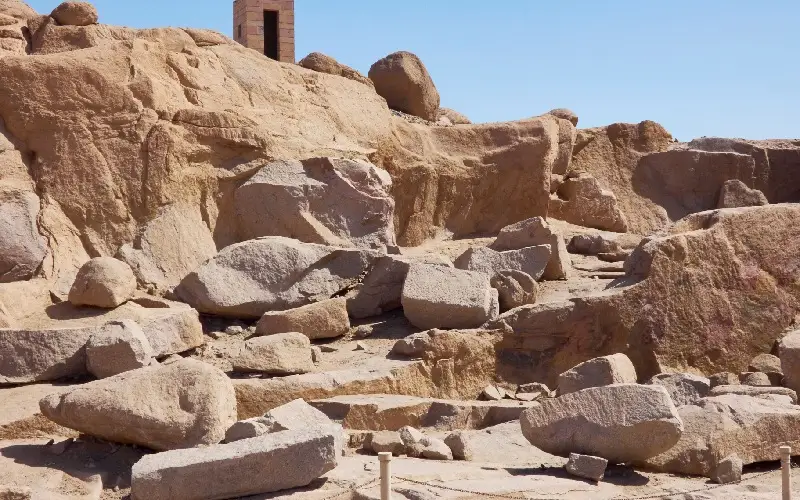
Ancient Egyptian stoneworkers used simple yet effective tools to shape these colossal monuments. These included dolerite pounding balls for pulverizing granite, copper tools with quartz sand as an abrasive for finer details, and wooden wedges for splitting granite along predetermined lines.
Legacy and Historical Significance
The abandoned monument has achieved something its creators never intended—becoming archaeology's most revealing teacher about ancient Egyptian stoneworking practices. Where completion would have hidden the construction process forever, abandonment preserved every detail of the quarrying operation for modern discovery.
What archeologists have learned from the site
Ochre-colored guiding lines snake across the granite surface alongside countless tool marks, creating a detailed record of ancient methodology. These markings reveal how work teams organized themselves along trenches, each group responsible for specific sections of the massive extraction. Modern photogrammetry analysis has quantified the ancient pace of work—approximately 216 cubic centimeters removed each hour through 85 precise strikes per minute.
The obelisk as a case study in ancient failure
The site demonstrates something remarkable about ancient Egyptian building standards: these craftsmen valued perfection over profit, willingly abandoning expensive projects rather than accepting flawed results. The decision captures a civilization's approach to monumental construction, where reputation mattered more than resources already spent.
Its role in understanding ancient Egyptian engineering
The quarry reveals sophisticated knowledge spanning geometry, surveying, material science, and structural mechanics—all accomplished without modern mathematical tools or measuring devices. Experimental archaeology suggests fire played a crucial role in weakening granite before extraction, allowing fewer workers to achieve faster progress.
How it compares to other obelisks in size and ambition
The intended monument would have dwarfed every standing obelisk in ancient Egypt by nearly one-third, creating an unprecedented 42-meter giant. Even Rome's famous Lateran Obelisk measures merely 32 meters without its base.
Why it remains a key archeological site today
Protected within Aswan's network of ancient quarries, the site functions as an open-air museum under Egyptian government stewardship. The failed obelisk has discovered new purpose—offering researchers insights that perfectly finished monuments could never provide.
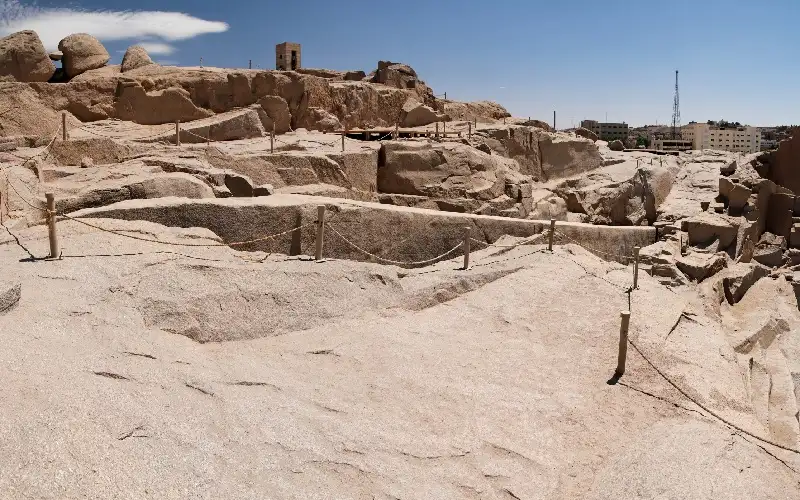
The Unfinished Obelisk provides unique insights into ancient Egyptian engineering techniques, quality control standards, and decision-making processes. Its incomplete state preserves tool marks, guiding lines, and quarrying methods that are not visible in completed monuments, making it an invaluable resource for understanding ancient stoneworking practices.
The Unfinished Obelisk in Aswan stands as a unique testament to ancient Egyptian ingenuity, offering unparalleled insights into engineering, planning, and craftsmanship. Though it never reached completion, its abandoned state preserves tool marks, quarrying techniques, and organizational strategies that completed monuments conceal. This “failure” reveals a civilization that valued precision, integrity, and understanding its limits. Today, the obelisk continues to illuminate Hatshepsut’s ambitious vision and the sophisticated methods of her builders, demonstrating that sometimes the greatest lessons come not from success, but from the careful study of challenges left unresolved.
Yes, the Unfinished Obelisk is open to visitors in Aswan. Tourists can observe the massive stone in its original quarry, along with detailed tool marks and carving techniques.
While exact records are unavailable, archaeologists estimate that work on the obelisk likely lasted several years before cracks in the granite forced its abandonment.
The obelisk provides evidence of highly organized labor, specialized skills, and teamwork. Workers used precise methods to shape the stone and control quality on a massive scale.
Yes, several unfinished obelisks exist, but the Aswan obelisk is the largest and most informative, offering unparalleled insight into ancient quarrying methods.
They planned to transport it by carefully lowering it into a specially constructed trench, then moving it on sledges over lubricated tracks, often using Nile waterways for final delivery.


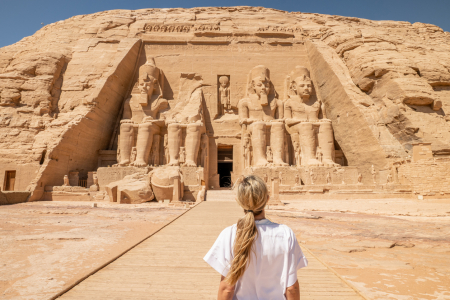
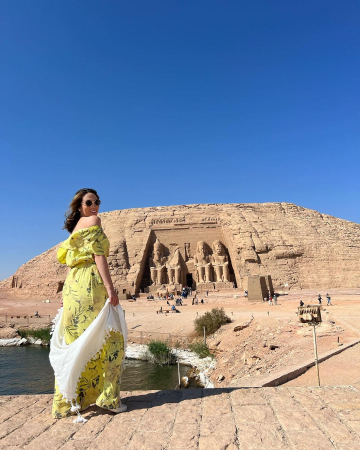


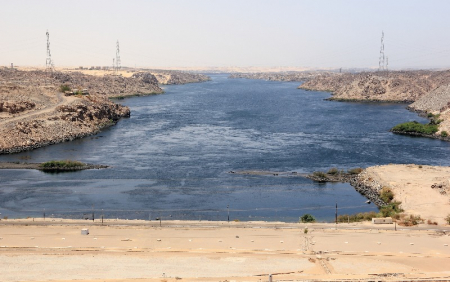
Lake Nasser, Egypt’s vast artificial reservoir, reshaped the Nile, boosted agriculture and fishing, and preserved historic sites like Abu Simbel.
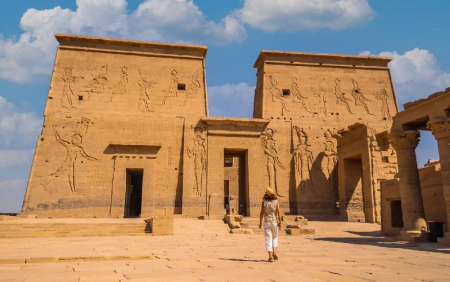
Philae Temple, dedicated to Isis, was relocated to Agilkia Island to preserve its ancient Ptolemaic structures and remains a UNESCO World Heritage site.

Aswan is one of the world’s oldest cities, marking ancient Egypt’s southern frontier. Rich in history, science, trade, and UNESCO-listed monuments, it remains a living link between past and present.
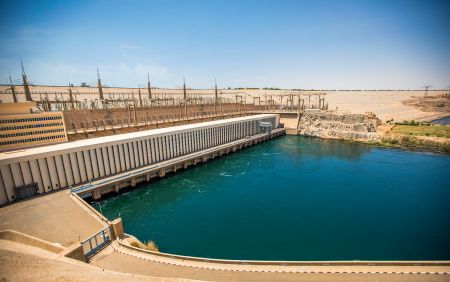
Aswan High Dam, completed 1970, transformed Egypt through Lake Nasser reservoir, hydroelectric power & year-round irrigation while displacing 100,000+ Nubians.
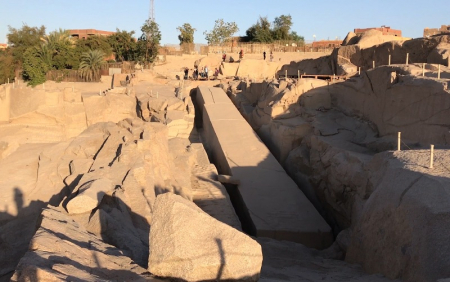
The Unfinished Obelisk in Aswan reveals ancient Egyptian quarrying techniques and ambitions, offering a rare glimpse into their engineering mastery.
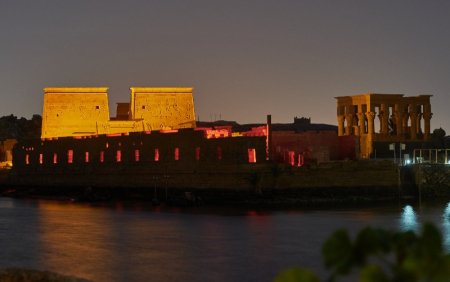
Discover the magic of Philae Temple after dark with a Sound & Light Show that brings the myths of Isis to life amid the beautifully preserved island sanctuary.

Explore El Nabatat Island, Aswan’s historic botanical garden featuring exotic plants, towering palms, and a sanctuary for birds along the Nile.

Nubian Museum Aswan features 3,000+ artifacts showcasing ancient Nubian heritage. Discover jewelry, statues & cultural displays in this 1997-opened institution.

Nubian Village near Aswan offers authentic culture with vibrant homes, traditional hospitality & henna art. Experience 8,000 years of living Nile heritage.
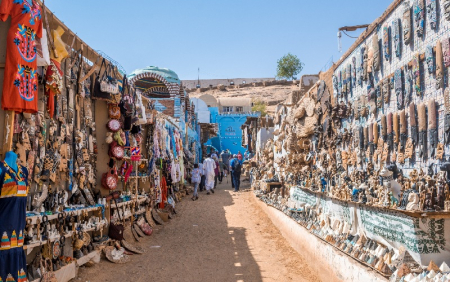
Aswan Old Souk offers a colorful, aromatic shopping experience along the Nile, featuring local crafts, spices, textiles, and souvenirs in Egypt’s southernmost city.
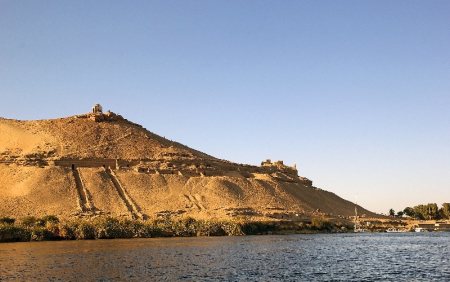
Elephantine Island in Aswan is a 5,000-year-old UNESCO site, once Egypt’s southern gateway, famed for its temples, Nilometers, and living Nubian heritage.
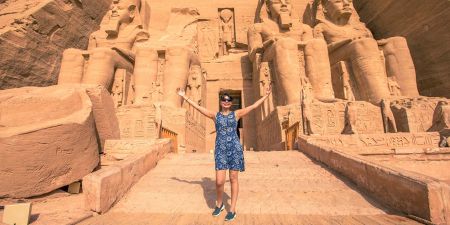
Discover Abu Simbel, Ramses II’s rock-cut temples famed for colossal statues, solar alignment, and an epic UNESCO rescue that saved them from Lake Nasser.